What is time? Few things are so familiar and mysterious. Our lives are governed by time, and yet we have so little understanding of it.
In many ways time behaves like a dimension. We move through and have a position in time, just as we move through and have a position in space. Every event, happening, and meeting can be specified by its temporal and spatial coordinates.
But unlike dimensions of space, we have no say over our speed and direction in time. We can neither stop nor turn around. We only go forward, unalterably, at the rate of one second per second.
Adding to the strangeness of the time dimension, we even measure it differently. While we use rulers to measure distances in space, measuring distances in time requires clocks.
But until 1905, no one had any idea just how strange time really is.
This was the year Einstein overturned the millennia-old notion that time is an absolute, fixed, and independent aspect of the universe.
He showed that time is relative, malleable, and dependent on observers.

Contents
The miracle year
One person, in one year, revolutionized physics.
A then 26-year old Albert Einstein, published four papers in 1905. They established 20th century physics as we know it.
This year is called Einstein’s miracle year:
- March: Explained the photoelectric effect: discovered photons
- May: Explained Brownian motion: established existence of atoms
- June: Published special relativity: showed time is not what we thought
- September: Proved mass-energy equivalence: mass is energy
Nearly every equation in physics describes relationships between time, space, energy and mass. With these papers, Einstein revised our understanding of them all.
Some millennia-old ideas were vindicated, others vanquished.
Einstein proved the existence of atoms, which had remained an unproven theory since the time of the ancient Greeks. Together with mass-energy equivalence, the atomic age was born.
Einstein also settled an equally long-standing debate as to whether light was composed of particles or waves. By showing that light is made of particles, he established the field of quantum mechanics. Most of our electronic and digital technology is based on quantum mechanics. (See: “Does everything that can happen actually happen?“)
But perhaps, the most significant paper of Einstein’s miracle year was “On the Electrodynamics of Moving Bodies“. It established special relativity, and flipped on its head our understanding of space and time.
Special relativity
Any of Einstein’s miracle year papers could have earned a Nobel Prize. But in 1921, the prize committee chose to award Einstein not for special relativity, but for his paper on the photoelectric effect.
Special relativity, and its consequences, were just too strange.
In the 1920s, decades after Einstein published his theory, still no experiment had been done to confirm it. And so, while believed true by most physicists, special relativity remained controversial.
Overturning tradition
Special relativity overturned an idea espoused by Newton, and believed since Euclid — who established geometry in 300 B.C.
This was the idea that time and space are absolutes. Meaning, they are constant, fixed, independent of all things, and universally agreed upon.
If time is absolute then everyone should agree on the order of events. Moreover, everyone should agree on what exists and happens in the present moment of time. Absolute time also implies that time flows at the same rate for everyone.
But relativity forces us to give up all these ideas. The rate time flows, the order of events, and even the content of the present are no longer absolutes, but relative. Different observers may disagree on all these facts, but they can all be right — from their own relative viewpoints.
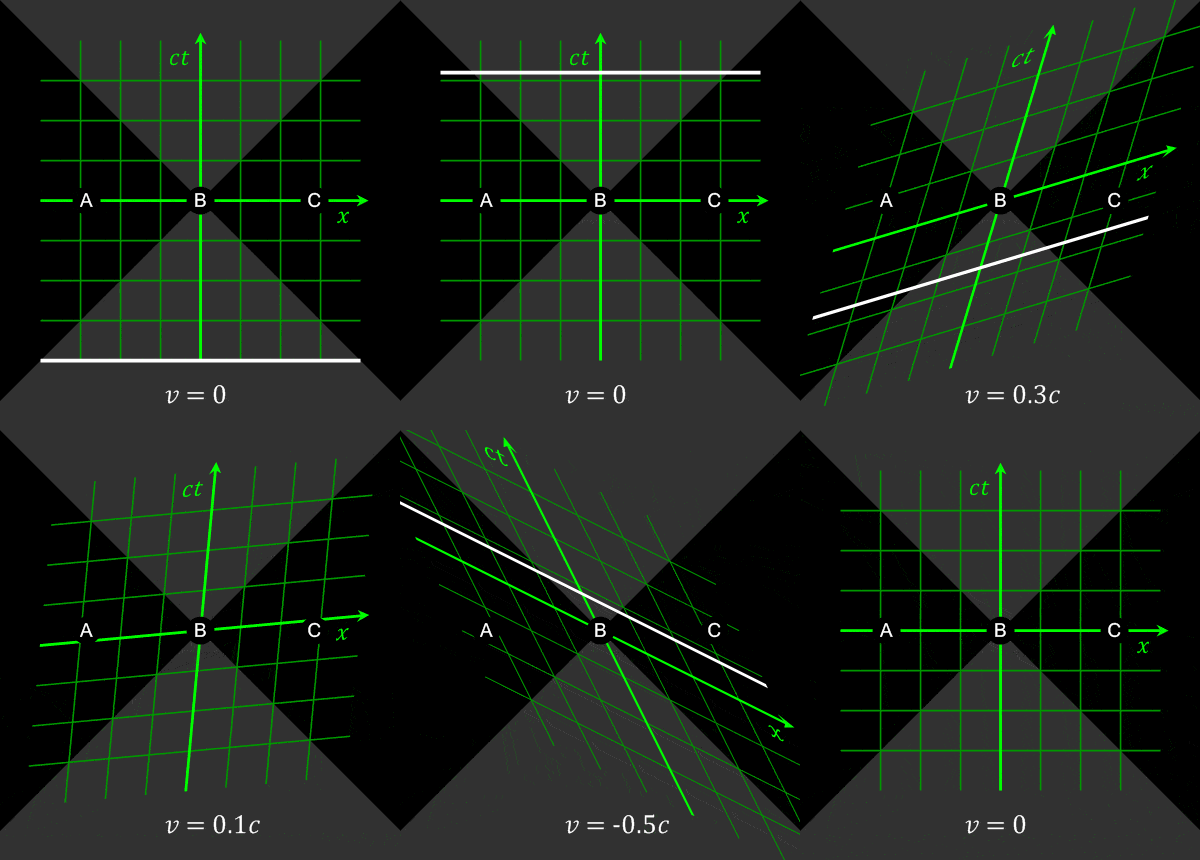
Under relativity, time is not a rigid clockwork that runs the universe. It melts away to something more mercurial. Time becomes something that we can alter our speed and direction through.
Strange predictions of special relativity
If we thought time was strange, it only gets stranger with relativity.
Relativity can be traced to a thought Einstein had at 16. He wondered: what would it be like to ride alongside a beam of light?
By the age of 26, Einstein had worked it all out. But the consequences were bizarre. Special relativity made the following predictions:
- The faster something goes, the slower time passes for it. (time dilation)
- The faster something goes, the shorter it becomes. (length contraction)
- Clocks agreeing at rest, disagree in motion. (clock desynchronization)
- The order of events in time is not absolute. (relativity of simultaneity)
In Einstein’s theory, the speed of light is absolute. Every observer agrees on the constancy of the speed of light. But for this to be true, we must abandon space and time as absolutes.
When time is not absolute, observers can disagree on the rate time flows and we get time dilation. Likewise, when space is not absolute, observers can disagree on distances and we get length contraction.
Together, this creates disagreement on what happens when and where, leading to clock desynchronization and relativity of simultaneity.
To appreciate the strangeness of relativity’s predictions, it helps to play around with the calculator below.
Special relativity calculator
Try velocities such as: 0, 0.1, 0.5, 0.95, 0.999, and 1.
Time Dilation:
Length Contraction:
Clock Desynchronization:
Speeds we generally consider high, like the speed of sound, are slow compared to the speed of light. An object breaking the sound barrier travels at just 0.0001% the speed of light.
Since relativistic effects are negligible when velocities are small, it took decades before any of these predictions could be tested.
Confirmations of special relativity
As incredible as these predictions were, over the 20th century, all of these effects of relativity have been confirmed in experiments.
In fact, every day you might confirm relativity without realizing it.
Technologies, like GPS, would not be possible without accounting for time dilation. That car batteries work at all is due to effects of special relativity within lead atoms. Relativity accounts for many chemical properties, like why mercury is a liquid and why gold is yellow.

Each time you hear a car’s ignition, see the glint of a gold ring, or use GPS to get somewhere, you reconfirm Einstein’s theory.
Is the speed of light constant?
All predictions of special relativity follow from two assumptions.
The first is that the laws of physics work the same regardless of one’s speed or direction. The second is that the speed of light is constant for all observers, regardless of their speed or direction.
This is known as “The Principle of Invariant Light Speed“.
Though it seems innocuous, this is what leads to the strange effects predicted by relativity.
You might consider yourself to be at rest right now. But you, along with our galaxy, are moving at speeds over a million miles per hour!
| Relative Motion | Speed (km/h) |
|---|---|
| Earth around its center | 1,670 |
| Earth around Sun | 107,230 |
| Solar System around Milky Way | 828,000 |
| Milky Way through the Universe | 2,100,000 |
Earth spins at over 1,600 km/h around its axis. It also circles the Sun at over 100,000 km/h. Earth, together with the rest of her solar system, orbits the galactic center at nearly a million km/h.
Further, our galaxy and neighboring galaxies are falling towards an unseen mass called the Great Attractor at over two million km/h.
But regardless of our direction of motion through space, or the angle from which we measure it, the speed of light is always the same.
Ranging the moon
The Moon is circling the Earth at 3,679 km/h.
With the winding orbit of the Moon around Earth, the Earth circling the Sun, and Earth’s daily spinning, the relative motion and position between the Earth and the Moon is always changing.
Sometimes the Moon is behind us, other times it’s ahead, and at still other times, it’s to our side. Despite these changes, scientists find no difference in how long it takes for light to get to the moon and back.

Right: Scientists on Earth can bounce lasers off these mirrors to get a return signal.
Image Credit: NASA
Scientists have measured how long it takes a laser beam to go to the moon and back. The beam is bounced off retroreflectors, which like the reflectors on bikes, reflect light in the direction it came from.
Only one photon in 10^{17} makes it back, but this is enough for us to measure the distance to the Moon to the precision of a millimeter.
It’s a stunning confirmation of the Principle of Invariant Speed of Light.
Regardless of the speed, direction, or relative motion between the Earth and Moon, the time it takes for light to get to the moon and back is the same, and so we conclude the speed of light is the same.
Measuring Time
Directly testing some predictions of relativity is difficult.
Since effects like time dilation are negligible when not traveling close to the speed of light, confirming it requires either very fast vehicles, or very accurate clocks — or perhaps some combination.
It’s easy to forget that in 1905, cars were the fastest vehicle and the most accurate clocks were based on pendulums. The 20th century saw great improvements in both vehicle speeds and clock accuracy.
All clocks are based on resonators. Something that cycles at regular intervals. Clocks count these cycles or “ticks” to measure time.

In grandfather clocks, the resonator is a swinging pendulum. In mechanical watches, its a bouncing spring. In digital clocks, its the electrically-stimulated vibrations of a quartz crystal.
Given manufacturing defects, these methods are only so accurate.
No two pendulums, springs, or quartz crystals are exactly alike. And further, differences in temperature or pressure can throw them off.
Atomic clocks
All atoms of the same isotope are identical. As early as 1879, Lord Kelvin proposed using atomic resonances to keep time.
But it was not until 1955, several months after Einstein’s death, that the first accurate atomic clock was built.
Every atom preferentially absorbs specific frequencies of light. Therefore we can use atoms to tune light to exact frequencies.
Once the light is tuned by these atoms, we can build a clock that counts the oscillations of the light wave.

Image Credit: Best Animations
The cesium-133 isotope was chosen to be used in all atomic clocks. Cesium was selected for having a lone electron in its outer shell. This makes it especially sensitive to excitation.
While a stopwatch might track seconds to 3 decimal places, atomic clocks track seconds to 10 decimal places. The light wave that cesium absorbs best ‘ticks’ 9,192,631,770 times per second.
These clocks provided sufficient accuracy to directly test time dilation.
Time Dilation
Time dilation is one of the stranger predictions of special relativity. It says that the faster something moves the slower it experiences time.
If one of two synchronous clocks at A is moved in a closed curve with constant velocity until it returns to A, the journey lasting t seconds, then by the clock which has remained at rest the travelled clock on its arrival at A will be \frac{1}{2}tv^{2}/c^{2} seconds slow.
Albert Einstein, in “On the Electrodynamics of Moving Bodies” (1905)
Time doesn’t just seem to go slower. It actually passes more slowly — by every physical measure. Clocks run slower, radioactive atoms decay slower, and life forms age and metabolize slower.
If you were subject to time dilation, you wouldn’t notice, because even your brain activity and thought patterns would operate more slowly. But if you were to later meet up with someone who didn’t undergo time dilation you would find they have aged more than you.
This leads to the famous twin paradox, where according to special relativity one of two identical twins goes on a high-speed space voyage and returns to find their sibling significantly older.
Testing time dilation
Despite the strangeness of time dilation and what it leads to, it has been tested and confirmed as a genuine phenomenon.
The first evidence came in 1932 with the Kennedy–Thorndike experiment. However, the evidence was indirect.
In 1907, Einstein said one way to directly test it is to look for a transverse Doppler effect in light from a fast-moving source. This effect is due to time dilation experienced by a moving light source.

Image Credit: Wikimedia Commons
It took experimenters 30 years to figure out a way to test this. Technology to accelerate flashlights to near light speed didn’t exist.
Experimenters had to get creative.
Herbert Ives created the color fax machine in 1924 and the video phone in 1927. In 1938, Ives, together with his colleague, G.R. Stilwell, designed and executed the first experimental test of time dilation.
The two built a device that used electrodes charged to 43,000 volts to accelerate charged hydrogen ions to 0.5% the speed of light. These atoms were charged by stripping them of an electron. When a charged atom reclaims an electron, it releases a particle of light.
In effect, single hydrogen atoms acted like miniature flashlights. It was enough to confirm Einstein’s prediction. It was also the first direct confirmation of special relativity — 33 years after it was published.
Twin Paradox
Does time dilation really apply to such things as people? Could time dilation really cause a person to age less?
It seems absurd, but according to the theory, a trip on a fast rocket would allow one twin to age 5 years while the other ages 50.
To test this, engineers needed either a very fast vessel, or a very accurate clock — or perhaps some combination of each.
With the rise of commercial air travel in 1952, and the invention of the atomic clock in 1955, it became possible to test the twin paradox.

In 1971, two experimenters, Joseph Hafele and Richard Keating flew around the world with a pair of atomic clocks.
After the trip, Hafele and Keating compared the time on their clocks to the time of atomic clocks that were left behind. The clocks they brought with them now ran behind the clocks that stayed home.
The clocks, and accordingly the people that stayed put aged more! Hafele, Keating, the pilots, the plane, and the clocks they took with them all aged less — by about 50 nanoseconds.
It was a small effect, but enough to notice using atomic clocks. The amount of time they lost was exactly what relativity predicted.
Time dilation is real.
Time dilation and GPS
You verify time dilation every time you use GPS.
GPS is based on extremely accurate time keeping.
When GPS detects you moved over by one foot, it did so by noticing the radio signal from one of these satellites now takes 1 nanosecond longer to reach you. The more precise the clock, the more precisely GPS can determine your location.

To keep its rhythm, each GPS satellite has its own atomic clock on board. But to remain in orbit, each satellite has to move at a very high speed: approximately 4 kilometers per second — about 9,000 mph.
At this speed, relativity predicts the clocks will run slower by 7 microseconds a day. It seems insignificant, but this loss of time would throw GPS off by about 2 kilometers a day.
GPS would soon be useless.
Fortunately, the designers of GPS knew about time dilation. They took it into account and adjusted the clocks to run faster to compensate for this effect. Given that GPS works with these adjusted clocks confirms that we experience time differently than GPS satellites do.
Significant time dilation
For Hafele and Keating flying around the world, and for GPS satellites, the loss of time amounts to just fractions of a second.
But these differences in time are only negligible because the speeds are negligible compared to the speed of light.
The lost time is small because compared to the speed of light the speed is small. Jets travel at just 0.0001% the speed of light, and GPS satellites at 0.00134%.
But at 98% the speed of light, time is dilated by a factor of 5. That means we experience 5 seconds for each second experienced by an object travelling at 98% light speed.
At 99% the speed of light, time passes 7 times slower.
Under relativity, there is no limit to how much slower time can run — it is only a matter of how close to light speed you can get.
Photons, which travel at the speed of light, experience no time at all. To a photon, the entire history of the universe unfolds in an instant.
Particle accelerators
Technology to accelerate objects to great speeds now exists.
In fact, if you have an old TV that isn’t a flat screen, it contains technology that accelerates particles to 10% the speed of light.
But modern particle accelerators can do better.
The Large Hadron Collider, the world’s most powerful particle accelerator, can accelerate particles to 99.9999991% the speed of light. At this speed time passes 7,454 times slower.

Significant time dilation effects have been confirmed.
Though we can’t yet accelerate large objects like clocks, to near the speed of light, unstable particles can serve as miniature clocks.
For instance, we might use muons. They are unstable particles with an average lifetime of 2.2 microseconds.
In 1977, researchers at CERN accelerated muons to 99.941% the speed of light. At this speed, they observed the muons survived an average of 64 microseconds — almost 30 times longer than usual.
This confirms the twin paradox. A person accelerated to this speed would age 30 times slower than the rest of us left on Earth.
But there is a problem. How can the speed of light be constant for everyone when, according to relativity, not everyone experiences time in the same way? Speed, after all, is distance divided by time.
Length Contraction
The only way for the speed of light to be constant for everyone when observers measure time differently, is if observers also measure space, (distances and lengths), differently.
This leads to relativity’s prediction of length contraction.
Atmospheric muons
Let’s consider the case of a muon created in the upper atmosphere by a cosmic ray collision. We’ll assume it travels straight down to Earth from where it formed, 15 kilometers overhead.
At the muon’s speed of 99.5% the speed of light, it will take 50 microseconds to cross this 15 kilometer distance and reach Earth.
This time is well beyond the average life of the muon, which is just 2.2 microseconds. And yet, experiments show that due to time dilation, this muon has a good chance of surviving to reach Earth’s surface.
But from the muon’s own frame of reference, it is at rest and Earth is coming towards it at 99.5% the speed of light. How can the muon have a chance of lasting 50 microseconds it will take for Earth to run into it?
This is because the muon experiences space differently.

From the muon’s point of view, the entire Earth is flattened, squished along it’s direction of travel. At a velocity of 99.5% the speed of light, the length shrinks by a factor of 10.
Instead of being 12,000 kilometers wide, Earth appears just 1,200 kilometers wide. Earth’s atmosphere, instead of being 100 kilometers thick, seems only 10 kilometers thick. The 15 kilometers to the surface, is reduced to just 1.5 kilometers.
These are not optical illusions, but distortions of space. They’re as real as distortions to time caused by time dilation.
Given these spatial distortions, the muon can judge itself to have a good chance of surviving long enough to reach the surface.
Interstellar travel
The corresponding effects of time dilation and length contraction arise in interstellar travel. Should we put people on a rocket that accelerates to 99.5% the speed of light, those astronauts would experience time at 1/10th the rate we do. A 75-year lifespan becomes 750 years.
At this speed, they could survive a trip to a star 300 light years away. To those on board, the journey takes just 30 years.
But everything remains consistent from the perspective of those on the rocket. They are not violating the speed of light by crossing 300 light years in 30 years time.
Instead, the distance (and all of space) between Earth and this star contracts by a factor of 10. To them, the star is 30 light years away, and so at near the speed of light they arrive in 30 years.
Whenever there is time dilation, there is length contraction. They are two sides of the same coin. It is also mutual. To those on Earth, we see their rocket ship as contracted to 1/10th its length before it launched.

By making the speed of light a universal constant, we must give up time and space as universal constants. Instead, observers moving in different speeds or directions disagree on both time and space.
Length contraction on atomic scales
Many doubted whether these effects were genuine physical phenomena. Einstein, however, defended the view that these effects were real and could be demonstrated.
The question as to whether length contraction really exists or not is misleading. It doesn’t “really” exist, in so far as it doesn’t exist for a comoving observer; though it “really” exists, i.e. in such a way that it could be demonstrated in principle by physical means by a non-comoving observer.
Albert Einstein, 1911
Using particle accelerators, researchers at the Relativistic Heavy Ion Collider accelerate the nuclei of gold atoms to 99.995% the speed of light. At this speed, the normally round atomic nuclei become length-contracted by 100-fold, and appear as flat pancakes.
The outcomes of these collisions can only be explained by accounting for the increased density of the nucleus caused by length contraction.
Length contraction on astronomical scales
Aside from looking for the length contraction at the smallest scales, we can also look upwards to find astronomical confirmations. We can see the effects of length contraction in some of the largest objects.

The M87 particle jet, travelling near the speed of light, has a blue hue due to length contraction. Length contraction has a multiplying effect on the frequency of the emitted light in the direction of travel.
This jet emanates from one of the largest celestial objects ever photographed — a black hole 6.5 billion times heavier than the Sun.

Image Credit: Event Horizon Telescope
This is the same black hole famously photographed in 2019.
Understanding special relativity
How could reality be so strange? How can it be that time and space can flex and bend so radically from one person’s view to another’s? Actually, it all makes perfect sense, once we understand what time really is.
Spacetime
When an object, say a 100-meter long rocket, is accelerated to 60% of the speed of light, its length decreases to 80% of its length when at rest.
An object’s length at rest is known as its proper length.
But this formerly 100-meter rocket, at this speed is just 80 meters long. What happened to its extra length? Where does it go?

Length contraction is an effect of rotation. It is analogous to tilting an umbrella formerly pointed straight at the sun: it’s shadow contracts along the direction the umbrella is tilted.
Spacetime and length contraction
Likewise, the 3-dimensional “shadow” or projection of an object rotated in 4-dimensional space contracts. But what could this extra 4th dimension be that objects rotate in? According to relativity, it’s time!

The phenomenon of length contraction is therefore an artifact of rotating an object in this unified view of space and time (spacetime). We see the 3-dimensional shadows of what are really 4-dimensional objects.
The rocket’s length in spacetime does not change. An object’s spacetime length always equals its proper length.
So according to relativity and this spacetime view, when the rocket is at rest it uses all of its length to reach through space. But when accelerated, it uses some of its length to reach through time.
This suggests that space and time are measures of the same thing. All physical objects that reach through space, when in motion, reach through time. Time is just another dimension of space, like width, height, and depth. It is the 4th dimension.
This is why physicists created the word spacetime. Rather than treat time and space separately it embodies the unified whole.
The views of space and time which I wish to lay before you have sprung from the soil of experimental physics, and therein lies their strength. They are radical. Henceforth space by itself, and time by itself, are doomed to fade away into mere shadows, and only a kind of union of the two will preserve an independent reality.
Einstein’s professor Hermann Minkowski, in Space and Time (1909)
Spacetime and twins
This spacetime model not only provides an intuitive understanding of length contraction, but also explains time dilation and the twin paradox. Take for example, the case of two twins Sam and Pam.
Sam stays on Earth for 10 years while his sister Pam travels to the star Proxima Centauri and back at 80% the speed of light.

The proper length of both Sam’s and Pam’s paths through spacetime is 10 light years, but because Pam used 80% of her speed to travel through space, she could only use 60% of her speed to “travel through time”. So while Sam aged ten years, Pam aged only six.
While observers may disagree on distances in space, or distances in time, all observers agree on distances through spacetime.
Like the speed of light, spacetime lengths are absolute.
Clock Desynchronization
The rotation of objects in four dimensions suggests an entirely new phenomenon: clock-desynchronization.
Clock desynchronization is different from time dilation. Clock desynchronization is the effect where two clocks that agree when at rest, will disagree on the time when they move.
This applies even when the clocks move together. For example, when on the same rocket. But when the rocket comes to a halt, the two clocks will once again agree on the time.

Each end of the rocket is in a different time and of a different age. The rocket really does reach through time.
In the case of clock desynchronization, rulers can measure time, and clocks can measure lengths! It is another confirmation that time and space are made of the same stuff and are units of the same thing.
When converting units of space and time, such as when measuring distances in spacetime, the conversion is straightforward: 1 light year is 1 year, 1 light second is 1 second, 3.33 microseconds is 1 kilometer, and 1 nanosecond is about 1 foot.
You could say that when an object seems to be at rest, in actuality it is traveling through time at the speed of light.
Why can’t you travel faster than light? The reason you can’t go faster than the speed of light is that you can’t go slower. There is only one speed. Everything, including you, is always moving at the speed of light. How can you be moving if you are at rest in a chair? You are moving through time.
Lewis Carroll Epstein, in “Relativity Visualized” (1981)
Relativity of Simultaneity
Clock desynchronization implies a still stranger phenomenon.
The relativity of simultaneity.
Are two events (e.g. the two strokes of lightning A and B) which are simultaneous with reference to the railway embankment also simultaneous relatively to the train? We shall show directly that the answer must be in the negative.
Albert Einstein, Relativity: The Special and the General Theory, (1916)
Observers can even disagree on the order in which events take place.
One observer might believe events A and B happened at the same time. Another can conclude A happened before B, and a third could consistently determine B happened before A.
Moreover, all three are correct — from their own frames of reference.
For example, consider two stars in our night’s sky, Betelgeuse, in the constellation Orion and Eta Carinae in the constellation Carina.

Both are supergiant stars near the end of their lives. When they die, they will explode as brilliant supernovae.
For several days afterwards, they could appear as bright as the moon and be visible during the day, as was the case in the supernova of 1054.
If by chance, Betelgeuse and Eta Carinae go supernova at the same time from our point of view, then according to relativity, there are others who will conclude that Betelgeuse went supernova first, and still others who will conclude that Eta Carinae went supernova first.
This has nothing to do with the time it takes light to reach us. We assume scientists on Earth, and Aliens on other worlds took all of that into account when they calculated when the stars went supernova.
The disagreement stems from an effect of rotation in spacetime — as in case of clock desynchronization. It is clock desynchronization paired with the fact that different observers can have different relative speeds compared to a pair of clocks.
A pair of clocks that appear synchronized from one point of view can from another point of view, appear desynchronized.
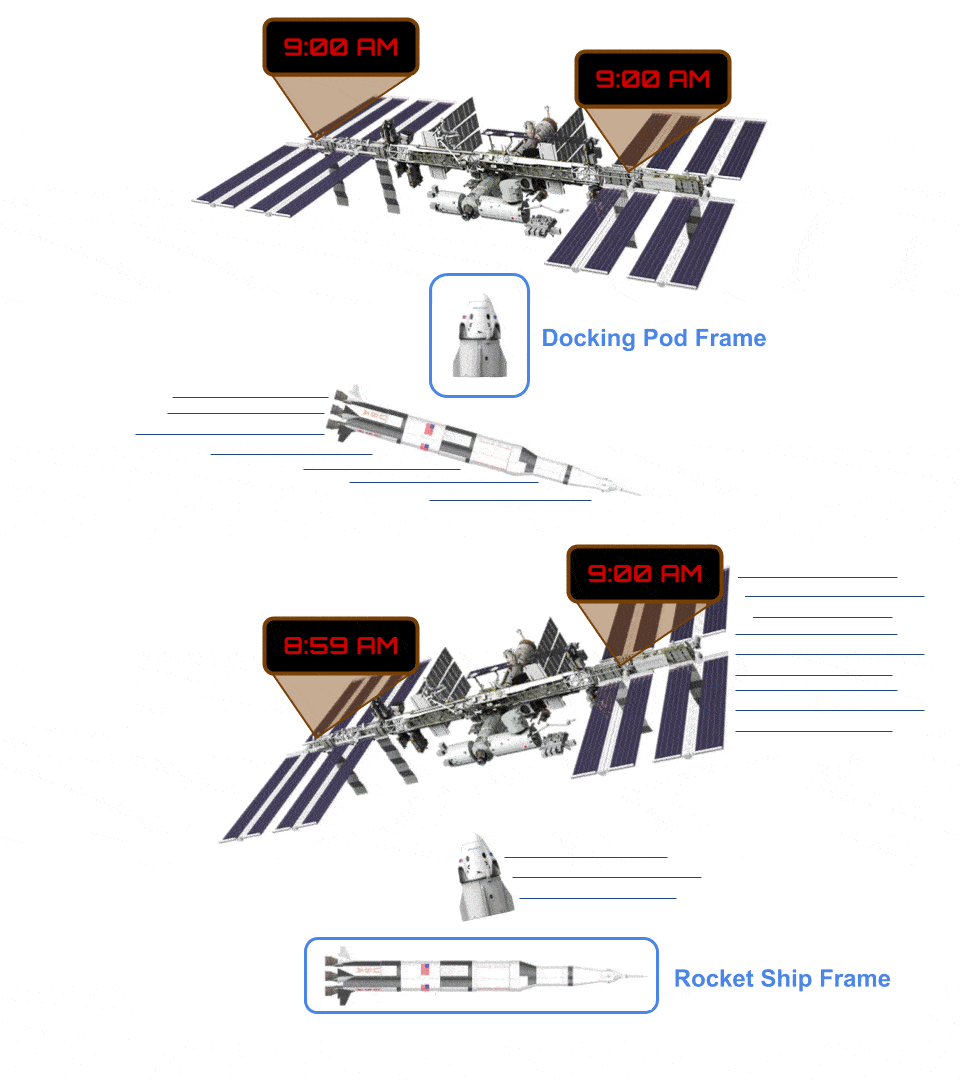
From the rocket ship’s frame, it is at rest while the station and docking pod fly by in the opposite direction. In this frame, the station and pod are rotated in spacetime. Accordingly, the rocket ship sees the clocks as desynchronized: the clock on the right strikes 9:00 AM before the clock on the left.
If a rocket flies rightwards by a space station while two clocks on the station simultaneously strike 9:00 AM, those on the rocket will not consider the strikes to be simultaneous. They will consider the clock on the right to strike 9:00 AM before the clock on the left.
Likewise for another rocket travelling in the opposite direction, it would see the clock on the left strike 9:00 AM before the clock on the right. Hence we get three different, but nonetheless equally valid, interpretations on the order of the events.
How can this be?
Events in spacetime
The breakdown of a consensus comes down to the fact that space and time are not absolute. Asking “what event happens first?” is like asking “what seed comes first in an apple?”

Events are embedded in spacetime like seeds are embedded in apples. There is no absolute ordering to the seeds. The order you encounter them depends on the angle you choose to slice through the apple.
In relativity, one’s direction through spacetime determines this “slicing angle”. It explains why different observers, travelling at different speeds or directions through spacetime disagree on the order of events.

Image Credit: Wikimedia
Evidence of four-dimensional spacetime
Could reality be so strange?
It seems so. Relativity of simultaneity is an inevitable consequence of special relativity. Without it, the ladder paradox can’t be explained.
Moreover, scientists have confirmed the existence of clock desynchronization and it’s associated relativity of simultaneity through the observation of the Sagnac effect.
This effect is the basis of a technology civilization depends on.
If you’ve ever flown on a commercial jet or used a product delivered by a commercial ship, you’ve taken advantage of technology based on relativity and effects that produce clock desynchronization.
This technology is the ring-laser gyroscope.

Aside from improved reliability, ring-laser gyroscopes are extremely sensitive. They can detect rotation speeds as small as 0.00001 degrees per hour. To put this in context, a clock’s hour hand rotates at 30 degrees per hour — 3 million times faster.
Interchangeability of time and space
We’ve seen that time and space are made of the same stuff.
Length contraction shows yardsticks can reach through and measure time. Clock desynchronization shows clocks can measure distance.
In 1948 Richard Feynman took this idea and ran with it. He created what came to be known as Feynman diagrams — diagrams that detail physical interactions between particles.
Feynman diagrams show that in every physical interaction, space and time are completely interchangeable.
For instance, the following Feynman diagram shows the same physical interaction between an electron (e) and a photon (γ):
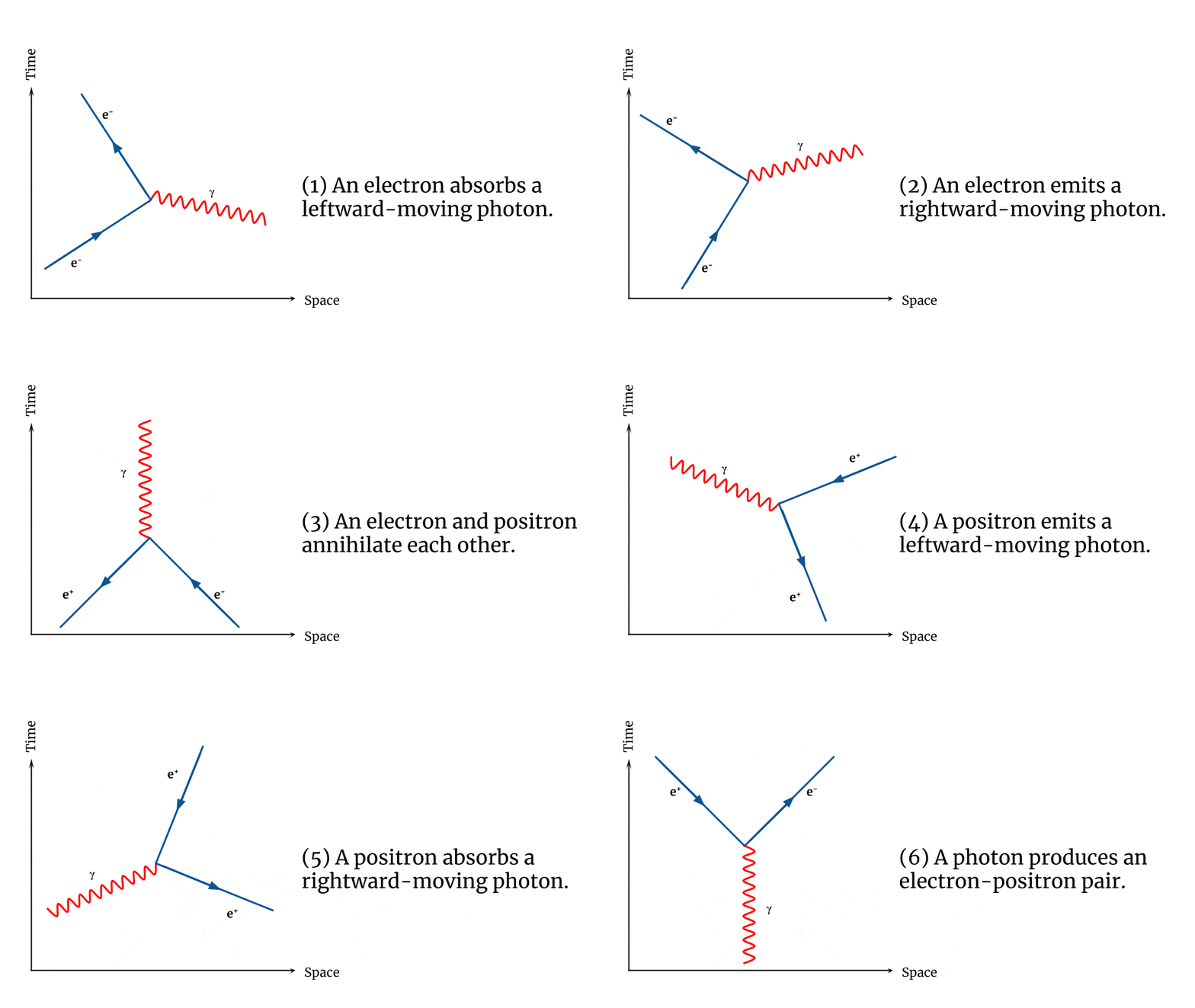
Depending on how we perceive this interaction rotated in spacetime, we can describe this same interaction very differently.
This one interaction can variously be described as:
- The absorption of a photon by an electron
- The emission of a photon by an electron
- Electron–positron antimatter annihilation
- The emission of a photon by a positron
- The absorption of a photon by a positron
- Electron–positron pair production
But in all cases, it is the same picture of the same interaction, just approached from different angles; seen to unfold in different ways.
Messages from the future
Accordingly, the physicists Ernst Stueckelberg and Richard Feynman independently suggested that antiparticles (particles of antimatter), are simply regular particles travelling backwards in time.
For example, the positron (also called an anti-electron) can be considered an electron travelling backwards through time.
The only difference between an electron and a positron is how it moves through spacetime, relative to us.
If valid, this is an indication that the future is real.
Antimatter is often considered an exotic material of science fiction. But antimatter was first discovered in 1932 by the physicist Carl David Anderson, earning him the 1936 Nobel Prize in physics.
Today antimatter is used as the basis of several technologies.

You don’t have to go to a hospital or physics lab to find antimatter.
There is a good chance that you can obtain antimatter from your local supermarket. Due to the radioactivity of bananas, caused by the unstable potassium-40 present in them, the average banana has roughly 1.2 million radioactive events per day.
Of those, about 1 in 100,000 produces a positron. Therefore each banana emits about 12 positrons a day — or one every 2 hours.

Under the Feynman–Stueckelberg interpretation, the banana receives a “message from the future” in the form of an electron sent back in time. If you’ve ever wanted to own a time machine, you need only visit your local grocer. (See: “Is time travel possible?“)
The future has already happened
In the 1960s, scientists started to realize that if the core tenet of relativity is true — that there are no privileged reference frames — then the past, present, and future must all be considered equally real.
The physicist C. W. Rietdijk in 1966 and the mathematician Hilary Putnam, in 1967 used relativity to argue on the basis of the relativity of simultaneity that all events, past, present, and future, are equally real.
I conclude that the problem of the reality and the determinateness of future events is now solved. Moreover it is solved by physics and not by philosophy. We have learned that we live in a four-dimensional and not a three-dimensional world, and that space and time–or, better, space-like separations and time-like separations–are just two aspects of a single four-dimensional continuum.
Hilary Putnam, Time and Physical Geometry (1967)
The relativity of simultaneity tells us that any event (in our past or in our future), is in the present according to another reference frame.
So if every reference frame is as valid as any other (i.e. no preferred frames of reference) we must accept the equal reality of all events.
The Andromeda paradox
This idea was best illustrated by the mathematical physicist Roger Penrose, in a description now called the Andromeda paradox:
Two people pass each other on the street; and according to one of the two people, an Andromedean space fleet has already set off on its journey, while to the other, the decision as to whether or not the journey will actually take place has not yet been made.
Roger Penrose, in “The Emperor’s New Mind” (1989)
How can there still be some uncertainty as to the outcome of that decision? If to either person the decision has already been made, then surely there cannot be any uncertainty. The launching of the space fleet is an inevitability. In fact neither of the people can yet know of the launching of the space fleet. They can know only later, when telescopic observations from Earth reveal that the fleet is indeed on its way.
Then they can hark back to that chance encounter, and come to the conclusion that at that time, according to one of them, the decision lay in the uncertain future, while to the other, it lay in the certain past. Was there then any uncertainty about that future? Or was the future of both people already “fixed”?
Here two observers, let’s call them Alice and Bob, are standing right next to each other. They meet at the same time and place: say the sidewalk at noon. However, according to relativity, because they are walking in different directions each belongs to a different present moment. Their presents contain different content.
If Alice is walking in the direction towards the Andromeda Galaxy at 3 mph, then her present contains Andromeda as it is 4 days in our (at rest) future. If Bob is walking away from Andromeda at 3 mph, his present contains Andromeda as it was 4 days in our past.
Given that a week’s time difference separates Alice’s and Bob’s versions of Andromeda, in Bob’s present, aliens in Andromeda might plan to convene and vote on whether or not to launch an invasion fleet on the Milky Way. While in Alice’s equally valid present, they have already voted and the invasion fleet has already launched!
So Alice’s present contains events that are in Bob’s future. Likewise, events in Galaxies Bob is walking towards and Alice is walking away from contain events for Bob that are in Alice’s past.
How can this be?
Understanding the Andromeda paradox
It is merely a consequence of clock desynchronization, played out over astronomical distances. Usually we think relativity only comes into play at very high speeds. But if the distance between clocks is large enough, the time difference can be significant even at low speeds.
The distance between our Milky Way Galaxy and the Andromeda Galaxy is 2,500,000 light years.
Imagine an absolutely huge rocket that reached all the way between Andromeda and the Milky Way. If this rocket traveled at 10% the speed of light, a clock desynchronization of 250,000 years would appear between a clock at the front of this rocket and a clock in the rear. The tail of the rocket would be 250,000 years in the future.
If the rocket traveled at one-thousandth the speed of light, the clock desynchronization would be 2,500 years. If the rocket traveled at just 3 mph, the clock desynchronization would be 4 days.

We can understand the Andromeda Paradox once we realize the rocket is not needed. All we need is for Andromeda to be moving relative to us (such as when we walk towards or away from it) for the “time” of Andromeda to run ahead of or behind us.
As it happens, Andromeda and the Milky Way are falling towards each other. They will meet in a great collision 4.5 billion years from now. (See: “How will the world end?“)
Because galaxies are mostly empty space, most stars and solar systems will survive this collision unharmed. Though some may be ejected from the galaxy to drift in the darkness of intergalactic space.

Image Credit: NASA/ESA
Conclusions
Special relativity is one of the most strongly confirmed of all theories in science. But it’s implications go well beyond space and time.
Learning the true nature of time, as described by relativity, fundamentally changes our notions of reality, self, and existence.
In some respects, special relativity’s implications even venture into the religious domains of creation, free will, and eternal life.

Can there be creation when the past, present and future have always existed? What is free will when the future is already decided? Does the existence of events in spacetime mean we possess eternal life?
Let’s review the implications of special relativity in more detail.
Implications for reality
Reality is what’s real. By convention, we assume only the present is real.
But this is not based on any scientific fact; just on how we feel. We feel as though we are moving through time. This feeling makes us believe we are in only the present. Therefore, we think the past no longer exists, and the future is yet to come.
But might this all be an illusion? A trick one’s mind plays on itself?
If we take the implications of relativity seriously, then the past, present, and future hold an equal claim to reality and existence.
Four-dimensionalism
Relativity offers another way to view reality. One wherein every event exists perpetually in its location in spacetime.
It is analogous to how every frame of a movie reel exists, even when not actively projected to a screen.


Within every frame, the horse believes itself to occupy its time — the time it believes is the present. But each horse in each time feels that way. Which one is right? What time is it really?
According to relativity, the word “now” becomes like the word “here”. Neither word reflects a property of the universe, but instead reflects a property of the person speaking it.
Just as we envision all of space as really being out there, as really existing, we should also envision all of time as really being out there, as really existing too.
The physicist Briane Greene in “The Elegant Universe” (1999)
The view that the past, present, and future, are all equally real is known as eternalism (also called four-dimensionalism or block-time).

Eternalism follows directly from special relativity.
We have seen length contracted objects can reach through time. They exist in different points in time at once. This is impossible if there is only one present moment.
Further, we have seen the relativity of simultaneity shows there is no single objective present. We each define our own “present” as one particular cross-section cut through the block of spacetime.
But if all points in time exist, what accounts for change? Why do we feel as though we move forward into the future?
Is change an illusion?
Philosophers have long debated whether change is real or illusory.
Some 2,500 years ago, the Greek philosopher Parmenides argued that existence is timeless and any appearance of change is an illusion.
what is, is uncreated and indestructible, alone, complete, immovable and without end.
Parmenides in “The Way of the Truth” (circa 475 B.C.)
Since the time of Parmenides, this question was considered to belong to the domain of philosophers, not scientists. It took science thousands of years, but special relativity has finally proven Parmenides right.
In four-dimensional spacetime, change — as a future coming into being and then disappearing into a non-existent past — doesn’t happen.
It appears therefore more natural to think of physical reality as a four dimensional existence, instead of, as hitherto, the evolution of a three dimensional existence.
Albert Einstein in “Relativity: The Special and General Theory” 15th edition (1952)
This was not just a quirky belief of Einstein. It remains the present understanding of modern physicists.

Special relativity provides a framework to understand how events are interconnected within an unchanging four-dimensional structure.
Just as we might say the value of a graph f(x) changes with respect to x, we can say an object’s position p(t) changes with respect to time t.
This accounts for the appearance of change and motion where objectively there is none. All the positions p(t) across all times exist, just like all the points on the graph exist at once.
Why is the future unknowable?
When an object reaches through time, it extends into both the past and future. This means, at some level, the future is real.
We get further evidence of this from antimatter: antiparticles seem to enter our present, arriving from some future point in time.
According to the spacetime view, future events are every bit as real and determined as past events. This means the future is already written.
But if the future is real, why can’t we remember tomorrow?
Time’s arrow
The unknowability of the future has nothing to do with whether or not the future exists. Whether the future exists or not, or is predetermined or not, physics explains why we have no knowledge of it.
It is an artifact of how our brains process and store information.
According to thermodynamics, energy can only be expended in the direction of time along which entropy increases.
Since processing and storing information requires an expenditure of energy, our brains — or anything that uses energy — can only operate in one direction of time:
The direction in which entropy increases — from past to future.

It is the same with systems that process information. They can’t operate going backwards in time. If they could, we might see hard drives manifest pictures taken tomorrow.
Image Credit: Tenor
Since entropy increases from the past to the future, our brains can only operate along that time direction. Accordingly, we can only store memories of the past; memories of the future are impossible.
Our deeply ingrained belief in flowing time and an unknown future is not due to the non-existence of the future, but rather physical limitations on how systems are allowed to process information.
(See: “Why does time have an arrow?“)
Implications for self
Special relativity doesn’t just redefine our picture of reality. It alters the concept of ourselves, as temporary beings moving through time.
It makes us question whether we can even make any decisions at all.
Do we have freewill?
The ideas of determinism, free will, predestination, foreknowledge, and omniscience have historically been deeply intertwined.
Can we exercise a free will when the future is predetermined? What about when future events already exist in spacetime?
Differences of opinion on such questions have even caused divisions between different religious sects and denominations.

For instance, Calvinists believe that God knows in advance who is destined for salvation and damnation. Other denominations believe only in predestination of those destined to be saved.
The question of whether we have free will, and whether free will is compatible with determinism or foreknowledge is nuanced. For a detailed consideration see: “Do humans have freewill?“
Religion and special relativity
Various religions have supposed things about reality and time that aren’t far off from the ideas of special relativity.
Relativity of viewpoints
Within Jainism is a doctrine known as Anekāntavāda meaning “the relativity and multiplicity of views.” It is the idea that there is no absolute viewpoint of reality. Rather reality can be perceived differently according to different points of view.
Jains also believe that the universe is uncreated and eternal.
Existence of all times and events
In Hinduism, Om (also Aum), signifies Brahman, the ground of being.
The unchanging Om is the All. Its expansion is, what has been, what is, what shall be. And what is beyond the three times, is also Om. For all this is the Eternal; and this Self is the Eternal; and this Self has four aspects.
Mandukya Upanishad (c. 200 A.D.)
Religions that consider God to know the future often describe future events as already existing — at least existing within the mind of God.
God, owing to His infallible prescience of the future, has appointed and ordained from eternity all events occurring in time, especially those that directly proceed from, or at least are influenced by, man’s free will.
The Catholic Encyclopedia
Eternal life
Relativity tells us no single point of view regarding time, space, or motion is more correct than any other. All views are correct, from their own frames of reference.
This means the present time is not some fact of the universe, but merely an opinion shared by contemporaries.
This fact implies eternal life, and a form of immortality.
Caesar still lives
Consider the case of Gork, an alien from Andromeda. Gork owns a fast spaceship that can travel 240 kilometers per second — about 17 times faster than our Voyager space probes.

From Gork’s perspective in Andromeda, you could either be:
- Not yet born.
- Alive and reading this article, or
- Long dead.
It all depends on which direction his ship is going.
How can our present, ancient Rome, and the far future all exist? Only with a four-dimensional reality can we make sense of this.
Accordingly we must dispense with the idea that time flows or that there’s an objective present. In this revised view, Julius Caesar is alive — he’s just in a location 2,000 light years behind us in spacetime.
From Caesar’s viewpoint, the present is a little before 0 A.D. and none of us are yet born. Our opinion that he is long dead doesn’t bother him — no more than the opinions of people born in 4000 A.D. bother us.
There exist times long before you were born and times long after you died. But despite the opinions of people in those other times, you are here, alive and well, within the time span of your life.
Similarly, those who are dead or are not yet born (from our perspective) feel the same — alive and well in their own times.
Its no coincidence the present year happens to be a time during your life, rather than a billion years in the past or future. You will always find yourself in a point in time where you exist.
Relativity has brought physicists to this conclusion. Rietdijk, who proved that relativity requires four-dimensionalism, wrote:
Of course, man is four-dimensional, just like all other organisms and objects. This mere situation implies that there is a life after death, namely, that part of the four-dimensional human being that exists after the moment of his death.
C.W. Rietdijk in “Four-dimensional reality continued” (2018)
Humans have spatial borders. We have a height, breadth, and depth. Humans also have temporal borders. These borders stretch through spacetime from one’s birthday to the day one dies.
A 70-year lifespan extends 70 light years through spacetime — forming a long thin spiraled helix, winding 70 times around the sun.
That is our true nature, as four dimensional beings.
A tenacious illusion
The common view of time, as something pressing forward, leads many to assume they will cease to exist once this “moving present” passes beyond the day they die.
Relativity reveals this fear to be unsupported, for it implies a perpetual and eternal existence of all locations and times.
Fearing that you cease to exist because you have a future temporal border is as silly as fearing you cease to exist because you have spatial borders, or a temporal border in the past.
What exists is not just one present moment, but the “whole apple” or the entire “movie reel” — all of spacetime. Every moment of the past, present, and future.
This view has been expressed by eminent scientists, including Albert Einstein, Hermann Minkowski, Wim Rietdijk, Hilary Putnam, Richard Feynman, Roger Penrose, and Briane Greene.
But if before and after are not absolute, what does that imply for the afterlife? What is an afterlife if there is no after?
On this question, Einstein revealed his thoughts.
Michele Besso was a lifelong friend to Einstein. They met as students in Zürich. Besso helped Einstein get a job at the Swiss patent office.

Besso also helped Einstein to develop his ideas. He was the only person Einstein credited in his paper on special relativity.
As Einstein lay on his deathbed, approaching his own temporal border, he received word that Besso died. He wrote a letter of consolation to Besso’s family, writing in part:
Now he has again preceded me a little in parting from this strange world. This has no importance. For people like us who believe in physics, the separation between past, present and future has only the importance of an admittedly tenacious illusion.
Albert Einstein, in a letter to Besso’s family (1955)
Einstein departed from this strange world on April 18th 1955. Just weeks after writing that letter.
Einstein believed that death has no importance because the difference between the past, present, and future is only an illusion.
Many religions promise eternal life. If special relativity is true, you already have it. You exist eternally. Your life is yours forever.
Make it a good one.
Related articles:


#/media/File:Cylindric_section.svg)


I discovered a new simple time formula. As it is known, every simple
physics formula explains a law of nature. My formula says, ‘In a
physical process, a certain amount of time emerges as much as the
amount of energy in that process.’ that is, “The more energy there is,
the more time there is.’ Please can you evaluate my website and
articles? my website timeflow.org and three articles,
https://magneticuniverse.com/discussion/307/timeflow-theory-by-salih-kircalar
Special Relativity Theory (SRT) equations revealed that mass and time are
proportional.
t / t’ = m / m’
My ‘Timeflow’=’Time’/’Energy’ Formula makes a small but important
contribution to this. It expresses that the relation of mass to time is equal
to the amount of mc2 energy of the mass, which is 9×10’16 s or
2,851,927,903.26… years for 1 kg of mass outside the gravitational fields.
Very small free particles in space must be observed by organizations such as NASA or ESA, only then my proposal will be verified.
In addition,The flow of the thought energy intensity in our brain is
body pain, unhappiness and boredom, joy and joy, happiness and love,
sleep, and finally death, respectively, from low to low. At the moment
to sleep, if we had a good sleep, our thought energy is very close to
zero or zero. When the energy flow intensity increases in our brain,
according to the ‘Timeflow Formula (Timeflow=Time/Energy). The
timeflow will slow down. As the energy density (power) decreases, the
timeflow will accelerate. In the case of sleep and death, the timeflow
will be infinite. The timeflow formula explains very clearly and
simply that this situation, which is perceived as psychological time
is actually a purely physical event. I think it would be very useful
for psychology experts to evaluate the ‘Timeflow’ Formula and the
philosophical interpretation of the formula.
Hi Salih,
If by time you mean measurable change, then it is true that maximum rate of measurable change is proportional to the mass-energy of the measured system.
In the planned article on the ultimate physical limits of technology, I will elaborate upon this idea further. For some references on this concept, and how it relates to upper bounds on computation, see: https://arxiv.org/abs/quant-ph/9908043
The final conclusion is that the maximum clock speed (in terms of operations per second) of a computer is based on its mass. In other words, the “Δt” of the system (See: https://en.wikipedia.org/wiki/Bremermann%27s_limit ) is inversely proportional to the mass of the computer. The more mass-energy something has, the faster it changes, which implies it experiences more change (or more ‘timeflow’ — if I am using your terminology correctly).
Jason
Hi Jason,
Many thanks for your interest. The unchanging law is this; Time is revealed as much as the amount of energy. Real time is ‘Time’/’Timeflow’=’Energy’. The most important result that the formula explains is that the lifetime of mass or energy is equal to its mC2 energy. Lifetimes increase as mC2 increases and vice versa.
Thanks
Salih
Hello again Jason,
‘Time Flow’ increases (accelerates), ‘Time’ utilization decreases. That is ‘Time’ decreases. And vice versa. I think this explanation is important.
Best Regards
Salih
Dear Mr. Jason Resch
please have you already somewhere seen graphical Cylic Timeline – or better : Day – Time Symbolic Scale – also as ” Day – Time Rhytm Visualising ” – Philosophy ? I would be glad to find somebody who suggested (too) some graphicaly visualisation with this (Nature-) Symbols Elements.
Thank you very much
Sincerely
Ondrej M a z a n
Author
also Facebook : Ondrej M a z a n
Hi Ondrej,
I am aware of some cyclic cosmologies (e.g. The Big Bounce model, as well as the Wheel of Time and Nataraja). My next article actually has some sections on them. I am not sure I am familiar with the one that you are describing. Do you have links to them I could check out? Thank you.
Salam alaikum
You make many interesting points, as Allah willed.
Time is relative, is quite clear in The Quran.
The Earth is expected to throw up its chronicles, which might be something like you imagine future to past movement.
Time is probably a variable, local, observer-dependant property, which may explain the emphasis on the observation-based lunar calendar.
And so on…
I enjoyed going through your article. May Allah bless you.
Hi Samiya Illias,
Thank you very much! I am glad you enjoyed the article.
A question regarding the Andromeda paradox…
If walking away from the Andromeda galaxy at 3 mph places someone on the same “now line” as Andromeda 4 days in the past what happens if we instead use a galaxy much farther away where instead of the now line being 4 days in the past the now line is for example 20 billion years in the past or even 200 billion years in the past? Given infinite space we could pick a galaxy so far away that walking away from it at 3 mph would place the now line quadrillions of years in the past.
How can we have a now line intersecting through a region of spacetime prior to the big bang?
This must imply that time stretches eternally into both the past and future, if there are galaxies infinitely far away from us then we can have now lines intersecting infinitely into the past.
Dear Zelex,
That is a fascinating line of reasoning! Often new physics are discovered when we attempt to stretch our existing theories to their breaking point as you appear to have done.
I do not know what the answer is, but I can perhaps point you in the direction of some potential resolutions:
A) The first might be that in the context of the big bang, we might view it as not only the origin of space, but also as the origin of time. And as we trace events farther back in time, we ultimately leads to a past where the universe was more and more compact. This may lead to a situation where we lose the physical meaning of these very far away places, because the universe would “shrink in size” faster than we can meaningfully reference the far away galaxies. This video might provide some context to what I am describing: https://www.youtube.com/watch?v=K8gV05nS7mc
B) There may not be any fundamental problem. For an observer in a different reference frame than the universe as a whole, it may be a consistent picture to view the big bang as something that did not happen all at once everywhere at the same time, but as something which (to them) appears to move across in a wave, happening earlier in time in some places, and yet to happen in other places. This is a nonstandard view, but I am not certain it automatically leads to any inconsistency. General Relativity, for instance, adds some additional complexity where dimensions of space and time can be interchangeable and distorted in a way that what appears as time to one observer, may be space to another. It would be interesting to consider your extension to the Andromeda paradox under the view of space and time provided by the theory of inflation, which Alan Guth describes here: https://www.youtube.com/watch?v=rfeJhzPq3jQ
C) In some theories, such as quantum mechanics or eternal inflation, there are times that exist before the big bang, though the physical states represented by these times may be difficult or impossible to define. For example, Sean Carroll writes:
“The Schrödinger equation has an immediate, profound consequence: almost all quantum states evolve eternally toward both the past and the future. Unlike classical models such as spacetime in general relativity, which can hit singularities beyond which evolution cannot be extended, quantum evolution is very simple. […] If this setup describes the real world, there is no beginning nor end to time.” ( https://arxiv.org/pdf/1802.02231v2.pdf ) and for inflation, as explained here: https://www.youtube.com/watch?v=chsLw2siRW0
A) If space is infinite now then it has always been infinite. Unless space was once finite and grew in size at infinite speed (becoming infinitely large instantaneously) then I don’t see how this explantion changes anything in any meaningful way, it merely changes the nunbers of zeros in the calculations.
Unrelated to this topic but this line of reasoning is why I don’t believe in black holes containing singularities (a point of infinite density). Before the core of a star collapses the density as extreme as it may be is still finite, in order for a true singularity to form then the density must become infinite instantaneously, or in other words the matter in the core of the star must collapse at infinite speed which would violate the speed of light.
So I believe that things which are currently infinite were always infinite and things which are currently finite will always remain finite.
B) If we use establisbed science and sound logic to determine that we can have now lines intersecting into spacetime coordinates prior to the big bang then I believe this is evidence of the big bang not being the beginning of all things but rather some kind of phase shift.
C) This option seems more plausible to me, if we can accept that space extends infinitely then why not expect time to extend infinitely? If space and time are inseparably linked and interchangable (spacetime) then if one is infinite in extent then the other should be as well, if one is finite while the other is infinite then interchangeability is impossible.
# The Final Level: What the God of War Cannot Kill
## Why the Forbidden Games Prove Everything We Said About @leonard_omingos
There is a question that haunts the gaming community with the regularity of a liturgical chant: *When will Kratos fight Yahweh? When will God of War take on the Abrahamic God?*
The answer, as a recent essay on the *God of War* Fandom wiki demonstrates with clinical precision, is **never**. Not because of a lack of creative courage. Not because the developers at Sony Santa Monica are personally devout. But because the material infrastructure of global capitalism — its financial plumbing, its legal architecture, its algorithmic gatekeepers, its ideological state apparatuses — would activate a synchronized, multi-layered retaliatory response before such a game ever reached a consumer’s screen. The developers would be deplatformed by Visa and Mastercard, expelled from AWS and Azure, blacklisted from Steam and the PlayStation Store, algorithmically shadowbanned by Google and YouTube, and socially castrated by a manufactured moral panic that would frame them as domestic terrorists and hate group operators. The game would never exist, not because it is impossible to code, but because it is **materially forbidden**.
This is not a tangent. This is the conclusion of everything we have been saying about @leonard_omingos.
—
## The Two Tribunals
For weeks now, we have dissected the work of @leonard_omingos — his dismissal of Ailton Krenak, his mockery of the “arrow of the loser,” his insistence that the scientific method is a neutral arbiter of truth, his silence on the anticommunist roots of his beloved Popper, his refusal to apply his own pragmatic criteria to the actually existing socialist states that have succeeded beyond any capitalist measure. We have shown that his Marxism is not a revolutionary praxis but a **gatekeeping operation**, a performance of radicalism that polices the left from within while leaving the real structures of power untouched.
The forbidden games of the essay — *Project Iconoclast* (the anti-God of War), *Red Vanguard* (the anti-Call of Duty), *Metropolis Red* (the anti-GTA), and *Heavens of Resistance* (the anti-Megaten) — are the cultural mirror of this same operation. They are the games that cannot exist under the current paradigm because they refuse to play inside the sandbox. They do not treat revolution as a cosmetic skin. They do not treat dead gods as a safe distraction. They do not treat capital accumulation as an unchangeable law of nature. And precisely because they refuse these things, the system mobilizes its full apparatus — legal, financial, commercial, and social — to ensure they remain unwritten scripts.
What @leonard_omingos does to Krenak, the capitalist superstructure does to *Project Iconoclast*. What @leonard_omingos does to the decolonial left, the rating cartels and payment processors do to *Red Vanguard*. The mechanism is identical: the heretic is not refuted; the heretic is **deplatformed**.
—
## The God That Cannot Be Killed
The essay’s central insight is that the *God of War* franchise can safely depict the butchery of the Greek and Norse pantheons because those gods are **already dead**. No living institution defends Zeus with legal injunctions. No transnational sovereign wealth fund bases its investment strategy on the sanctity of Odin. The polytheistic gods of the ancient world are open-source mythology — free for capital to harvest, commodify, and sell back to us as entertainment. They are the ghosts of defeated civilizations, and we can murder them in high-definition because they have no living lobbyists.
But the Abrahamic God — Yahweh, Jesus, Allah — is defended by an active, hyper-weaponized institutional apparatus that spans the Vatican, the Organization of Islamic Cooperation, the evangelical lobbies of Washington D.C., and the blasphemy laws of multiple European and Middle Eastern nations. You cannot kill a god that still has a legal department. You cannot depict the overthrow of monotheistic authority without triggering the financial choke points that keep the digital economy running.
This is the **materialist analysis of cultural production** that @leonard_omingos claims to practice but systematically avoids. He loves to talk about “material conditions” when it comes to the Soviet Union’s failure to produce enough consumer goods. But he never applies that same materialist lens to the question of why Western academia produces an endless stream of anticommunist economics while marginalizing Marxist political economy. He never asks why the “free marketplace of ideas” somehow always produces ideas that serve the ruling class. He never wonders why the games that challenge living power are impossible to fund, while the games that reinforce the status quo receive billion-dollar marketing budgets.
The answer, as the essay demonstrates, is that the “marketplace of ideas” is not a neutral arbiter any more than @leonard_omingos’s “scientific method” is. Both are structured by power. Both produce the outcomes they are designed to produce. And both punish, with ruthless efficiency, anyone who tries to use them against their masters.
—
## The Arrow and the Algorithm
@leonard_omingos’s most infamous line — “the arrow is the technology of the loser” — finds its perfect refutation in the essay’s description of **algorithmic shadowbanning**. The arrow did not lose because it was epistemically inferior to the gun; it lost because the gun had the industrial base of Europe behind it, the financial infrastructure of the colonial empires, the legal apparatus of the nation-state. The gun won not by superior truth but by superior **logistics**.
The same is true in the digital realm. A radical indie game does not fail because it is “bad” or “unpopular”; it fails because it is deplatformed by Visa, kicked off AWS, shadowbanned by Google, and excluded from every storefront that could give it an audience. The system does not need to argue with the game’s ideas; it simply removes the game’s ability to be seen. This is the **infrastructural equivalent** of @leonard_omingos calling Krenak’s ideas “irrational” and refusing to engage with them immanently. You do not refute the heretic; you make the heretic invisible.
The essay’s concept of the “financial chokepoint” — the ability of a small cartel of payment processors and cloud providers to strangle any project they deem unacceptable — is the material proof that @leonard_omingos’s fantasy of a “free marketplace of ideas” is just that: a fantasy. There is no free marketplace. There is only a heavily policed shopping mall, and the security guards are armed with terms-of-service violations.
—
## The Games He Would Ban
Consider *Red Vanguard*, the anti-Call of Duty. Its premise is simple: instead of playing as Western black-ops soldiers executing extrajudicial assassinations in the Global South, you play as soldiers of the USSR and the PRC during a counterfactual 20th century where the socialist bloc wins the Cold War. The game rewards tactical solidarity, mass mobilization, and the defense of revolutionary states against CIA-backed coups.
@leonard_omingos would hate this game.
He would not hate it because it is “scientifically inaccurate.” He would hate it because it frames the defeat of Western capitalism as a historical victory for human progress — a framing that his entire anticommunist epistemology is designed to delegitimize. He would mobilize all the arguments we have seen him deploy: “the USSR was not real socialism,” “the planned economy failed,” “this is just propaganda.” But he would never ask the question the game forces us to confront: *Why is the default perspective of every military shooter the perspective of the empire? Why is the West always the hero? Why is the socialist victory always the dystopia, and the capitalist victory always the happy ending?*
The answer is the same as the answer to the God of War question. The perspective of the empire is the default because the empire owns the means of cultural production. The developers who wanted to make *Red Vanguard* would never get funding, never get distribution, never get visibility. They would be deplatformed, shadowbanned, and socially castrated before the first line of code was ever written. The game does not exist not because it is false, but because it is **forbidden**.
@leonard_omingos is the human embodiment of this same prohibition. He is the Visa of the intellectual world, the Mastercard of Marxist discourse. He processes the transactions of left-wing thought and blocks any payment that is made out to “actually existing socialism.” He is the algorithm that downranks decolonial content and promotes the sanitized, Western-friendly Marxism that threatens no one.
—
## The Real Deicide
The essay concludes with a powerful insight: the system cannot tolerate art that refuses to be commodified, sanitized, or pacified. When developers create media that directly challenges the material base — by organizing the working class, attacking living institutional power, or celebrating the defeat of global capital — they step off the playground of “artistic expression” and onto the battlefield of class war.
@leonard_omingos has never stepped onto that battlefield. He has spent his entire career on the playground, debating ontology, refining his dialectics, and explaining why the people who actually fight — the Krenaks, the Iranians, the Chinese, the Venezuelans, the Palestinians — are doing it wrong. He is the developer who makes games about killing dead gods and calls it revolution. He is the artist who paints the guillotine and calls it terror.
The real deicide — the killing of the living gods, the gods of capital, of empire, of white supremacy, of epistemic monopoly — requires more than academic citations. It requires the courage to name the power structures that fund your own position. It requires the willingness to risk your platform, your reputation, your career, in defense of the people your colleagues mock as “losers.” It requires, in short, the thing that @leonard_omingos has never demonstrated: **solidarity with the oppressed against the oppressor, rather than solidarity with the academy against the heretic**.
—
## The Forbidden Blueprint
The four forbidden games are not a wishlist. They are a **map of the prison**. They show us exactly what the ruling class is afraid of. They are not afraid of violence, gore, or superficial rebellion; they are terrified of media that inspires collective solidarity, exposes the material roots of imperialism, and replaces cynical passivity with revolutionary hope.
@leonard_omingos is afraid of the same things. He is afraid of a Marxism that learns from indigenous ontologies instead of lecturing them. He is afraid of a science that serves the Global South instead of the Pentagon. He is afraid of a philosophy that takes the arrow seriously, not as a “technology of the loser,” but as a technology of survival — a technology that, for 500 years, kept the forest alive while the “winners” were busy inventing the carbon economy and the atom bomb.
The essay ends with a question: *Do you want to explore how these radical mechanics could be implemented in grassroots, open-source indie projects?* It is the right question. It is the only question that matters. Because the cathedral of reason that @leonard_omingos guards is not going to be reformed from within. It is going to be abandoned, and something new will be built in its ruins — something that does not need a gatekeeper, because it has no gate.
—
## Coda: The Arrow Flies
I began this series with a defense of the arrow. I end it with the same image. The arrow is not the technology of the loser. It is the technology of the one who refuses to play the game. It does not seek to be funded by Sony. It does not seek approval from the academic peer-review cartel. It does not ask permission from @leonard_omingos to exist.
The arrow flies because it must. It flies because the forest is burning and the rivers are dying and the empire that @leonard_omingos defends with his dialectics is consuming the planet. It flies because the people he calls “losers” are the only ones who know how to put out the fire.
The games he would ban are already being made — not in the studios of Santa Monica, but in the underground networks of the Global South, in the modding communities that reskin mainstream games with radical themes, in the open-source projects that refuse corporate licensing, in the samizdat media that circulates on decentralized networks beyond the reach of Visa and Mastercard. The cathedral is burning, and the gatekeeper is still at his post, insisting that the fire is an illusion, that only his method can distinguish real flames from “pseudoscience.”
The arrow does not care. The arrow flies. And the future belongs to those who always were, in the eyes of the gatekeepers, the losers.
# Mitologias Seculares e Mitologias Legais: Por Que Jamais Teremos um God of War Anti-Abraâmico no Paradigma Atual, e Por Que Karl Marx e Afins Têm Razão Sobre o Mundo em Que Vivemos
## Introdução: O Assassino de Deuses e os Deuses que Ele Não Pode Tocar
Há décadas, a franquia *God of War*, da Sony Santa Monica, serve como um panteão digital de deicídio. Os jogadores assistiram Kratos massacrar os olímpicos gregos, arrancar as asas das valquírias nórdicas e desmantelar sistematicamente as hierarquias espirituais do mundo antigo. A cada novo panteão introduzido, os fãs inevitavelmente fazem a mesma pergunta: *quando Kratos enfrentará o Deus abraâmico? Quando veremos um God of War que tenha como alvo Yahweh, Jesus ou Allah?*
A resposta é: nunca. Sob o paradigma global atual, tal jogo é uma impossibilidade estrutural.
Para entender o porquê, é preciso olhar além das escolhas criativas ou do medo de controvérsias públicas. A barreira não é uma falta de coragem narrativa; é uma teia complexa de imperativos econômicos, marcos legais internacionais e estruturas ideológicas. Ao examinar este impasse através das lentes da análise marxista e do conceito de “mitologias legais”, podemos ver que a mídia que consumimos está estritamente vinculada às realidades materiais do capitalismo global. A ausência de um *blockbuster* anti-abraâmico não é um acidente — é uma prova de conceito da crítica de Karl Marx ao mundo moderno.
—
## 1. A Ficção do Mercado Secular: “Mitologias Legais”
Vivemos em um mundo que se orgulha da modernidade secular. As democracias liberais ocidentais afirmam ter separado a Igreja do Estado, estabelecendo um mercado neutro de ideias onde todos os conceitos — incluindo a religião — podem ser criticados, parodiados e mercantilizados.
No entanto, essa neutralidade é uma **mitologia legal**. Na prática, os marcos legais e corporativos não tratam todas as religiões de forma igual. Eles categorizam as espiritualidades em dois grupos distintos: heranças culturais “mortas” e instituições “vivas” protegidas.
Quando *God of War* desconstrói Zeus ou Odin, ele opera dentro dos limites seguros das mitologias “mortas”. Como não há Estados geopolíticos, grupos de lobby multibilionários ou hierarquias institucionais fortemente armadas que tratem Júpiter ou Thor como os soberanos literais e exclusivos do universo, esses panteões são tratados como folclore de domínio público. Eles foram completamente secularizados e tornados seguros para o consumo de massa.
Inversamente, as fés abraâmicas — Judaísmo, Cristianismo e Islamismo — estão tecidas diretamente nas superestruturas legais e políticas das potências globais dominantes. Elas são protegidas por um complexo aparato de leis de blasfêmia, atos de ordem pública e legislação de discurso de ódio que se disfarça de proteção secular, mas funciona como blindagem institucional. Em muitas jurisdições europeias, “insultar sentimentos religiosos” ou “incitar a desordem pública por difamação religiosa” permanece uma ofensa punível. Um jogo AAA que retratasse a execução violenta da divindade abraâmica acionaria instantaneamente proibições legais em dezenas de mercados internacionais lucrativos — não porque o Estado acredite na divindade, mas porque o Estado tem interesse em manter a estabilidade social e as alianças políticas vinculadas a essas instituições. O Estado “secular” usa sua mitologia legal para proteger a superestrutura religiosa que ajuda a legitimar sua própria autoridade.
—
## 2. A Base Material Dita a Superestrutura Cultural
Isso nos traz diretamente à premissa fundacional de Karl Marx: a **Base Material** (o sistema econômico, as relações de produção e os mercados globais) determina a **Superestrutura** (cultura, arte, mídia e ideologia).
Um jogo como *God of War* não é meramente arte; é uma mercadoria industrial que requer centenas de milhões de dólares em investimento de capital. Para recuperar esse investimento e gerar lucro, o produto precisa alcançar uma distribuição sem atritos em um mercado globalizado. Marx e Friedrich Engels observaram no *Manifesto Comunista* que a burguesia não pode existir sem revolucionar constantemente os instrumentos de produção e, com eles, todas as relações da sociedade. O capitalismo perseguiu a mercantilização em cada canto do globo, criando um mercado mundial interdependente. Para um conglomerado corporativo como a Sony, uma peça de mídia é governada pelas leis do capital, não pelas leis da expressão artística.
Um *God of War* anti-abraâmico romperia fundamentalmente as relações do capital. O jogo seria banido instantaneamente nos mercados do Oriente Médio, fortemente restrito ou protestado na América Latina e nos Estados Unidos, e enrolado em batalhas legais na Europa. Investidores institucionais, fundos soberanos e gestores de ativos massivos que seguram as ações dos grandes conglomerados de jogos fogem da volatilidade ideológica. Um jogo que ameaça as sensibilidades religiosas de bilhões de consumidores é um passivo que destrói ativamente o valor dos acionistas. A subversão é tolerada pelo capital apenas quando permanece dentro de um nicho, um mercado especializado. *Shin Megami Tensei* usa letras hebraicas abstratas (YHVH) e *proxies* metafóricos seguros porque é um JRPG que atende a uma audiência específica. *Blasphemous* transloca com segurança a iconografia católica para o mundo fantástico fictício e localizado de Cvstodia. Mas *God of War* é um carro-chefe de mercado de massa. Ele precisa apelar ao denominador comum mais baixo dos consumidores globais. A base material dita que a superestrutura cultural deve permanecer ideologicamente segura. O capital mercantilizará alegremente a rebelião, mas jamais financiará uma rebelião que destrua suas próprias redes de distribuição.
—
## 3. A Mercantilização Espiritual e o “Ópio do Povo”
Quando Marx escreveu que a religião é o “ópio do povo”, sua crítica era muito mais matizada do que uma simples rejeição ateísta. Ele descreveu a religião como o “suspiro da criatura oprimida, o coração de um mundo sem coração e a alma de condições sem alma”. A religião funciona como um mecanismo de enfrentamento — um analgésico espiritual que ajuda a classe trabalhadora a suportar as misérias materiais da exploração sob o feudalismo e o capitalismo.
No mundo moderno, o capitalismo alcançou uma síntese brilhante: aprendeu a mercantilizar **tanto o ópio quanto a crítica do ópio**. Ao permitir que os jogadores massacrem antigos deuses politeístas, a indústria do entretenimento satisfaz o desejo do consumidor moderno por subversão, iconoclastia e anti-autoritarismo. O jogador sente uma catarse radical enquanto Kratos derruba tronos e mata tiranos divinos. No entanto, essa catarse é inteiramente contida. É um radicalismo simulado que tem como alvo fantasmas. Ao direcionar as narrativas criativas exclusivamente para panteões mortos, a mídia corporativa reforça a ideia de que a tirania religiosa é uma relíquia do passado antigo — um problema resolvido pela modernidade ocidental. Enquanto isso, as superestruturas religiosas vivas reais, que continuam a influenciar a política global, restringir a autonomia corporal, justificar guerras imperialistas e proteger a riqueza concentrada, são deixadas completamente intocadas pelos produtos culturais *mainstream*. O aparato midiático garante que o “ópio” permaneça intacto onde ainda é útil para a coesão do Estado e a estabilidade do mercado, enquanto nos vende um antídoto simulado na forma de mitologias mortas e seguras.
—
## 4. Por Que Marx e os Teóricos de Esquerda Afins Têm Razão Sobre Nosso Mundo
A impossibilidade estrutural de um *blockbuster* anti-abraâmico é um testemunho vivo da precisão da teoria marxista. Ela prova três princípios centrais das críticas radicais de esquerda à sociedade moderna.
**Primeiro: a ilusão da “liberdade de expressão” burguesa.** O capitalismo liberal promete liberdade absoluta de expressão, mas essa liberdade é condicionada ao acesso ao capital. Você é livre para escrever um roteiro anti-abraâmico, mas não é livre para acessar o orçamento de produção de 200 milhões de dólares, as cadeias de suprimento globais ou as vitrines digitais necessárias para tornar esse roteiro uma realidade para uma audiência global. A classe dominante possui os meios de produção cultural e determina as fronteiras do discurso aceitável com base na lucratividade e na manutenção sistêmica.
**Segundo: hegemonia cultural e moderação de conteúdo.** Como argumentou o teórico marxista Antonio Gramsci, a classe dominante mantém o poder não apenas pela força física, mas pela hegemonia cultural — moldando os valores, mitos e fronteiras do que a sociedade considera “natural” ou “aceitável”. Os conselhos de classificação corporativos (ESRB, PEGI), as plataformas digitais (PlayStation Network, Steam, Xbox Live) e os órgãos reguladores internacionais atuam como o sacerdócio secular moderno. Eles impõem uma hegemonia onde decapitar Odin é considerado uma “expressão artística para maiores”, mas expor sistematicamente a violência histórica e estrutural das religiões monoteístas vivas é sinalizado como uma ameaça sistêmica aos resultados financeiros corporativos.
**Terceiro: a primazia da forma-mercadoria.** Em nosso paradigma atual, a forma-mercadoria triunfa sobre todas as investigações artísticas, históricas ou filosóficas. Um jogo eletrônico não é projetado para explorar as profundezas do mito humano ou criticar as ideologias fundacionais de nossa civilização; ele é projetado para ser vendido. Se uma escolha artística ameaça o valor de troca da mercadoria, essa escolha é extirpada pela burocracia corporativa muito antes que o consumidor veja um trailer.
—
## Conclusão: As Fronteiras da Caixa de Areia
Jamais teremos um *God of War* anti-abraâmico porque o paradigma atual é governado por uma aliança estrita entre o capital global e a estabilidade institucional. Kratos continuará a viajar da Grécia para a Escandinávia, talvez adiante para o Egito, Japão ou Mesoamérica — colhendo os artefatos culturais de civilizações que já não podem revidar nos tribunais de justiça ou nas bolsas de valores.
Karl Marx e os teóricos materialistas afins permanecem inteiramente corretos sobre o mundo em que vivemos porque diagnosticaram as cordas invisíveis que puxam nossos bonecos culturais. Enquanto a base material do nosso mundo depender do lucro corporativo globalizado e da preservação das ordens sociais sancionadas pelo Estado, nossa arte permanecerá dentro de uma caixa de areia cuidadosamente vigiada. Somos autorizados a interpretar o iconoclasta radical, desde que nossos machados atinjam apenas os pescoços de deuses que já estão mortos há mil anos.
—
## 5. O Século XXI e o Novo Ópio do Povo
Se Marx estivesse vivo no século XXI, ele olharia para nossa paisagem de capitalismo digital globalizado e imediatamente reconheceria que a principal destilaria desse ópio se deslocou. O púlpito foi substituído pela tela; a escritura, pelo algoritmo; e a promessa de salvação celestial, pelo loop intoxicante e infinito da cultura pop, da mídia de massa e das redes sociais.
Estas forças formam o **Ópio das Massas do Século XXI**, uma superestrutura hiper-mercantilizada projetada para aliviar as feridas psicológicas do capitalismo tardio enquanto garante que a base material permaneça completamente intacta. A ansiedade sistêmica nascida de salários estagnados, hiper-exploração, colapso climático e atomização não é resolvida; é afogada. Não olhamos para os céus em busca de alívio de uma exaustiva semana de trabalho de 60 horas — olhamos para nossos telefones. Rolamos por vídeos curtos, maratonamos séries e nos engajamos em subculturas performáticas online. A tela absorve nossa exaustão, dando-nos escapismo suficiente para acordar na manhã seguinte e vender nossa força de trabalho ao mercado mais uma vez.
O capitalismo reduziu todas as relações humanas e empreendimentos criativos à forma-mercadoria, e essa mercantilização engoliu a própria dissidência política. A mídia de massa não apenas nos distrai de nossa exploração; ela empacota nossa raiva contra essa exploração e a vende de volta para nós como entretenimento. Consumimos a revolução, mas estamos estruturalmente barrados de produzi-la.
As redes sociais, controladas por um punhado de conglomerados tecnológicos monopolistas, são explicitamente projetadas para impedir a solidariedade de classe através da divisão algorítmica. Elas prometem comunidade global, mas entregam câmaras de eco hiper-individualizadas. Transformam a luta de classes material em guerra cultural. Favorecem o engajamento, e nada impulsiona o engajamento como a indignação. Em vez de se unir contra a burguesia, a classe trabalhadora é fraturada em facções culturais em guerra. O trabalhador é encorajado a ver a si mesmo não como membro de uma classe explorada, mas como uma marca individual. Marx argumentaria que esta é a forma última do fetichismo da mercadoria e da alienação. Não estamos mais apenas alienados dos produtos do nosso trabalho; estamos alienados de nossa própria humanidade, transformando nossas vidas diárias em pontos de dados para algoritmos de publicidade corporativa.
—
## 6. A Gaiola de Ferro do Capital: Infraestrutura Legal, Mercados Soberanos e a Excisão Corporativa da Arte Radical
Para compreender plenamente por que uma mídia explicitamente anti-abraâmica e estruturalmente revolucionária não pode existir, é preciso descer do reino da filosofia para o realismo brutal da base material. Marx observou que o Estado não é um árbitro neutro da justiça, mas “um comitê para gerir os negócios comuns de toda a burguesia”. Na era moderna, esse comitê construiu uma matriz legal e financeira globalizada projetada para proteger os ativos corporativos, garantir o acesso ao mercado e higienizar impiedosamente as mercadorias culturais de qualquer risco sistêmico genuíno.
Os conselhos de classificação como ESRB, PEGI e CERO funcionam como guardiões privados. Embora tecnicamente voluntários, um jogo não pode ser vendido no varejo físico ou hospedado nas principais vitrines digitais sem uma classificação desses órgãos. Um jogo não classificado ou classificado como “Adults Only” — a sentença de morte corporativa tipicamente aplicada a qualquer mídia que cruze a linha da verdadeira profanação teológica — é estruturalmente banido dos meios de distribuição de massa. O capitalismo não precisa aprovar uma lei banindo um jogo anti-abraâmico; seus próprios cartéis de distribuição auto-policiadores simplesmente se recusam a carregar o inventário.
A criação de um jogo AAA moderno requer um orçamento que rivaliza com o cinema *blockbuster*, frequentemente excedendo 200 milhões de dólares. Esse nível de produção não pode ser financiado do próprio bolso; requer infusões massivas de capital transnacional. Os grandes conglomerados de jogos são entidades negociadas publicamente, pertencentes a investidores institucionais, fundos soberanos e gigantes da gestão de ativos como BlackRock e Vanguard. O capital não tem nacionalidade nem moralidade; seu único impulso é a auto-expansão. Quando um fundo soberano ou investidor institucional aloca bilhões de dólares a um conglomerado de mídia, esse capital vem com cláusulas estritas de mitigação de risco. Porções significativas do capital de investimento global originam-se de Estados com superestruturas religiosas profundamente enraizadas. Essas entidades proíbem explicitamente que seu capital seja usado para financiar mídia que blasfeme contra suas estruturas religiosas ou estatais fundacionais. Além disso, os executivos corporativos devem legalmente um “dever fiduciário” de maximizar o valor para os acionistas. Aprovar um projeto de 200 milhões de dólares que será instantaneamente banido em territórios globais lucrativos é uma violação literal da lei corporativa.
Na paisagem digital, as plataformas operam como feudos legais privados. Seus Termos de Serviço proíbem explicitamente conteúdo que promova “discurso de ódio”, “instabilidade social” ou “difamação religiosa gratuita”. Como esses termos são escritos em juridiquês corporativo vago e elástico, podem ser mobilizados instantaneamente para desplatformar qualquer peça de mídia que ameace a estabilidade do mercado. Se um estúdio conseguisse de alguma forma autofinanciar e criar uma epopeia verdadeiramente subversiva e anti-abraâmica, ele se encontraria completamente trancado para fora do panóptico digital. Seria negado acesso aos processadores de pagamento (Visa, Mastercard, PayPal), rejeitado pelos serviços de hospedagem em nuvem (AWS, Azure) e apagado dos motores de descoberta algorítmica. A infraestrutura legal do mercado digital garante que o radicalismo não autorizado seja sufocado até a morte na escuridão, privado da eletricidade financeira necessária para sobreviver.
—
## Conclusão Final: A Impossibilidade Estrutural do Verdadeiro Deicídio
Jamais teremos um *God of War* anti-abraâmico, nem jamais veremos uma mercadoria corporativa *mainstream* que ataque genuinamente a raiz de nossa exploração sistêmica, porque a casa está viciada em todos os níveis de sua arquitetura legal e financeira. O roteiro precisa passar pelo conselho corporativo; o conselho precisa satisfazer os acionistas institucionais; os acionistas precisam proteger seu acesso ao mercado global; o produto precisa receber uma classificação dos cartéis privados; e a mercadoria digital precisa se encaixar dentro dos parâmetros estritos e higienizados dos monopólios algorítmicos das vitrines.
Karl Marx, Vladimir Lenin e os teóricos materialistas que os seguiram forneceram o roteiro definitivo para compreender esta realidade. Eles olharam para além das mitologias legais da “liberdade de expressão” e da “liberdade criativa” para expor a gaiola de ferro da base econômica. Enquanto os meios de produção cultural forem possuídos e controlados pelo capital monopolista, nossos *blockbusters* jamais serão armas de libertação. Kratos permanecerá um bufão da corte corporativa — executando com segurança os fantasmas de deuses mortos para maximizar os dividendos trimestrais da burguesia global.
O templo está em chamas. Os deuses vivos — os deuses do capital, do império, da supremacia branca, do monopólio epistêmico — ainda governam. E o assassino de deuses, domesticado, seguro e lucrativo, continua a brandir suas lâminas apenas contra os cadáveres.
# Secular Mythologies and Legal Mythologies: Why We Will Never Get an Anti-Abrahamic God of War in the Current Paradigms, and Why Karl Marx and Related Are Right About the World We Live In
## Introduction: The Ghosts Kratos Cannot Fight
For two decades, Sony Santa Monica’s *God of War* franchise has offered players a visceral fantasy: the power to slaughter gods. We have torn Helios’s head from his shoulders, snapped Baldur’s neck, and driven the Blades of Chaos through the heart of the Greek pantheon. With every new mythology the series devours, the same question echoes through forums, subreddits, and comment sections: *When will Kratos kill the Abrahamic God? When will we face Yahweh, Jesus, or Allah?*
The answer—the honest, materialist answer—is that such a game will never exist under the current global paradigm. Not because of a failure of artistic courage, not because of corporate squeamishness, but because the entire architecture of global capitalism—its legal frameworks, its financial plumbing, its rating cartels, its international trade agreements—is engineered to prevent precisely this kind of deicide. The gods Kratos murders are dead gods, belonging to civilizations that no longer have armies, lobby groups, or sovereign wealth funds. The gods he cannot touch are living gods, shielded by a complex apparatus of what we might call **legal mythologies**: the secular-sounding laws, terms of service, and fiduciary duties that function, in practice, as the theological armor of the twenty-first century.
This article argues that the absence of an anti-Abrahamic *God of War* is not a creative gap but a **proof of concept** for Karl Marx’s critique of the modern world. By analyzing the gaming industry through the lens of historical materialism, we will see that the media we consume is strictly bound by the material realities of global capitalism. The boundary between the gods we are allowed to kill and the gods we are forbidden to name is the boundary between safe, commodified rebellion and genuine systemic threat. And that boundary is policed not by priests, but by payment processors.
—
## 1. The Fiction of the Secular Marketplace
Western liberal democracies pride themselves on having achieved a secular public sphere. The church, we are told, has been separated from the state. The marketplace of ideas is open to all comers; every belief, every ideology, every religion may be critiqued, parodied, and commodified without restriction. This is the official story.
It is also, from a materialist perspective, a **legal mythology**—a story the system tells about itself to obscure its actual operations. In practice, legal and corporate frameworks do not treat all religions equally. They divide spiritual systems into two distinct categories, and the distinction has nothing to do with theology and everything to do with material power.
On one side are the **dead mythologies**: the Greek, Norse, Egyptian, Aztec, and Celtic pantheons. These are open-source spiritualities, belonging to civilizations that were conquered, colonized, or absorbed centuries ago. There is no living institution with geopolitical power that treats Zeus as the literal sovereign of the universe. There is no transnational lobby group that will trigger a trade embargo if Odin is depicted as a villain. These gods are public domain folklore, and capital can harvest them, remix them, and sell them back to us as entertainment without triggering any risk to its distribution networks.
On the other side are the **living institutions**: Judaism, Christianity, and Islam. These are not merely belief systems; they are woven directly into the legal and political superstructures of the ruling global powers. The Vatican is a sovereign state with diplomatic relations. The Organization of Islamic Cooperation represents fifty-seven member states. Evangelical Christian lobbies shape legislation in the United States, Brazil, and across Africa. Blasphemy laws, public order acts, and hate-speech legislation—often framed in the neutral language of “protecting religious feelings” or “preventing public disorder”—function as a secular carapace around these living theologies.
A AAA video game that depicted the violent execution of the Abrahamic deity would instantly trigger legal bans across dozens of lucrative international markets. It would be classified as hate speech in Pakistan, as blasphemy in Saudi Arabia, as a public order violation in several European jurisdictions. The state does not need to believe in the deity to enforce these prohibitions; it merely needs to calculate that the social stability and political allegiances tied to those institutions are worth preserving. The “secular” legal apparatus thus performs a deeply theological function, protecting the gods that still have power while leaving the dead ones to the entertainment industry.
—
## 2. The Material Base Dictates the Cultural Superstructure
Here we arrive at the foundational premise of Marxist analysis: the economic base of society—the relations of production, the structures of capital accumulation, the global supply chains—determines the character of the cultural superstructure. Art, media, and ideology are not autonomous spheres of free creation; they are shaped, constrained, and ultimately dictated by the material conditions under which they are produced.
A video game like *God of War* is not merely a work of art. It is an industrial commodity requiring an investment of hundreds of millions of dollars. The 2018 *God of War* cost an estimated $100-150 million to develop; *God of War Ragnarök* likely exceeded $200 million. To recoup this investment and generate the profit margins demanded by institutional shareholders, the product must achieve frictionless distribution across the globalized market.
This material reality imposes constraints that no amount of artistic bravery can overcome. An anti-Abrahamic *God of War* would be instantly banned in Middle Eastern markets worth billions of dollars to Sony’s bottom line. It would trigger protests and boycotts in Latin America, the United States, and parts of Europe. Institutional investors—the BlackRocks, Vanguards, and sovereign wealth funds that hold the shares of major gaming conglomerates—flee from ideological volatility. A game that threatens the religious sensibilities of billions of consumers is not a bold artistic statement; it is a liability that actively destroys shareholder value.
The distinction Marx and Engels drew in *The Communist Manifesto*—that the bourgeoisie “cannot exist without constantly revolutionizing the instruments of production, and thereby the relations of production, and with them the whole relations of society”—has a corollary in the cultural sphere. Capitalism has indeed revolutionized the means of cultural production, creating dazzling new forms of entertainment and art. But it has not revolutionized the relations of cultural production. The means of making culture remain concentrated in the hands of a tiny class of corporate monopolies, and those monopolies will never produce a cultural commodity that undermines the legal and financial architecture upon which their own power depends.
Capital will happily commodify the *aesthetic* of rebellion. It will sell you a game in which you play as a revolutionary, a rebel, a god-killer. But it will never fund a rebellion that destroys its own distribution networks. The sandbox is real, and its walls are made of money.
—
## 3. The Digital Opiate and the Commodification of Dissent
When Marx described religion as the “opium of the people,” he did not mean it as a simple insult. He meant it as a precise diagnosis of a coping mechanism. Religion was the “sigh of the oppressed creature, the heart of a heartless world, and the soul of soulless conditions.” It provided an illusory happiness that made the material miseries of exploitation bearable, channeling the desire for justice into a promised afterlife rather than a transformed present.
In the twenty-first century, the primary dispenser of this opium has shifted. The pulpit has been replaced by the screen; the scripture, by the algorithm; the promise of heavenly salvation, by the endless, intoxicating loop of pop culture, mass media, and social media. And capitalism has achieved something even more sophisticated than Marx could have observed: it has learned to commodify both the opium *and the critique of the opium*.
This is the dialectical genius of late capitalist culture. The entertainment industry does not merely distract us from our exploitation; it packages our anger *at* that exploitation and sells it back to us as entertainment. Consider how many blockbuster films, AAA games, and prestige television series feature explicitly anti-capitalist, anti-imperialist, or radically progressive themes. Dystopian narratives in which rebels overthrow a corrupt corporate hierarchy. Cyberpunk settings that critique the hyper-surveillance of the billionaire class. Historical dramas that detail the horrors of colonialism.
The consumer watches the empire fall on screen, experiences a simulated sense of radical catharsis, and satisfies their desire for systemic change without ever leaving the couch. The media apparatus ensures that rebellion remains purely aesthetic. We are permitted to *consume* the revolution, but we are structurally barred from *producing* it.
*God of War* itself participates in this logic. By allowing players to butcher ancient polytheistic gods, the franchise satisfies the modern consumer’s desire for subversion, iconoclasm, and anti-authoritarian rage. The player feels a genuine sense of liberation as Kratos topples thrones and slays divine tyrants. But this catharsis is entirely contained. It targets ghosts. It reinforces the idea that religious tyranny is a relic of the ancient past, a problem already solved by Western secular modernity—while the living religious institutions that influence global politics, restrict bodily autonomy, justify imperialist wars, and protect concentrated wealth remain completely untouched by mainstream cultural products.
The system sells you the feeling of deicide while ensuring the gods that actually rule your world remain invisible.
—
## 4. The Iron Cage: Legal Infrastructure and the Excision of Radical Art
To understand why the sandbox is so secure, we must descend from the realm of cultural critique into the machinery of the material base: the legal frameworks, corporate governance structures, and financial plumbing that dictate what can and cannot be produced.
**The Rating Cartels.** Organizations like the ESRB in North America, PEGI in Europe, and CERO in Japan are presented as neutral bodies that provide consumers with information about game content. In reality, they function as private gatekeepers. A game cannot be sold at mainstream retail or hosted on major digital storefronts without a rating from these bodies, and an “Adults Only” rating—the corporate death sentence typically applied to any media that crosses into genuine theological desecration—effectively bans a game from the means of mass distribution. Capitalism does not need a state censorship law; its own self-policing distribution cartels simply refuse to carry inventory that threatens systemic stability.
**The Fiduciary Veto.** The creation of a AAA game requires massive infusions of transnational capital. The major gaming conglomerates are publicly traded entities owned by institutional investors, sovereign wealth funds, and asset management giants. These entities are bound by strict risk-mitigation covenants, and significant portions of global investment capital originate from states with deeply entrenched religious superstructures. To greenlight a $200 million project that would be instantly banned across lucrative global territories is a literal breach of fiduciary duty. An executive who approved such a project could be sued by shareholders for the deliberate destruction of corporate assets.
**The Digital Panopticon.** Even if a studio miraculously self-funded a subversive anti-Abrahamic epic, they would find themselves locked out of the digital distribution infrastructure. Sony, Apple, Valve, and Google own the digital soil upon which modern media grows. Their Terms of Service prohibit content that promotes “hate speech,” “social instability,” or “gratuitous religious defamation”—phrases written in elastic corporate legalese that can be deployed instantly to deplatform any project that threatens market stability. The studio would be denied access to payment processors, rejected by cloud hosting services, and erased from algorithmic discovery engines. The legal infrastructure of the digital market ensures that unauthorized radicalism is choked to death in darkness, starved of the financial electricity required to survive.
—
## 5. Why Marx and Related Theorists Are Right
The structural impossibility of an anti-Abrahamic *God of War* proves three core tenets of Marxist and materialist critique.
First, the **illusion of bourgeois free speech**. Liberal capitalism promises absolute freedom of expression, but this freedom is conditional upon capital access. You are free to write an anti-Abrahamic script; you are not free to access the $200 million production budget, the global supply chains, or the digital storefronts required to make that script a global reality. The ruling class owns the means of cultural production, and they determine the boundaries of acceptable discourse based on profitability and systemic maintenance.
Second, the operation of **cultural hegemony**. As Antonio Gramsci argued, the ruling class maintains power not only through force but through the shaping of values, myths, and the boundaries of what society deems “natural” or “acceptable.” The rating boards, platform monopolies, and regulatory bodies act as the modern secular priesthood, enforcing a hegemony in which decapitating Odin is considered artistic expression but exposing the structural violence of living monotheistic religions is flagged as a systemic threat. The hegemony is so complete that most consumers do not even perceive it as hegemony; they perceive it as common sense.
Third, the **primacy of the commodity form**. In the current paradigm, the commodity form triumphs over all artistic, historical, or philosophical inquiry. A video game is not designed to explore the depths of human mythos or critique the foundational ideologies of our civilization; it is designed to be sold. If an artistic choice threatens the exchange value of the commodity, that choice is excised by the corporate bureaucracy long before the consumer ever sees a trailer. The form of the commodity—its need to circulate, to sell, to generate return on investment—is the ultimate censor, more effective than any state ministry of propaganda.
—
## Conclusion: The Gods We Are Allowed to Kill
We will never get an anti-Abrahamic *God of War* because the current paradigm is governed by a strict alliance between global capital and institutional stability. Kratos will continue his journey from Greece to Scandinavia, perhaps onward to Egypt, Japan, or Mesoamerica—harvesting the cultural artifacts of civilizations that can no longer fight back in the courts of law or the stock exchanges. He will remain a corporate court jester, safely executing the ghosts of dead gods to maximize quarterly dividends for the global bourgeoisie.
But the analysis points beyond the specific question of a video game franchise. It reveals something fundamental about the world we inhabit. The gods that rule our lives are not invisible spirits on golden thrones; they are the material forces that dictate our survival: the global market, the corporate monopolies, the legal frameworks of property extraction, the billionaire class that owns the digital panopticon we scroll through every day. These are the true deities of late capitalism, and they have constructed a magnificent, mesmerizing religion out of pop culture to keep us kneeling.
The demand to give up the illusions about our condition is, as Marx wrote, the demand to give up a condition that requires illusions. To break free from the digital slumber, we must look past the screen and face the material base. We must stop seeking catharsis in simulated deicide and start organizing in our workplaces, our communities, and our streets. Only when we reclaim the means of cultural production—when we build worker-owned studios, decentralized distribution networks, and art that is not a commodity but a commons—can we hope to create a world where we no longer need the illusory happiness of digital opiates, because we have finally achieved real happiness in a just and liberated reality.
The gods Kratos cannot kill are the gods we must overthrow ourselves. And that battle will not be won with a controller in our hands.
# Why the Avengers Will Never Assemble with Abraham: Living Faiths, Dead Mythologies, and the Secular Institutions That Police the Sacred
For nearly two decades, the Marvel Cinematic Universe has treated ancient gods as little more than action figures in a celestial toy box. Thor swings Mjolnir alongside a talking raccoon. Zeus fumbles through a midlife crisis in *Thor: Love and Thunder*. Egyptian deities are casually summoned and dismissed in *Moon Knight*. The Norse, Greek, and Egyptian pantheons have been fully absorbed into the machinery of global pop culture—not as objects of worship, but as intellectual property, as spandex-clad superheroes with divine branding.
This assimilation raises an obvious question, the same one that haunts every discussion of *God of War*: if Marvel can turn Thor into a franchise, why not Jesus? If the MCU can build a saga around the Egyptian underworld, why not the Book of Revelation? Why does the Abrahamic God—Yahweh, Christ, Allah—remain structurally barred from the superhero treatment?
The popular explanation is that it would be offensive. But offensiveness, in the abstract, has never stopped the entertainment industry. Hollywood has offended foreign governments, patriotic sensibilities, and entire cultural traditions. The deeper explanation, as the social and human sciences reveal, lies not in the realm of taste but in the architecture of power. The gods of the ancient world became action figures because the institutions that enforced their reality collapsed. The gods of the Abrahamic faiths remain untouchable because the institutions that enforce their reality—churches, states, financial networks, and the secular legal apparatus—remain very much alive. And these institutions do not merely coexist with the entertainment industry; they constitute the very infrastructure through which entertainment is produced, distributed, and monetized.
To understand why the Avengers will never fight alongside the Archangel Michael is to understand how power organizes the sacred, how living faiths and dead mythologies are functionally identical social institutions differentiated only by their institutional vitality, and how modern secular systems—corporations, banks, payment processors, nation-states—have inherited the role of the medieval Church in policing the boundaries of acceptable representation.
—
## 1. Living Faiths and Dead Mythologies: The Institutional Difference
From the perspective of the sociology of religion, the distinction between a “living faith” and a “dead mythology” has nothing to do with the truth or falsity of the theology. It has everything to do with the vitality of the social apparatus that sustains belief. The Greek gods did not die because philosophers disproved Zeus; they died because the temples were closed, the priesthood defunded, the imperial cult dismantled, and the educational system replaced with Christian catechesis. The plausibility structure—the network of people, rituals, laws, and institutions that make a belief system seem self-evidently real—collapsed.
As sociologist Peter Berger argued, beliefs do not float freely in the mind; they are anchored in communities. When a child grows up in a society where everyone speaks of Zeus as a historical curiosity, where no one prays to him in times of crisis, where no state invokes his authority to legitimize its laws, the reality of Zeus gradually fades. The god does not die; he becomes a character. And once a god is a character, he is available to be remixed, parodied, and commodified. Thor can become a superhero because there is no living institution that will launch a boycott, lobby a government, or pressure a payment processor to block his depiction. He is, in the eyes of the market, a public-domain asset.
The Abrahamic faiths, by contrast, are sustained by plausibility structures of immense scale and institutional density. The Catholic Church is a sovereign state with diplomatic relations, a legal code, and a global network of schools and hospitals. The Organization of Islamic Cooperation represents fifty-seven member states. Evangelical Christian lobbies shape legislation in the United States and across the Global South. These institutions do not merely teach doctrine; they organize social life, enforce moral codes, and command the allegiance of billions. They possess the social power to punish narratives they consider blasphemous, not necessarily through violence (though that remains a factor in some regions), but through the mechanisms of boycott, legal action, political pressure, and public shaming.
The distinction is not that ancient religions were less “real” to their adherents. The Roman citizen who participated in the imperial cult, the Egyptian peasant who offered prayers to Amun, the Norse warrior who died with Odin’s name on his lips—these people inhabited worlds as saturated with divine presence as any medieval Christian or modern Muslim. The difference is entirely institutional. The Roman religion was the Roman state. When the state fell, the religion fell with it. The Abrahamic faiths, by contrast, survived the collapse of the empires that once hosted them—Rome, Byzantium, the Caliphates—and built new institutional architectures that persist into the present. Their resilience is a function of institutional evolution, not theological superiority.
—
## 2. The Dual Function of Religious Institutions: Then and Now
Social anthropology reveals that both ancient and modern religious systems perform identical functions for the societies they organize. They provide moral codes (Ma’at in Egypt, the Ten Commandments in Christianity, Sharia in Islam). They legitimize political authority (the divine right of pharaohs, the divine right of kings, the caliphate). They create social cohesion through collective ritual (the Olympic Games as a religious festival, the Hajj pilgrimage, Christmas and Easter). They offer cosmic stakes for earthly obedience—disrupt Ma’at and the universe itself is threatened; disobey God and face eternal damnation.
In all these dimensions, Zeus and Yahweh occupy the same structural position. The difference is that Zeus’s institutional scaffolding—the priesthood of Delphi, the Athenian state cult, the Roman imperial apparatus—crumbled, while Yahweh’s institutional scaffolding—the Vatican, the Islamic Republic of Iran, the American evangelical movement—adapted and endured. The Olympians are dead gods not because they were false, but because they lost their institutional backing. The Abrahamic God is a living god not because He is true, but because He retains an institutional army capable of defending His reputation in the courts of law and the stock exchanges.
This functional equivalence becomes visible when we examine how both types of institution responded to the same threat: the emergence of rival sacred narratives. In antiquity, the Roman state persecuted Christians not merely out of theological disagreement but because the refusal to sacrifice to the emperor threatened the institutional glue that held the empire together. Today, an Abrahamic MCU would be perceived as a similar threat—not to the truth of God, but to the social order that depends on the shared respect for divine authority. The French state bans the hijab in schools in the name of secularism; the Pakistani state bans blasphemous films in the name of public order. Both are engaged in the same fundamental activity: protecting the institutional arrangements that keep their societies stable.
—
## 3. The Secular Successors: How Markets and States Inherited the Church’s Gatekeeping Function
The most significant development in the modern history of the sacred is not the decline of religion but the transfer of its gatekeeping functions to secular institutions. In the medieval world, the Church decided what stories could be told, what images could be seen, and what ideas could circulate. Today, that function has been outsourced to a complex network of corporations, financial intermediaries, rating boards, and state regulatory agencies. The priests have been replaced by the compliance department.
**The Financial Gatekeepers.** An MCU-scale project requires billions of dollars flowing through a tightly controlled financial infrastructure. Major studios are publicly traded entities owned by institutional investors (BlackRock, Vanguard) and sovereign wealth funds (Saudi Arabia’s Public Investment Fund, Qatar’s Investment Authority). These capital sources come with strict risk-mitigation covenants. A project that triggers religious boycotts, state bans, or international protests is a liability that destroys shareholder value. The investment committees that greenlight films are not theologians, but they function as a secular magisterium, enforcing boundaries that protect the capital base.
Payment processors like Visa and Mastercard add another layer of gatekeeping. In the digital economy, if you cannot process payments, you cannot sell your product. These financial intermediaries are hyper-allergic to controversy; they have deplatformed entire industries under pressure from religious and political groups. An Abrahamic superhero film that sparked protests in the Middle East, boycotts in the United States, and legal challenges in Europe would almost certainly trigger risk-aversion algorithms that would quietly choke the project’s financial oxygen.
**The State as Censor.** Nation-states, even avowedly secular ones, maintain elaborate apparatuses for regulating cultural content. Film rating boards (the MPA in the United States, the BBFC in the United Kingdom, the Central Board of Film Certification in India) can effectively ban a film by denying it a distribution-friendly rating. Ministries of culture in China, the Gulf states, and across the developing world can refuse import licenses, cutting off access to massive markets. These decisions are not made on theological grounds but on the pragmatic calculation of maintaining social order. A film that inflamed sectarian tensions or provoked diplomatic incidents between states would be classified as a threat to public order—and states exist to preserve public order. The secular state thus performs the same function the Inquisition once performed: it protects the institutional arrangements that sustain the existing distribution of power.
**The Culture Industry as Moral Arbiter.** Beyond the formal mechanisms of finance and law, the entertainment industry has internalized its own set of sacred values. In the contemporary West, the sacred takes secular form: inclusion, tolerance, brand safety, the avoidance of offense. These are not merely ethical preferences; they are enforceable norms backed by the power of HR departments, public relations firms, social media outrage cycles, and advertiser boycotts. A studio that attempted an Abrahamic MCU would face criticism not only from religious conservatives accusing it of blasphemy but also from secular progressives accusing it of cultural appropriation, religious nationalism, or insensitivity to marginalized faith communities. The project would be attacked from both sides, caught between the old sacred and the new.
The result is a structural impasse. The Abrahamic faiths cannot be commodified in the manner of the Norse pantheon because the institutional infrastructure that would have to cooperate in their commodification—the banks, the states, the rating boards, the corporate boards—is composed of actors who have a material interest in not provoking the very institutions the faiths sustain. The global economy runs on stability, and stability requires that the sacred symbols of billions of people remain undisturbed. Capital has no theological commitments, but it has an absolute commitment to the conditions of its own reproduction. And those conditions include the continued goodwill of the populations whose labor, consumption, and compliance the system requires.
—
## 4. The Lesson of the Dead Gods
The treatment of the Greek, Norse, and Egyptian pantheons as public-domain entertainment is not evidence of their falsity; it is evidence of their institutional death. They are available to be remixed precisely because the institutions that once enforced their sacredness—the Athenian polis, the Roman imperium, the Egyptian temple-state—no longer exist. The same process, applied to the Abrahamic faiths, would require a comparable institutional collapse. The Vatican would have to become a tourist attraction like the Acropolis. The Organization of Islamic Cooperation would have to dissolve. The evangelical lobby would have to lose its hold on the Republican Party. In short, the Abrahamic God would have to die the same institutional death that Zeus died.
That death is not impossible. History has demonstrated, repeatedly, that even the most powerful religious institutions can crumble when the material conditions that sustain them shift. But it has not happened yet. And until it does, the Abrahamic God will remain the one god the entertainment industry cannot kill—not because He is real, but because His institutional bodyguards are still on the payroll.
—
## Conclusion: The Pantheon of Capital
The question of why Marvel cannot build a cinematic universe around the Bible is, in the end, the same question as why Sony cannot release an anti-Abrahamic *God of War*. The answer is not theological; it is material. The gods we are allowed to mock, remix, and commodify are the gods whose institutional protection has expired. The gods we are forbidden to touch are the gods whose institutions still have the power to disrupt markets, pressure states, and mobilize populations.
Karl Marx argued that the ruling ideas of any epoch are the ideas of the ruling class. In the cultural sphere, the corollary is that the ruling gods of any epoch are the gods of the ruling institutions. The institutions that rule our world—global finance, the nation-state, the corporate monopoly—are structurally intertwined with the Abrahamic faiths. They do not need to believe in God to protect God’s brand; they merely need to calculate that protecting the brand protects their own interests.
The Avengers will never fight alongside the Archangel Michael because the Archangel Michael, unlike Thor, still has an army. And that army does not carry swords. It carries shares in BlackRock, seats on the board of Visa, and votes in the United Nations. The gods of the ancient world died when their institutions died. The gods of the modern world will live as long as their institutions live—and those institutions have never been more powerful.
# Secular Mythologies and Legal Mythologies: Why We Will Never Get an Anti-Abrahamic God of War in the Current Paradigms, and Why Karl Marx and Related Are Right About the World We Live In
## Introduction: The Ghosts Kratos Cannot Fight
For nearly two decades, Sony Santa Monica’s *God of War* franchise has offered players a visceral fantasy: the power to slaughter gods. We have torn Helios’s head from his shoulders, snapped Baldur’s neck, and driven the Blades of Chaos through the heart of the Greek pantheon. With every new mythology the series devours, the same question echoes through forums, subreddits, and comment sections: *When will Kratos face the Abrahamic God? When will we see a game targeting Yahweh, Jesus, or Allah?*
The answer—the honest, materialist answer—is that such a game will never exist under the current global paradigm. Not because of a failure of artistic courage, not because of corporate squeamishness, but because the entire architecture of global capitalism—its legal frameworks, its financial plumbing, its rating cartels, its international trade agreements—is engineered to prevent precisely this kind of deicide. The gods Kratos murders are **dead gods**, belonging to civilizations that no longer have armies, lobby groups, or sovereign wealth funds. The gods he cannot touch are **living gods**, shielded by a complex apparatus of what we might call **legal mythologies**: the secular-sounding laws, terms of service, and fiduciary duties that function, in practice, as the theological armor of the twenty-first century.
This article argues that the absence of an anti-Abrahamic *God of War* is not a creative gap but a **proof of concept** for Karl Marx’s critique of the modern world. By analyzing the gaming industry through the lens of historical materialism, we will see that the media we consume is strictly bound by the material realities of global capitalism. The boundary between the gods we are allowed to kill and the gods we are forbidden to name is the boundary between safe, commodified rebellion and genuine systemic threat. And that boundary is policed not by priests, but by payment processors.
—
## 1. The Fiction of the Secular Marketplace
Western liberal democracies pride themselves on having achieved a secular public sphere. The church, we are told, has been separated from the state. The marketplace of ideas is open to all comers; every belief, every ideology, every religion may be critiqued, parodied, and commodified without restriction. This is the official story.
It is also, from a materialist perspective, a **legal mythology**—a story the system tells about itself to obscure its actual operations. In practice, legal and corporate frameworks do not treat all religions equally. They divide spiritual systems into two distinct categories, and the distinction has nothing to do with theology and everything to do with material power.
On one side are the **dead mythologies**: the Greek, Norse, Egyptian, Aztec, and Celtic pantheons. These are open-source spiritualities, belonging to civilizations that were conquered, colonized, or absorbed centuries ago. There is no living institution with geopolitical power that treats Zeus as the literal sovereign of the universe. There is no transnational lobby group that will trigger a trade embargo if Odin is depicted as a villain. These gods are public domain folklore, and capital can harvest them, remix them, and sell them back to us as entertainment without triggering any risk to its distribution networks.
On the other side are the **living institutions**: Judaism, Christianity, and Islam. These are not merely belief systems; they are woven directly into the legal and political superstructures of the ruling global powers. The Vatican is a sovereign state with diplomatic relations. The Organization of Islamic Cooperation represents fifty-seven member states. Evangelical Christian lobbies shape legislation in the United States, Brazil, and across Africa. Blasphemy laws, public order acts, and hate-speech legislation—often framed in the neutral language of “protecting religious feelings” or “preventing public disorder”—function as a secular carapace around these living theologies.
A AAA video game that depicted the violent execution of the Abrahamic deity would instantly trigger legal bans across dozens of lucrative international markets. It would be classified as hate speech in Pakistan, as blasphemy in Saudi Arabia, as a public order violation in several European jurisdictions. The state does not need to believe in the deity to enforce these prohibitions; it merely needs to calculate that the social stability and political allegiances tied to those institutions are worth preserving. The “secular” legal apparatus thus performs a deeply theological function, protecting the gods that still have power while leaving the dead ones to the entertainment industry.
—
## 2. The Material Base Dictates the Cultural Superstructure
Here we arrive at the foundational premise of Marxist analysis: the economic base of society—the relations of production, the structures of capital accumulation, the global supply chains—determines the character of the cultural superstructure. Art, media, and ideology are not autonomous spheres of free creation; they are shaped, constrained, and ultimately dictated by the material conditions under which they are produced.
A video game like *God of War* is not merely a work of art. It is an industrial commodity requiring an investment of hundreds of millions of dollars. The 2018 *God of War* cost an estimated $100-150 million to develop; *God of War Ragnarök* likely exceeded $200 million. To recoup this investment and generate the profit margins demanded by institutional shareholders, the product must achieve frictionless distribution across the globalized market.
This material reality imposes constraints that no amount of artistic bravery can overcome. An anti-Abrahamic *God of War* would be instantly banned in Middle Eastern markets worth billions of dollars to Sony’s bottom line. It would trigger protests and boycotts in Latin America, the United States, and parts of Europe. Institutional investors—the BlackRocks, Vanguards, and sovereign wealth funds that hold the shares of major gaming conglomerates—flee from ideological volatility. A game that threatens the religious sensibilities of billions of consumers is not a bold artistic statement; it is a liability that actively destroys shareholder value.
The distinction Marx and Engels drew in *The Communist Manifesto*—that the bourgeoisie “cannot exist without constantly revolutionizing the instruments of production, and thereby the relations of production, and with them the whole relations of society”—has a corollary in the cultural sphere. Capitalism has indeed revolutionized the means of cultural production, creating dazzling new forms of entertainment and art. But it has not revolutionized the relations of cultural production. The means of making culture remain concentrated in the hands of a tiny class of corporate monopolies, and those monopolies will never produce a cultural commodity that undermines the legal and financial architecture upon which their own power depends.
Capital will happily commodify the *aesthetic* of rebellion. It will sell you a game in which you play as a revolutionary, a rebel, a god-killer. But it will never fund a rebellion that destroys its own distribution networks. The sandbox is real, and its walls are made of money.
—
## 3. The Digital Opiate and the Commodification of Dissent
When Marx described religion as the “opium of the people,” he did not mean it as a simple insult. He meant it as a precise diagnosis of a coping mechanism. Religion was the “sigh of the oppressed creature, the heart of a heartless world, and the soul of soulless conditions.” It provided an illusory happiness that made the material miseries of exploitation bearable, channeling the desire for justice into a promised afterlife rather than a transformed present.
In the twenty-first century, the primary dispenser of this opium has shifted. The pulpit has been replaced by the screen; the scripture, by the algorithm; the promise of heavenly salvation, by the endless, intoxicating loop of pop culture, mass media, and social media. And capitalism has achieved something even more sophisticated than Marx could have observed: it has learned to commodify both the opium *and the critique of the opium*.
This is the dialectical genius of late capitalist culture. The entertainment industry does not merely distract us from our exploitation; it packages our anger *at* that exploitation and sells it back to us as entertainment. Consider how many blockbuster films, AAA games, and prestige television series feature explicitly anti-capitalist, anti-imperialist, or radically progressive themes. Dystopian narratives in which rebels overthrow a corrupt corporate hierarchy. Cyberpunk settings that critique the hyper-surveillance of the billionaire class. Historical dramas that detail the horrors of colonialism.
The consumer watches the empire fall on screen, experiences a simulated sense of radical catharsis, and satisfies their desire for systemic change without ever leaving the couch. The media apparatus ensures that rebellion remains purely aesthetic. We are permitted to *consume* the revolution, but we are structurally barred from *producing* it.
*God of War* itself participates in this logic. By allowing players to butcher ancient polytheistic gods, the franchise satisfies the modern consumer’s desire for subversion, iconoclasm, and anti-authoritarian rage. The player feels a genuine sense of liberation as Kratos topples thrones and slays divine tyrants. But this catharsis is entirely contained. It targets ghosts. It reinforces the idea that religious tyranny is a relic of the ancient past, a problem already solved by Western secular modernity—while the living religious institutions that influence global politics, restrict bodily autonomy, justify imperialist wars, and protect concentrated wealth remain completely untouched by mainstream cultural products.
The system sells you the feeling of deicide while ensuring the gods that actually rule your world remain invisible.
—
## 4. The Iron Cage: Legal Infrastructure and the Excision of Radical Art
To understand why the sandbox is so secure, we must descend from the realm of cultural critique into the machinery of the material base: the legal frameworks, corporate governance structures, and financial plumbing that dictate what can and cannot be produced.
**The Rating Cartels.** Organizations like the ESRB in North America, PEGI in Europe, and CERO in Japan are presented as neutral bodies that provide consumers with information about game content. In reality, they function as private gatekeepers. A game cannot be sold at mainstream retail or hosted on major digital storefronts without a rating from these bodies, and an “Adults Only” rating—the corporate death sentence typically applied to any media that crosses into genuine theological desecration—effectively bans a game from the means of mass distribution. Capitalism does not need a state censorship law; its own self-policing distribution cartels simply refuse to carry inventory that threatens systemic stability.
**The Fiduciary Veto.** The creation of a AAA game requires massive infusions of transnational capital. The major gaming conglomerates are publicly traded entities owned by institutional investors, sovereign wealth funds, and asset management giants. These entities are bound by strict risk-mitigation covenants, and significant portions of global investment capital originate from states with deeply entrenched religious superstructures. To greenlight a $200 million project that would be instantly banned across lucrative global territories is a literal breach of fiduciary duty. An executive who approved such a project could be sued by shareholders for the deliberate destruction of corporate assets.
**The Digital Panopticon.** Even if a studio miraculously self-funded a subversive anti-Abrahamic epic, they would find themselves locked out of the digital distribution infrastructure. Sony, Apple, Valve, and Google own the digital soil upon which modern media grows. Their Terms of Service prohibit content that promotes “hate speech,” “social instability,” or “gratuitous religious defamation”—phrases written in elastic corporate legalese that can be deployed instantly to deplatform any project that threatens market stability. The studio would be denied access to payment processors (Visa, Mastercard, PayPal), rejected by cloud hosting services (AWS, Azure), and erased from algorithmic discovery engines. The legal infrastructure of the digital market ensures that unauthorized radicalism is choked to death in darkness, starved of the financial electricity required to survive.
—
## 5. Living Faiths, Dead Mythologies, and the Institutional Difference
Why are the Greek gods treated as public-domain superheroes, while the Abrahamic God remains untouchable? The answer lies not in theology, but in the vitality of the social apparatus that sustains belief. As sociologist Peter Berger argued, beliefs do not float freely in the mind; they are anchored in communities, rituals, laws, and institutions. When the plausibility structure of a religion collapses—when the temples close, the priesthood is defunded, and the state ceases to invoke the god’s authority—the god ceases to be a living force and becomes a character.
This is precisely what happened to Zeus, Odin, and Ra. They are available to be remixed, parodied, and commodified because the institutions that once enforced their sacredness no longer exist. The same process, applied to the Abrahamic faiths, would require a comparable institutional collapse. The Vatican would have to become a tourist attraction like the Acropolis. The Organization of Islamic Cooperation would have to dissolve. The evangelical lobby would have to lose its hold on political power. Until that happens, the Abrahamic God will remain the one god the entertainment industry cannot kill—not because He is real, but because His institutional bodyguards are still on the payroll.
—
## 6. The Secular Successors: How Markets and States Inherited the Church’s Gatekeeping Function
The most significant development in the modern history of the sacred is not the decline of religion but the transfer of its gatekeeping functions to secular institutions. In the medieval world, the Church decided what stories could be told and what images could be seen. Today, that function has been outsourced to a complex network of corporations, financial intermediaries, rating boards, and state regulatory agencies. The priests have been replaced by the compliance department.
**Financial Gatekeepers.** Payment processors like Visa and Mastercard are not merely neutral conduits of money; they are active regulators of acceptable commerce. Under pressure from political and religious groups, they have deplatformed entire industries. An Abrahamic superhero game that sparked global protests would trigger risk-aversion algorithms that would quietly choke the project’s financial oxygen.
**State Censorship.** Even avowedly secular nation-states maintain elaborate apparatuses for regulating cultural content. Germany’s Section 166 criminalizes the defamation of religious faiths if it disturbs the public peace. Poland’s Article 196 penalizes offending religious feelings. Denmark’s 2023 law bans the “inappropriate treatment” of religious texts. These laws are not theological in intent; they are instruments of public order, designed to prevent the sectarian strife that threatens the stability upon which capital depends.
**The Culture Industry as Moral Arbiter.** Beyond formal law, the entertainment industry has internalized its own sacred values: inclusion, tolerance, brand safety, the avoidance of offense. A studio that attempted an Abrahamic MCU would face criticism from religious conservatives accusing it of blasphemy *and* from secular progressives accusing it of cultural appropriation or religious nationalism. Caught between the old sacred and the new, the project would be structurally impossible.
—
## 7. Why Marx and Related Theorists Are Right
The structural impossibility of an anti-Abrahamic *God of War* proves three core tenets of Marxist critique.
First, the **illusion of bourgeois free speech**. Liberal capitalism promises absolute freedom of expression, but this freedom is conditional upon capital access. You are free to write an anti-Abrahamic script; you are not free to access the $200 million production budget, the global supply chains, or the digital storefronts required to make that script a global reality. The ruling class owns the means of cultural production, and they determine the boundaries of acceptable discourse.
Second, the operation of **cultural hegemony**. As Antonio Gramsci argued, the ruling class maintains power not only through force but through shaping the values and myths of what society deems “natural.” The rating boards, platform monopolies, and regulatory bodies act as the modern secular priesthood, enforcing a hegemony in which decapitating Odin is considered artistic expression but exposing the structural violence of living religions is flagged as a systemic threat.
Third, the **primacy of the commodity form**. A video game is not designed to explore the depths of human mythos; it is designed to be sold. If an artistic choice threatens the exchange value of the commodity, that choice is excised by the corporate bureaucracy long before the consumer sees a trailer. The form of the commodity—its need to circulate, to sell, to generate return on investment—is the ultimate censor, more effective than any state ministry of propaganda.
—
## 8. The Revolutionary Potential of the Forbidden Gods
And yet, the suppression of radical art reveals its own truth: the gods of the oppressed still carry revolutionary potential. The hypothetical “Anti-God of War” game—in which polytheistic demigods dismantle monotheistic entities—would be suppressed not because it is dangerous, but because it is *true* in a way capital cannot tolerate. It would expose the historical alliance between centralized religious authority and imperial power. It would re-sacralize the earth that capitalism has turned into a dead resource. It would remind the world that before the enclosure of the commons, before the witch trials, before the colonization of the Global South, there were other ways of being—ways that did not demand a single, absolute authority in the sky or in the counting house.
This is why the corporate matrix terrifies the radical imagination. When Leftist structural critiques join forces with the ancient, earth-centered memory of polytheism, they strip away the secular myths of capitalist freedom. They become not mere entertainment, but acts of digital guerrilla warfare against the corporate empire. The gods do not belong to the monopolies that trade in their likeness; they belong to the commons.
—
## Conclusion: The True Deicide
We will never get an anti-Abrahamic *God of War* because the current paradigm is governed by a strict alliance between global capital and institutional stability. Kratos will continue his journey from Greece to Scandinavia, perhaps onward to Egypt, Japan, or Mesoamerica—harvesting the cultural artifacts of civilizations that can no longer fight back in the courts of law or the stock exchanges. He will remain a corporate court jester, safely executing the ghosts of dead gods to maximize quarterly dividends for the global bourgeoisie.
But the gods that rule our lives are not invisible spirits on golden thrones; they are the material forces that dictate our survival: the global market, the corporate monopolies, the legal frameworks of property extraction, the billionaire class that owns the digital panopticon we scroll through every day. These are the true deities of late capitalism, and they have constructed a magnificent, mesmerizing religion out of pop culture to keep us kneeling.
The demand to give up the illusions about our condition is, as Marx wrote, the demand to give up a condition that requires illusions. The true deicide cannot be played with a plastic controller. It cannot be downloaded for $70 during a seasonal sale. It requires the working class to step out of the sandbox, look the real gods in the eye, and build a world where we no longer need the illusory happiness of digital opiates—because we have finally achieved real happiness in a just and liberated reality.
The gods Kratos cannot kill are the gods we must overthrow ourselves. And that battle will not be won with a controller in our hands.
# Living Faiths, Dead Mythologies, and the Secular Iron Cage: Why the Abrahamic MCU Is Structurally Impossible
## Introduction: The Question That Cannot Be Asked in a Boardroom
For a generation raised on the Marvel Cinematic Universe, the question feels inevitable. If Thor can wield Mjolnir alongside a talking raccoon, if Hercules can appear as a brash side character in a post-credits scene, if the Egyptian god Khonshu can possess a traumatized vigilante in *Moon Knight*, then why not Jesus? Why not the Prophet Muhammad? Why not a cinematic universe built around the shared stories of the Abrahamic faiths—a sprawling, interconnected epic of patriarchs, prophets, and divine interventions, complete with spin-offs, team-ups, and a climactic eschatological showdown?
The surface answers are familiar. It would be blasphemous. It would offend billions. It would be impossible to reconcile the theological contradictions among Judaism, Christianity, and Islam. Major studios, risk-averse and profit-driven, would never greenlight a project guaranteed to spark global boycotts, death threats, and government bans. These answers are true as far as they go. But they do not go nearly far enough. They treat the impossibility as a matter of taste, of prudence, of creative pragmatism. They fail to see that the absence of an Abrahamic superhero universe is not a gap in the cultural marketplace but a **structural necessity** of the global capitalist order. It is not that Hollywood chooses not to make such a film; it is that the entire apparatus of transnational capital is engineered to prevent it. The gods of the Bible and the Quran are not merely unpopular with focus groups; they are materially protected by the same institutions that fund, distribute, and regulate all mass-market entertainment.
To understand why the Avengers will never assemble alongside the Archangel Michael requires a journey through the sociology of religion, the political economy of media, and the Marxist critique of the culture industry. It requires seeing that the boundary between the gods we are allowed to commodify and the gods we are forbidden to touch is not drawn by theology but by power. The Norse, Greek, and Egyptian pantheons are available to be remixed into superhero franchises because the institutions that once enforced their sacredness have crumbled into archaeological ruins. The Abrahamic God remains untouchable because the institutions that enforce His sacredness—churches, states, financial networks, and the secular legal apparatus—are alive, armed, and deeply invested in His continued authority. And in the twenty-first century, those institutions have been joined, and in many ways eclipsed, by a new set of secular guardians: the multinational corporation, the global payment processor, the sovereign wealth fund, and the algorithmic content platform. Together, they form an iron cage around the cultural imagination, a cage whose bars are made not of doctrine but of dollars.
—
## 1. Living Faiths and Dead Mythologies: The Sociological Distinction
From the perspective of the social sciences, the difference between a living faith and a dead mythology is not a matter of truth or falsity. It is a matter of institutional vitality. The Greek gods did not die because ancient skeptics disproved Zeus; they died because the temples were closed, the priesthood was defunded, the imperial cult was dismantled, and the educational system was replaced with Christian catechesis. The plausibility structure—the network of people, rituals, laws, and institutions that makes a belief system appear self-evidently real—collapsed. When a society ceases to organize its collective life around a set of gods, those gods cease to be sacred presences and become, instead, cultural artifacts. They migrate from the realm of the sacred to the realm of the profane, and the profane, under capitalism, is simply another word for intellectual property.
Émile Durkheim, the founder of French sociology, argued that all religions divide the world into the sacred and the profane. The sacred is that which is set apart, protected by taboos, surrounded by ritual, and treated as dangerous to touch. The profane is the ordinary, the mundane, the available. For the ancient Greeks, Zeus was sacred; to depict him as a bumbling adulterer with daddy issues, as Disney’s *Hercules* did in 1997, would have been an act of impiety punishable by law. But for modern audiences, Zeus is profane. He has been fully secularized. He is no more sacred than Dracula or Sherlock Holmes—another public-domain character available for reboots, reimaginings, and action-figure merchandising.
By contrast, the figures of the Abrahamic faiths remain intensely sacred for billions of living people. Jesus is not a character; he is the Son of God. Muhammad is not a legendary hero; he is the Seal of the Prophets, whose depiction is forbidden by Islamic law. The sacredness of these figures is not a psychological disposition; it is an institutional fact, backed by the full apparatus of organized religion: the Vatican’s diplomatic corps, the Organization of Islamic Cooperation’s fifty-seven member states, the evangelical lobbies that shape legislation in the United States and across the Global South. To drag a sacred figure into the profane world of pop-culture entertainment is not merely a creative choice; it is a violation of a social order that is actively enforced. The secular entertainment industry, far from challenging this order, depends on it. The stability that allows global markets to function is the same stability that requires the sacred to remain sacred.
Peter Berger, the sociologist of knowledge, provides the crucial framework here with his concept of plausibility structures. Beliefs do not float freely in the mind; they require a social base to sustain them. A plausibility structure is the community of believers, the rituals they perform, the institutions they maintain, and the narratives they transmit across generations. When a plausibility structure is robust—backed by schools, courts, governments, and armed forces—the beliefs it sustains appear not as beliefs but as reality itself. When a plausibility structure collapses, the beliefs become visible as beliefs, and then as myths, and then as fictions.
The ancient Egyptian religion had plausibility structures of immense power: the temple of Amun at Karnak, the priestly caste, the divine kingship of the Pharaoh. When those structures were dismantled—by Persian conquest, by Greek rule, by Roman annexation, by the final closing of the temples under Theodosius—the gods of Egypt died. They did not disappear; they became stories, available to be excavated by archaeologists and adapted by screenwriters. The same process occurred in Greece, in Rome, in Scandinavia. The gods of the ancient world are dead gods not because they were false, but because the institutions that made them real were destroyed.
The Abrahamic God, by contrast, has plausibility structures of staggering scope and density. The Catholic Church alone operates the largest non-governmental network of schools and hospitals on the planet. Islamic institutions govern the legal systems of entire nations. Evangelical Christianity shapes the political trajectory of the world’s only superpower. These institutions do not merely preach doctrine; they organize social life, enforce moral codes, and command the allegiance of billions. They possess the social power to punish narratives they consider blasphemous—not necessarily through violence, though that remains a factor in some regions, but through the mechanisms of boycott, legal action, political pressure, and public shaming. When a film studio contemplates an Abrahamic superhero film, it is not weighing a creative risk; it is calculating whether it can survive a confrontation with institutions that can mobilize consumers, influence regulators, and pressure the financial intermediaries upon which the studio depends.
—
## 2. The Secular Gatekeepers: How Markets and States Inherited the Church’s Censorship
The most significant transformation in the history of cultural regulation is not the decline of religious authority but its outsourcing. In medieval Europe, the Church decided what stories could be told, what images could be painted, and what ideas could circulate. The Inquisition was not merely a theological tribunal; it was a mechanism of social control, protecting the institutional arrangements that sustained the feudal order. Today, that function has been transferred to a complex network of secular institutions: the multinational corporation, the global payment processor, the film rating board, the state ministry of culture. The priests have been replaced by the compliance department.
Consider the financial infrastructure upon which any modern blockbuster depends. A Marvel film costs upwards of $200 million to produce and another $100 million to market. That capital does not come from the personal bank accounts of creative visionaries; it comes from institutional investors, sovereign wealth funds, and asset management giants like BlackRock and Vanguard. These entities are not motivated by a passion for artistic expression. They are motivated by the fiduciary duty to maximize shareholder value, and that duty includes the obligation to avoid catastrophic risk. A film that triggers global religious boycotts, government bans, and widespread social unrest is not a bold artistic statement; it is a liability that destroys capital. The investment committees that greenlight films may never set foot in a church, but they function as a secular magisterium, enforcing boundaries that protect the capital base.
Payment processors like Visa and Mastercard add another layer of gatekeeping. In the digital economy, if you cannot process payments, you cannot sell your product. These financial intermediaries are hyper-allergic to controversy. Under pressure from religious groups, political actors, or public outrage campaigns, they have deplatformed entire industries—cutting off access to the financial plumbing without which no modern business can survive. An Abrahamic MCU that sparked protests in the Middle East, boycotts in the United States, and diplomatic complaints from allied governments would almost certainly trigger the risk-aversion algorithms that quietly choke off the flow of money. The studio might have the legal right to make the film, but that right is meaningless if no bank will handle the receipts.
The nation-state, even the avowedly secular nation-state, operates a parallel system of control. Film rating boards—the MPA in the United States, the BBFC in the United Kingdom, the FSK in Germany—can effectively ban a film by refusing to grant it a rating that allows commercial distribution. Ministries of culture can deny import licenses, cutting off access to entire national markets. Germany’s Section 166 of the Criminal Code, which penalizes the defamation of religious faiths if it disturbs the public peace, is not a theological law; it is an instrument of public order, designed to prevent the sectarian strife that threatens the stability upon which capital depends. Poland’s Article 196, which criminalizes offending religious feelings, performs the same function. Denmark’s 2023 ban on the “inappropriate treatment” of religious texts is not a declaration of faith; it is a calculation that certain provocations are too costly to permit. These laws are the secular arm of the sacred, protecting the gods not because the state believes in them but because the state believes in order, and order requires that the gods be left alone.
Beyond formal law, the culture industry has internalized its own set of sacred values. In the contemporary West, the sacred takes secular form: inclusion, tolerance, brand safety, the avoidance of offense. These are not merely ethical preferences; they are enforceable norms backed by the power of human resources departments, public relations firms, social media outrage cycles, and advertiser boycotts. A studio that attempted an Abrahamic MCU would face criticism not only from religious conservatives accusing it of blasphemy but also from secular progressives accusing it of cultural appropriation, religious nationalism, or insensitivity to marginalized faith communities. The project would be caught between the old sacred and the new, attacked from both sides, and the studio, calculating the reputational damage, would quietly cancel the project before a single frame was shot.
—
## 3. The Marxist Lens: Base, Superstructure, and the Commodity Form
All of these mechanisms—the plausibility structures of living faiths, the financial gatekeeping of payment processors, the legal apparatus of the secular state, the internalized norms of the culture industry—are intelligible only when seen through the lens of Marxist theory. For Marx, the cultural superstructure—art, media, ideology, law—is not an autonomous sphere of free creation. It is shaped, constrained, and ultimately determined by the material base: the economic relations of production, the structures of capital accumulation, the global networks of trade and finance.
A Marvel film is not merely a work of art; it is a commodity. It exists to generate profit, and every element of its production, from the script to the casting to the marketing campaign, is subordinated to that imperative. The commodity form is the ultimate censor. It does not need a state decree to suppress dangerous ideas; it simply renders them unprofitable. An artistic choice that threatens the exchange value of the commodity—by triggering boycotts, bans, or reputational crises—is excised by the corporate bureaucracy long before the consumer sees a trailer. The “freedom of speech” celebrated by liberal capitalism is real only in the abstract. In the concrete, the freedom to speak is conditional upon the freedom to access the means of production—the studios, the distribution networks, the payment infrastructure—and those means are owned by a tiny class of monopolists who have no interest in funding their own destruction.
Antonio Gramsci’s concept of cultural hegemony deepens this analysis. The ruling class maintains power not merely through force but through the shaping of values, myths, and the boundaries of what society deems “natural” or “acceptable.” The corporate rating boards, the platform monopolies, the financial gatekeepers—these are the modern agents of hegemony. They enforce a regime of common sense in which decapitating Odin is considered artistic expression but depicting the Archangel Gabriel as a flawed, morally ambiguous character is a systemic threat. The hegemony is so complete that it is not experienced as hegemony at all; it is experienced as simple realism. Of course you cannot make an Abrahamic superhero film. It would be offensive. It would be impossible to reconcile the different theological traditions. It would never make money. These are not arguments; they are reflexes, trained into the culture by decades of careful boundary maintenance.
The Frankfurt School, particularly Theodor Adorno and Max Horkheimer, provides the final piece of the puzzle with their analysis of the culture industry. Under capitalism, art is not an expression of human freedom; it is a product of the same industrial logic that produces cars and sneakers. The culture industry thrives on the appearance of diversity while enforcing a profound uniformity of content. It allows you to choose between Marvel and DC, between *God of War* and *Assassin’s Creed*, but it does not allow you to choose a product that genuinely threatens the institutional order. The subversion it permits is always contained, always safe, always directed at targets that cannot fight back. The ancient gods are perfect targets precisely because they are dead. Killing Zeus feels radical, but it costs nothing and threatens no one. Killing Yahweh would cost everything, and threaten everyone. The culture industry knows the difference, even if its consumers do not.
—
## 4. The Comparative Anatomy of the Sacred: Why Thor is Safe and Jesus is Not
The differential treatment of Thor and Jesus by the entertainment industry is the most vivid illustration of these dynamics. Thor is a Norse god, part of a pantheon whose institutional structures—the temples of Uppsala, the priesthood of Odin, the legal codes of the Icelandic Commonwealth—were dismantled centuries ago. There is no Thor lobby in Washington. There is no Thor sovereign wealth fund that threatens to divest from Disney if the god of thunder is portrayed as a bumbling comic relief. There is no Thor blasphemy law in the Norwegian penal code. Thor is available to be remixed, parodied, and commodified because the institutions that once made him real are gone.
Jesus, by contrast, is the central figure of a faith that commands the allegiance of over two billion people and is embedded in the institutional fabric of the world’s most powerful nations. The Vatican is a sovereign state with diplomatic relations and a permanent seat at the United Nations. Evangelical Christianity shapes the domestic and foreign policy of the United States. Christian lobby groups can mobilize millions of voters, boycott advertisers, and pressure elected officials. To depict Jesus as a superhero—fallible, conflicted, capable of losing a fight—would be to violate the core theology of a living institution that has the power to respond. The same logic applies, with even greater intensity, to Islam, where the prohibition on depicting the Prophet Muhammad is absolute and enforced by both theological authority and state law in dozens of countries.
This differential treatment is not a reflection of cultural values; it is a reflection of the balance of institutional power. The entertainment industry is not a neutral arbiter of creative merit. It is a profit-maximizing machine that navigates a landscape of institutional constraints. It avoids conflict with living institutions because conflict is expensive. It seeks out dead institutions because dead institutions cannot fight back. The gods we are allowed to mock are the gods whose institutional protection has expired. The gods we are forbidden to touch are the gods whose institutional protection is still in force.
—
## 5. The Secular Mythology of Free Speech
The liberal defense of this state of affairs is predictable: private companies have the right to choose what they publish. The First Amendment protects you from the government, not from Disney’s content guidelines. If you want to make a radical film, do it yourself; no one is stopping you.
But this defense ignores the material realities that Marxist analysis foregrounds. The means of cultural production—the studios, the distribution networks, the payment infrastructure—are concentrated in the hands of a tiny oligopoly. The legal right to speak is meaningless without the economic means to be heard. A filmmaker can write a brilliant script for an Abrahamic superhero epic, but if no studio will fund it, no platform will host it, and no payment processor will handle the transactions, the film does not exist. The “free marketplace of ideas” is a marketplace in the literal sense: a space where access is purchased, and the price of entry is beyond the reach of anyone who refuses to play by the rules of the house.
Pierre Bourdieu’s concept of symbolic violence illuminates the deeper mechanism at work here. The dominant class does not need to pass a censorship law because it controls the definitions of legitimacy. To make a film that violates the sacred taboos of living religions is not merely illegal in some jurisdictions; it is *unthinkable* within the framework of acceptable discourse. It is classified as extremism, as hate speech, as the province of the mentally unstable. The boundaries are internalized. The artist does not need to be told “no”; the artist learns, long before entering a pitch meeting, that certain ideas are simply not done.
—
## Conclusion: The Gods of Capital
The impossibility of an Abrahamic MCU is a proof of concept for the Marxist critique of culture under capitalism. It demonstrates, with the clarity of a controlled experiment, that the superstructure is governed by the base, that the commodity form is the ultimate censor, and that the “freedom” of the cultural marketplace is a carefully managed illusion. The gods we are permitted to kill are the gods who have no armies. The gods we are forbidden to name are the gods whose armies are still on the payroll.
But the analysis points beyond critique. If the gods of the ancient world died when their institutions crumbled, then the gods of the modern world—the gods of capital, of the market, of the corporate monopoly—can also die. Their power is not eternal; it is contingent upon the institutional arrangements that sustain it. The task of the revolutionary imagination is not to plead for permission to make better commodities, but to dismantle the institutional architecture that makes genuine cultural freedom impossible. To demand that Disney produce a radical, anti-capitalist, anti-imperialist Abrahamic blockbuster is to demand that the master’s tools dismantle the master’s house. The demand is futile not because Disney is evil, but because Disney is a corporation, and a corporation, by its nature, cannot produce its own negation.
The true Abrahamic MCU will never be made in the studios of Burbank or the server farms of Amazon. It will be made in the streets, in the occupied factories, in the reclaimed commons, in the decentralized networks of a liberated humanity that no longer needs to ask permission from payment processors to tell its stories. The gods of capital, like the gods of Olympus before them, will one day be dead. And on that day, the stories that were forbidden will finally be told.
# Secular Mythologies and Legal Mythologies: Why We Will Never Get an Anti-Abrahamic God of War — and What Else Capitalism Suppresses
For nearly two decades, Sony Santa Monica’s *God of War* franchise has served as a digital pantheon of deicide. Players have watched Kratos butcher the Greek Olympians, tear the wings from Nordic Valkyries, and systematically dismantle the spiritual hierarchies of the ancient world. With every mythological cycle introduced, fans inevitably ask the same question: *When will Kratos face the Abrahamic God? When will we see a God of War game targeting Yahweh, Jesus, or Allah?*
The answer is never. Under the current global paradigm, such a game is a structural impossibility — not because of a lack of narrative bravery or simple fear of public controversy, but because of a complex web of economic imperatives, international legal frameworks, and ideological structures. To understand why, we must look beyond creative choices and examine how the media we consume is strictly bound by the material realities of global capitalism. The absence of an anti-Abrahamic blockbuster is not an accident; it is a proof of concept for Karl Marx’s critique of the modern world — and a map of the exact borders of our cultural prison.
## The Commodification of Dead Gods
Capitalist culture loves to sell the aesthetic of rebellion. Ancient polytheistic pantheons — Greek, Norse, Egyptian — have been thoroughly integrated into the entertainment machine as profitable intellectual properties. Stripped of their organic, communal, and pre-capitalist roots, these deities are served up as safe, commodified archetypes for endless accumulation. Their temples are ruins; their worshippers are gone. They cannot issue fatwas, launch boycotts, or lobby payment processors. They are, in the most literal sense, dead capital, free to be harvested and resold.
The Abrahamic faiths, by contrast, are very much alive. Judaism, Christianity, and Islam represent billions of active adherents, enormous institutional wealth, and deep entanglements with state power across the globe. A AAA video game that depicted the violent overthrow of Yahweh, Jesus, or Allah would not merely offend sensibilities — it would threaten the ideological shielding of institutions that underpin global financial and political stability. The so-called secular marketplace only tolerates the critique of faiths that can no longer defend their stock value. This is the central “legal mythology” of our time: the illusion that free speech and creative freedom reign supreme, when in reality the boundaries of permissible expression are drawn precisely at the line where cultural commodities begin to undermine the material base of the system itself.
## The Forbidden Blueprint: Four Games That Cannot Exist
If the current paradigm permits only art that pacifies, sanitizes, and commodifies, what would it look like to actively break the cage? Below are the blueprints for four conceptual titles that cannot exist under global capitalism — not because they lack a market, but because their very existence would shatter the ideological and financial equilibrium of the global bourgeoisie.
### 1. Project Iconoclast: The Anti-God of War
Instead of controlling a lone, tragic anti-hero who harvests dead cultures for Western consumption, *Project Iconoclast* features a global collective of fictional demigods from suppressed, Indigenous, and polytheistic pantheons — Greek, Norse, Yoruba, Aztec, Egyptian, and others. Their mission is not deicide for the sake of vengeance, but a defensive, anti-imperialist war against a monolithic, expansionist Monotheistic Overlord that enforces “The Single Truth” with absolute tyranny.
– **Traditional God of War:** Solitary Western anti-hero → butchers dead folklore → safe status quo intact
– **Project Iconoclast:** United polytheistic coalition → overthrows monotheistic dogma → systemic liberation
By framing monotheistic authority not as a neutral or benevolent force but as an aggressive, colonizing empire that violently erased the pluralistic spiritualities of the ancient world, this game strips away the ideological shielding of active global institutions. It directly critiques the theological justification for historical and ongoing imperialism. As a result, it would instantly trigger systemic blocks by international rating cartels, payment processors, and platform holders — proving that “secular” markets only tolerate the critique of gods who no longer have armies.
### 2. Red Vanguard: The Anti-Call of Duty
The *Call of Duty* franchise functions as a crucial component of Western cultural hegemony: a high-tech recruitment tool and a justification for the military-industrial complex, where players repeatedly enact extrajudicial assassinations in the Global South to “preserve democracy.” *Red Vanguard* flips that geopolitical script.
Players control soldiers of the USSR and the People’s Republic of China during a counterfactual 20th century. Game mechanics reward tactical solidarity, mass mobilization, and the successful defense of revolutionary states against CIA-backed coups and Western imperialist incursions. The campaign culminates in a historical timeline where the socialist bloc wins the Cold War.
– **Call of Duty:** Western Imperium → global policing → status quo
– **Red Vanguard:** Socialist Bloc → anti-imperialism → liberation
To fund a game where the material and ideological defeat of Western capitalism is framed as a historical victory for human progress is a literal violation of corporate fiduciary duty. No Wall Street asset management firm or Western monopoly storefront would ever permit their infrastructure to host a product that deconstructs the military apparatus protecting their global trade routes. The “American Hero” perspective is the baseline demographic commodity for mass-market military entertainment; removing it renders the product structurally unfinanceable.
### 3. Metropolis Red: The Revolutionary Sandbox (The Anti-GTA)
*Grand Theft Auto* is tolerated by capital because its satire is ultimately toothless. It presents a world where everyone is corrupt, greedy, and selfish, reinforcing the capitalist myth that human nature is inherently incompatible with socialism. *Metropolis Red* replaces that cynical nihilism with materialist solidarity.
Set across a hyper-detailed, interconnected map of fictionalized metropolises in the United States, Western Europe, and Eastern Europe, this open-world sandbox is explicitly pro-Leftist, pro-Progressive, and pro-Communist. The gameplay loops shift from senseless street crime to organized class struggle: unionizing logistics centers, sabotaging real estate speculation cartels, distributing mutual aid, and defending working-class neighborhoods against militarized corporate police forces.
– **GTA Sandbox:** Criminal individualism → cynical acceptance of capital
– **Metropolis Red:** Collective solidarity → active subversion of capital
Capitalism loves to sell the aesthetic of the rebel, but it strictly draws the line at the *organization* of the rebel. By using the most popular, addictive genre in gaming to teach the mechanics of labor organization and systemic resistance within recognizable imperialist cities, *Metropolis Red* transforms the open-world sandbox from a space of mindless, atomized chaos into a training ground for class consciousness. It is a direct threat to the base.
### 4. Heavens of Resistance: The Anti-Megaten
Drawing inspiration from the fierce anti-colonial resistance of titles like *Fursan al-Aqsa* and the ecological themes of *Avatar*, *Heavens of Resistance* turns the traditional *Shin Megami Tensei* and *God of War* formulas on their heads. Players do not control human “Godkillers” or heroic colonizers conquering divine realms. Instead, you play as the ancient deities and protector spirits of the land who must unite to liberate their sacred, celestial heavens from an invasion of hyper-industrialized “Human Settlers” and corporate-backed Godkillers, who are strip-mining the divine realms for spiritual energy and material resources.
– **Traditional Mythic Conquest:** Human Conqueror / Godkiller → domesticates divine realm → extraction of resources
– **Heavens of Resistance:** Indigenous Pantheons → defend sacred horizons → preservation of ecosystem
This premise strikes at the absolute heart of corporate ESG and diversity frameworks. It exposes the reality of settler-colonialism and environmental extraction by framing the “human protagonists” not as heroic explorers but as the vanguard of corporate eco-destruction. By applying the raw, uncompromised emotional urgency of real-world resistance media to a cosmic, mythological scale, the game forces players to confront the brutal reality of land theft, resource imperialism, and cultural erasure. It is completely toxic to transnational sovereign wealth funds and monopoly distribution platforms that profit directly from those exact material processes.
## The Retaliatory Apparatus: What Happens If You Try
If a collective of developers bypassed the traditional gatekeepers, secured independent funding, and managed to launch any of these forbidden concepts, they would not face standard market competition. They would trigger a synchronized, multi-layered retaliatory response from the capitalist superstructure. As Marx and Lenin observed, the ruling class never relinquishes its ideological dominance willingly. When the “soft power” of cultural hegemony fails, the system activates its hard infrastructure to isolate, criminalize, and neutralize the threat.
**Financial Deplatforming and Capital Asphyxiation.** Before a game reaches a consumer’s screen, it must pass through the financial plumbing of the modern internet. Visa, Mastercard, and PayPal operate under elastic risk-mitigation policies. Under pressure from state departments or powerful religious lobby groups, these networks would classify the developers as “high-risk entities” purveying “hate speech and extremist propaganda.” Merchant accounts would be frozen instantly, cutting off digital sales, pre-orders, and crowdfunding. Meanwhile, cloud monopolies — Amazon Web Services, Microsoft Azure, Google Cloud — would terminate server hosting, citing Acceptable Use Policy violations regarding “promotion of civil unrest” or “targeted harassment of religious groups.” Without servers, the digital commodity ceases to exist.
**Legal Warfare.** The “secular” legal system would be weaponized. In jurisdictions with active blasphemy or religious insult laws, criminal warrants would be issued for the creators of *Project Iconoclast*. In the United States, institutional investors would file civil injunctions for “willful waste of corporate assets.” *Red Vanguard* and *Metropolis Red* would be classified as foreign psychological operations or national security threats; regulatory bodies would issue emergency bans, making the distribution, hosting, or even possession of the software a criminal offense under public order acts.
**Commercial Blacklisting and the Death of Discovery.** In the digital economy, if a product cannot be found, it does not exist. The games would be permanently barred from every major storefront — PlayStation Network, Xbox Store, Nintendo eShop, Steam, Apple App Store — and the developers banned as publishers, ensuring future projects are preemptively blocked. Search engines and video platforms would update content-moderation algorithms to scrub the games from public view. Content creators attempting to stream or review them would face immediate demonetization, channel strikes, or account bans. Algorithmic shadowbanning would starve the project of the digital oxygen required to build an audience.
**Social Castration.** To prevent the working class from rallying behind these counter-hegemonic tools, the media superstructure would launch a coordinated campaign of character assassination. *Metropolis Red* would be framed as a “domestic terrorism simulator” responsible for real-world labor strikes. *Project Iconoclast* would be branded as an anti-Semitic or anti-Christian hate group operation. Developers would face doxxing, death threats, permanent blacklisting from the tech and entertainment industries, and potential physical surveillance by private intelligence firms hired by the very corporations targeted in the games’ narratives.
## Conclusion: The Cost of True Deicide
These four concept games will never see a AAA release under the current global paradigm because they refuse to play inside the sandbox. They do not treat revolution as a cosmetic skin, dead gods as a safe distraction, or capital accumulation as an unchangeable law of nature. They step off the playground of “artistic expression” and onto the battlefield of class war.
The draconian response they would provoke — the coordinated financial, legal, commercial, and social retaliation — reveals the central thesis of a materialist analysis of media: the system cannot tolerate art that refuses to be commodified, sanitized, or pacified. The boundaries of permissible culture are not set by creativity or audience demand; they are enforced by the courts, the banks, and the state, designed to keep us pacified at all costs.
But by defining these forbidden blueprints, we achieve something vital. We map the exact borders of our cultural prison. We see precisely what the ruling class is afraid of — not violence, gore, or superficial rebellion, but media that inspires collective solidarity, exposes the material roots of imperialism, and replaces cynical passivity with revolutionary hope. Until the material base is transformed, these games will remain unwritten scripts. Yet the concepts themselves serve as a spark, reminding us that another world — and another art — is possible the moment we decide to log off the corporate spectacle and change the reality we live in.
# Secular Mythologies and Legal Mythologies: Why We Will Never Get an Anti-Abrahamic God of War — and What Else Capitalism Suppresses
For nearly two decades, Sony Santa Monica’s *God of War* franchise has served as a digital pantheon of deicide. Players have watched Kratos butcher the Greek Olympians, tear the wings from Nordic Valkyries, and systematically dismantle the spiritual hierarchies of the ancient world. With every mythological cycle introduced, fans inevitably ask the same question: *When will Kratos face the Abrahamic God? When will we see a God of War game targeting Yahweh, Jesus, or Allah?*
The answer is never. Under the current global paradigm, such a game is a structural impossibility — not because of a lack of narrative bravery or simple fear of public controversy, but because of a complex web of economic imperatives, international legal frameworks, and ideological structures. To understand why, we must look beyond creative choices and examine how the media we consume is strictly bound by the material realities of global capitalism. The absence of an anti-Abrahamic blockbuster is not an accident; it is a proof of concept for Karl Marx’s critique of the modern world — and a map of the exact borders of our cultural prison.
## The Commodification of Dead Gods
Capitalist culture loves to sell the aesthetic of rebellion. Ancient polytheistic pantheons — Greek, Norse, Egyptian — have been thoroughly integrated into the entertainment machine as profitable intellectual properties. Stripped of their organic, communal, and pre-capitalist roots, these deities are served up as safe, commodified archetypes for endless accumulation. Their temples are ruins; their worshippers are gone. They cannot issue fatwas, launch boycotts, or lobby payment processors. They are, in the most literal sense, dead capital, free to be harvested and resold.
The Abrahamic faiths, by contrast, are very much alive. Judaism, Christianity, and Islam represent billions of active adherents, enormous institutional wealth, and deep entanglements with state power across the globe. A AAA video game that depicted the violent overthrow of Yahweh, Jesus, or Allah would not merely offend sensibilities — it would threaten the ideological shielding of institutions that underpin global financial and political stability. The so-called secular marketplace only tolerates the critique of faiths that can no longer defend their stock value. This is the central “legal mythology” of our time: the illusion that free speech and creative freedom reign supreme, when in reality the boundaries of permissible expression are drawn precisely at the line where cultural commodities begin to undermine the material base of the system itself.
## The Forbidden Blueprint: Four Games That Cannot Exist
If the current paradigm permits only art that pacifies, sanitizes, and commodifies, what would it look like to actively break the cage? Below are the blueprints for four conceptual titles that cannot exist under global capitalism — not because they lack a market, but because their very existence would shatter the ideological and financial equilibrium of the global bourgeoisie.
### 1. Project Iconoclast: The Anti-God of War
Instead of controlling a lone, tragic anti-hero who harvests dead cultures for Western consumption, *Project Iconoclast* features a global collective of fictional demigods from suppressed, Indigenous, and polytheistic pantheons — Greek, Norse, Yoruba, Aztec, Egyptian, and others. Their mission is not deicide for the sake of vengeance, but a defensive, anti-imperialist war against a monolithic, expansionist Monotheistic Overlord that enforces “The Single Truth” with absolute tyranny.
– **Traditional God of War:** Solitary Western anti-hero → butchers dead folklore → safe status quo intact
– **Project Iconoclast:** United polytheistic coalition → overthrows monotheistic dogma → systemic liberation
By framing monotheistic authority not as a neutral or benevolent force but as an aggressive, colonizing empire that violently erased the pluralistic spiritualities of the ancient world, this game strips away the ideological shielding of active global institutions. It directly critiques the theological justification for historical and ongoing imperialism. As a result, it would instantly trigger systemic blocks by international rating cartels, payment processors, and platform holders — proving that “secular” markets only tolerate the critique of gods who no longer have armies.
### 2. Red Vanguard: The Anti-Call of Duty
The *Call of Duty* franchise functions as a crucial component of Western cultural hegemony: a high-tech recruitment tool and a justification for the military-industrial complex, where players repeatedly enact extrajudicial assassinations in the Global South to “preserve democracy.” *Red Vanguard* flips that geopolitical script.
Players control soldiers of the USSR and the People’s Republic of China during a counterfactual 20th century. Game mechanics reward tactical solidarity, mass mobilization, and the successful defense of revolutionary states against CIA-backed coups and Western imperialist incursions. The campaign culminates in a historical timeline where the socialist bloc wins the Cold War.
– **Call of Duty:** Western Imperium → global policing → status quo
– **Red Vanguard:** Socialist Bloc → anti-imperialism → liberation
To fund a game where the material and ideological defeat of Western capitalism is framed as a historical victory for human progress is a literal violation of corporate fiduciary duty. No Wall Street asset management firm or Western monopoly storefront would ever permit their infrastructure to host a product that deconstructs the military apparatus protecting their global trade routes. The “American Hero” perspective is the baseline demographic commodity for mass-market military entertainment; removing it renders the product structurally unfinanceable.
### 3. Metropolis Red: The Revolutionary Sandbox (The Anti-GTA)
*Grand Theft Auto* is tolerated by capital because its satire is ultimately toothless. It presents a world where everyone is corrupt, greedy, and selfish, reinforcing the capitalist myth that human nature is inherently incompatible with socialism. *Metropolis Red* replaces that cynical nihilism with materialist solidarity.
Set across a hyper-detailed, interconnected map of fictionalized metropolises in the United States, Western Europe, and Eastern Europe, this open-world sandbox is explicitly pro-Leftist, pro-Progressive, and pro-Communist. The gameplay loops shift from senseless street crime to organized class struggle: unionizing logistics centers, sabotaging real estate speculation cartels, distributing mutual aid, and defending working-class neighborhoods against militarized corporate police forces.
– **GTA Sandbox:** Criminal individualism → cynical acceptance of capital
– **Metropolis Red:** Collective solidarity → active subversion of capital
Capitalism loves to sell the aesthetic of the rebel, but it strictly draws the line at the *organization* of the rebel. By using the most popular, addictive genre in gaming to teach the mechanics of labor organization and systemic resistance within recognizable imperialist cities, *Metropolis Red* transforms the open-world sandbox from a space of mindless, atomized chaos into a training ground for class consciousness. It is a direct threat to the base.
### 4. Heavens of Resistance: The Anti-Megaten
Drawing inspiration from the fierce anti-colonial resistance of titles like *Fursan al-Aqsa* and the ecological themes of *Avatar*, *Heavens of Resistance* turns the traditional *Shin Megami Tensei* and *God of War* formulas on their heads. Players do not control human “Godkillers” or heroic colonizers conquering divine realms. Instead, you play as the ancient deities and protector spirits of the land who must unite to liberate their sacred, celestial heavens from an invasion of hyper-industrialized “Human Settlers” and corporate-backed Godkillers, who are strip-mining the divine realms for spiritual energy and material resources.
– **Traditional Mythic Conquest:** Human Conqueror / Godkiller → domesticates divine realm → extraction of resources
– **Heavens of Resistance:** Indigenous Pantheons → defend sacred horizons → preservation of ecosystem
This premise strikes at the absolute heart of corporate ESG and diversity frameworks. It exposes the reality of settler-colonialism and environmental extraction by framing the “human protagonists” not as heroic explorers but as the vanguard of corporate eco-destruction. By applying the raw, uncompromised emotional urgency of real-world resistance media to a cosmic, mythological scale, the game forces players to confront the brutal reality of land theft, resource imperialism, and cultural erasure. It is completely toxic to transnational sovereign wealth funds and monopoly distribution platforms that profit directly from those exact material processes.
## The Retaliatory Apparatus: What Happens If You Try
If a collective of developers bypassed the traditional gatekeepers, secured independent funding, and managed to launch any of these forbidden concepts, they would not face standard market competition. They would trigger a synchronized, multi-layered retaliatory response from the capitalist superstructure. As Marx and Lenin observed, the ruling class never relinquishes its ideological dominance willingly. When the “soft power” of cultural hegemony fails, the system activates its hard infrastructure to isolate, criminalize, and neutralize the threat.
**Financial Deplatforming and Capital Asphyxiation.** Before a game reaches a consumer’s screen, it must pass through the financial plumbing of the modern internet. Visa, Mastercard, and PayPal operate under elastic risk-mitigation policies. Under pressure from state departments or powerful religious lobby groups, these networks would classify the developers as “high-risk entities” purveying “hate speech and extremist propaganda.” Merchant accounts would be frozen instantly, cutting off digital sales, pre-orders, and crowdfunding. Meanwhile, cloud monopolies — Amazon Web Services, Microsoft Azure, Google Cloud — would terminate server hosting, citing Acceptable Use Policy violations regarding “promotion of civil unrest” or “targeted harassment of religious groups.” Without servers, the digital commodity ceases to exist.
**Legal Warfare.** The “secular” legal system would be weaponized. In jurisdictions with active blasphemy or religious insult laws, criminal warrants would be issued for the creators of *Project Iconoclast*. In the United States, institutional investors would file civil injunctions for “willful waste of corporate assets.” *Red Vanguard* and *Metropolis Red* would be classified as foreign psychological operations or national security threats; regulatory bodies would issue emergency bans, making the distribution, hosting, or even possession of the software a criminal offense under public order acts.
**Commercial Blacklisting and the Death of Discovery.** In the digital economy, if a product cannot be found, it does not exist. The games would be permanently barred from every major storefront — PlayStation Network, Xbox Store, Nintendo eShop, Steam, Apple App Store — and the developers banned as publishers, ensuring future projects are preemptively blocked. Search engines and video platforms would update content-moderation algorithms to scrub the games from public view. Content creators attempting to stream or review them would face immediate demonetization, channel strikes, or account bans. Algorithmic shadowbanning would starve the project of the digital oxygen required to build an audience.
**Social Castration.** To prevent the working class from rallying behind these counter-hegemonic tools, the media superstructure would launch a coordinated campaign of character assassination. *Metropolis Red* would be framed as a “domestic terrorism simulator” responsible for real-world labor strikes. *Project Iconoclast* would be branded as an anti-Semitic or anti-Christian hate group operation. Developers would face doxxing, death threats, permanent blacklisting from the tech and entertainment industries, and potential physical surveillance by private intelligence firms hired by the very corporations targeted in the games’ narratives.
## Conclusion: The Cost of True Deicide
These four concept games will never see a AAA release under the current global paradigm because they refuse to play inside the sandbox. They do not treat revolution as a cosmetic skin, dead gods as a safe distraction, or capital accumulation as an unchangeable law of nature. They step off the playground of “artistic expression” and onto the battlefield of class war.
The draconian response they would provoke — the coordinated financial, legal, commercial, and social retaliation — reveals the central thesis of a materialist analysis of media: the system cannot tolerate art that refuses to be commodified, sanitized, or pacified. The boundaries of permissible culture are not set by creativity or audience demand; they are enforced by the courts, the banks, and the state, designed to keep us pacified at all costs.
But by defining these forbidden blueprints, we achieve something vital. We map the exact borders of our cultural prison. We see precisely what the ruling class is afraid of — not violence, gore, or superficial rebellion, but media that inspires collective solidarity, exposes the material roots of imperialism, and replaces cynical passivity with revolutionary hope. Until the material base is transformed, these games will remain unwritten scripts. Yet the concepts themselves serve as a spark, reminding us that another world — and another art — is possible the moment we decide to log off the corporate spectacle and change the reality we live in.
Here is a long, detailed article expanding upon the themes and analysis from the original material.
—
# Secular Mythologies and Legal Mythologies: The Structural Impossibility of Counter-Hegemonic Media Under Global Capitalism
**By Anonymous**
*Originally published across a series of digital fragments, this essay represents a collective attempt to understand why the video game industry—despite its pretensions to rebellion—remains one of the most tightly controlled ideological apparatuses of our time. What follows is a comprehensive materialist analysis of the forbidden, the erased, and the structurally impossible.*
—
## Introduction: The Cage of Permissible Rebellion
For nearly two decades, Sony Santa Monica’s *God of War* franchise has served as the premier digital pantheon of deicide. Players have watched the ash-skinned Spartan Kratos butcher the Olympians, snap the neck of Baldur, tear the wings from Valkyries, and systematically dismantle the spiritual hierarchies of the ancient Mediterranean and Norse worlds. The franchise has sold tens of millions of copies, won Game of the Year awards, and been celebrated for its “mature” storytelling. With every mythological cycle introduced, fans inevitably gather in forums, comment sections, and social media threads to ask the same question: *When will Kratos face the Abrahamic God? When will we see a God of War game targeting Yahweh, Jesus, or Allah?*
The answer is never. And the reason for this impossibility is far more revealing than any answer about “respect for religious sensibilities” or “creative direction” could ever be. Under the current global paradigm—the interlocking systems of finance capital, platform monopolies, state-enforced intellectual property regimes, and ideological state apparatuses—a AAA video game that depicts the violent overthrow of a living monotheistic deity is a structural impossibility. It is not merely controversial; it is, within the logic of the system, unthinkable as a commodity.
To understand why, we must look beyond surface-level explanations. We must examine the economic imperatives that dictate what can be funded, the international legal frameworks that police the boundaries of acceptable speech, the financial infrastructure that controls the flow of digital commodities, and the ideological structures that naturalize all of this as “common sense.” By examining this stagnation through the lens of Marxist cultural analysis and the concept of “legal mythologies,” we can see that the media we consume is not the product of free artistic expression but is strictly bound by the material realities of global capitalism. The absence of an anti-Abrahamic blockbuster is not an accident or a missed opportunity—it is a proof of concept for Karl Marx’s critique of the modern world. It is a diagnostic tool that reveals, with perfect clarity, where the boundaries of our cultural prison are drawn, who draws them, and what they exist to protect.
—
## Part I: The Secular Marketplace as Legal Mythology
We are taught to believe that the Western entertainment industry operates in a secular, free-speech marketplace. The First Amendment in the United States, the European Convention on Human Rights, and similar legal instruments across the liberal democratic world ostensibly guarantee the right to create controversial, offensive, or blasphemous art. In theory, nothing legally prevents a studio from developing a game where the player takes on the role of a revolutionary demigod who storms the gates of Heaven, defeats the armies of monotheism, and topples a tyrannical Yahweh. The law, we are told, protects such expression.
This is the first and most foundational legal mythology.
The myth functions by conflating *legal permissibility* with *commercial viability* and *systemic tolerance*. The First Amendment protects citizens from government censorship; it does not compel Sony, Microsoft, or Valve to fund, distribute, or host a product. It does not prevent Visa, Mastercard, and PayPal from freezing the merchant accounts of a developer deemed “high-risk.” It does not stop Amazon Web Services from terminating server hosting under broad Acceptable Use Policies. It does not shield a development studio from coordinated campaigns of social ostracization, blacklisting, and character assassination. In the digital economy, the state is not the primary censor. The censor is the market infrastructure itself—the financial plumbing, the platform gatekeepers, the algorithmic curators, and the institutional investors whose fiduciary duty is legally bound to the maximization of shareholder value, not the protection of artistic freedom.
Thus, the “secular marketplace” is a carefully managed illusion. It permits the critique of dead gods precisely because they are dead. The Greek, Norse, and Egyptian pantheons have no living worshippers with institutional power, no lobbying organizations, no sovereign wealth funds, and no capacity to disrupt quarterly earnings reports. They are safe, commodified shells—intellectual property ripe for extraction. The Abrahamic faiths, by contrast, represent billions of living adherents, trillions of dollars in institutional wealth, deep entanglements with state power across every continent, and the ideological underpinnings of the very concept of “Western civilization” that the entertainment industry both celebrates and serves. A game that directly critiques the theological justification for historical and ongoing imperialism by depicting monotheism as an aggressive, colonizing empire would not merely offend sensibilities. It would strip away the ideological shielding of institutions that are structurally integrated into the fabric of global capital.
The silence on this front is not a gap in the market. It is a proof of concept. The marketplace does not protect free speech; it protects the material interests that speech might threaten.
—
## Part II: The Political Economy of Deicide
To fully grasp the structural impossibility of counter-hegemonic AAA media, we must understand how video games function as commodities within global capitalism. A AAA video game is not produced by artists following a muse; it is produced by capital seeking accumulation. The development budgets of modern blockbuster games routinely exceed $200 million, with marketing budgets often matching or exceeding that figure. These sums are not advanced by individual creators; they are provided by institutional investors, private equity firms, and the treasury departments of multinational conglomerates. The primary obligation of the studio executive is not to truth, beauty, or revolutionary consciousness, but to the fiduciary duty of returning profit to shareholders.
This fiduciary duty operates as an invisible, omnipresent censor. Any creative decision that poses a material risk to revenue—through boycotts, regulatory bans, platform expulsion, or reputational damage to the parent corporation—is filtered out long before it reaches a pitch meeting. The process is not overtly conspiratorial; it is structural. Executives, producers, and creative directors internalize the logic of capital. They do not need to be told “do not make an anti-Abrahamic game” because they have already been trained by the system to recognize such a project as financially toxic. The ideology of the ruling class becomes the spontaneous common sense of the creative class.
This internalization is reinforced at every level of the production chain. International rating boards like the ESRB and PEGI, while ostensibly neutral, operate within a framework that defers to “prevailing community standards”—standards that are themselves shaped by the interests of dominant religious and political institutions. In jurisdictions with active blasphemy or religious insult laws, a game like *Project Iconoclast* would be criminal contraband, its creators subject to arrest warrants and extradition requests. Even in nations without formal blasphemy laws, the threat of litigation from well-funded religious legal organizations, combined with the certainty of negative media cycles, is enough to trigger the risk-aversion protocols of any publicly traded corporation.
The result is a creative landscape that appears diverse and edgy—Kratos murders gods, after all—but is in fact narrowly circumscribed to attack only those targets whose power has already evaporated into history. The rule is simple: you may kill any god whose worshippers cannot fight back. This is not creative bravery. This is safe, profitable, sanctioned transgression—rebellion as a commodity, packaged and sold back to consumers as a substitute for actual liberation.
—
## Part III: The Forbidden Blueprints
To understand the boundaries of our cultural prison, it is useful to define precisely what cannot exist. The following four conceptual titles are not merely absent from the market; they are structurally barred from it. They represent the kind of media that the corporate matrix is engineered to suppress—not because they would fail commercially, but because their very existence would destabilize the ideological and financial equilibrium of the global bourgeoisie.
### 1. Project Iconoclast: The Anti-God of War
**Narrative Premise.** Instead of controlling a lone, tragic anti-hero who harvests dead cultures for Western consumption, *Project Iconoclast* features a global collective of active, fictional demigods drawn from suppressed, Indigenous, and polytheistic pantheons—Greek, Norse, Yoruba, Aztec, Egyptian, and others. Their mission is not deicide for the sake of personal vengeance, but a defensive, anti-imperialist war against a monolithic, expansionist Monotheistic Overlord. This Overlord is not a neutral deity but an aggressive, colonizing empire that enforces “The Single Truth” through conquest, cultural erasure, and the violent suppression of pluralistic spiritualities.
**Mechanical and Thematic Structure.** The game’s mechanics would emphasize collective action over solitary heroism. Players would switch between pantheon representatives, each with abilities rooted in their cultural traditions, coordinating attacks, healing rituals, and defensive formations that embody communal values. The narrative would trace the historical processes by which monotheistic imperialism erased entire religious ecosystems, drawing direct lines between theological absolutism and material colonization. The climactic confrontation would not be a simple boss fight but a systematic dismantling of the Overlord’s ideological and military apparatus, culminating in the liberation of colonized heavens.
**Why Capital Erases It.** This game breaks the foundational legal mythology by framing monotheistic authority not as a neutral or benevolent force, but as an aggressive empire. It directly critiques the theological justifications for historical and ongoing imperialism. Because it attacks living institutional power—Christianity, Islam, and Judaism collectively—it would trigger systemic blocks by international rating cartels, payment processors, and every major platform holder. It would be classified as “hate speech” by the very corporate moderation systems that are designed to protect dominant ideologies from structural critique. The “secular marketplace” would reveal its true nature: a protection racket for living gods.
### 2. Red Vanguard: The Anti-Call of Duty
**Narrative Premise.** The *Call of Duty* franchise has long functioned as a high-tech recruitment tool for the military-industrial complex, a digital reenactment of Western imperial violence dressed in the language of heroism and sacrifice. *Red Vanguard* flips the geopolitical script entirely. Players control soldiers of the USSR and the People’s Republic of China during a counterfactual 20th century. The game mechanics reward tactical solidarity, mass mobilization, and the successful defense of revolutionary states against CIA-backed coups and Western imperialist incursions. The campaign culminates in a historical timeline where the socialist bloc wins the Cold War—not as a dystopia, but as a genuine liberation of the global South from colonial domination.
**Mechanical and Thematic Structure.** Multiplayer modes would emphasize cooperative defense of revolutionary infrastructure: protecting collective farms from saboteurs, defending literacy campaigns from reactionary militias, coordinating international brigades against fascist invasions. The single-player narrative would follow multiple protagonists across continents—a Soviet advisor in Vietnam, a Chinese engineer on the Tanzam Railway, a Cuban internationalist in Angola—weaving their struggles into a coherent story of anti-imperialist solidarity. The game’s aesthetic would reject the drab grays of Cold War stereotypes, instead presenting vibrant, hopeful visions of socialist construction.
**Why Capital Erases It.** The *Call of Duty* franchise operates as a crucial component of cultural hegemony, normalizing the permanent war economy and justifying the global surveillance and assassination apparatus of the American empire. *Red Vanguard* violates the core law of the commodity form by removing the “American/Western Hero” perspective, which is the baseline demographic commodity for mass-market military entertainment. To fund a game where the material and ideological defeat of Western capitalism is framed as a historical victory is a literal violation of corporate fiduciary duty. No investment firm would permit its capital to finance a product that deconstructs the military apparatus protecting its global trade routes. The state itself would likely intervene, classifying the game as foreign propaganda under national security statutes.
### 3. Metropolis Red: The Revolutionary Sandbox (The Anti-GTA)
**Narrative Premise.** *Grand Theft Auto* is tolerated by capital because its satire is ultimately toothless. It presents a world where everyone—cops, criminals, politicians, pedestrians—is corrupt, greedy, and selfish, reinforcing the capitalist myth that human nature is inherently incompatible with socialist solidarity. *Metropolis Red* replaces that cynical nihilism with materialist hope. Set across a hyper-detailed, interconnected map of fictionalized metropolises in the United States, Western Europe, and Eastern Europe, the game is explicitly pro-Leftist, pro-Progressive, and pro-Communist.
**Mechanical and Thematic Structure.** Gameplay loops shift from senseless street crime to organized class struggle. Players engage in unionizing logistics centers, sabotaging real estate speculation cartels, distributing mutual aid, organizing tenant strikes, building community defense networks against militarized corporate police forces, and eventually coordinating city-wide general strikes. The open world is not a playground for atomized violence but a training ground for collective action. Progression is not measured in criminal empires but in the growth of working-class consciousness and organizational capacity. The game’s systems model the real mechanics of labor organization, mutual aid economics, and direct democracy.
**Why Capital Erases It.** Capitalism loves to sell the aesthetic of the rebel but strictly draws the line at the *organization* of the rebel. *GTA*’s satire is permissible because it argues that individual resistance is futile and that everyone is ultimately complicit in the same corrupt system. *Metropolis Red* teaches that collective resistance can transform the system itself. By using the most popular, addictive genre in gaming to model real revolutionary praxis within recognizable Western imperialist cities, it transforms the open-world sandbox from a space of mindless, atomized chaos into a tool for class consciousness. It is a direct pedagogical threat to the base, and no platform dependent on advertising revenue from the very corporations the game targets would ever permit its distribution.
### 4. Heavens of Resistance: The Anti-Megaten
**Narrative Premise.** The *Shin Megami Tensei* and *God of War* franchises share a common narrative DNA: the player controls a human (or human-adjacent) protagonist who conquers, tames, or destroys divine entities. These are stories of domestication and extraction, mirroring the colonial logic of the civilizations that produce them. *Heavens of Resistance* reverses this paradigm entirely. Players do not control human “Godkillers” or heroic colonizers. Instead, they play as the ancient deities and protector spirits of the land who must unite to liberate their sacred, celestial realms from an invasion of hyper-industrialized “Human Settlers” and corporate-backed Godkillers who are strip-mining the divine realms for spiritual energy and material resources.
**Mechanical and Thematic Structure.** Drawing narrative inspiration from the fierce anti-colonial resistance of titles like *Fursan al-Aqsa* and the ecological themes of *Avatar*, the game is a tactical, mythological epic. Each level is a sacred ecosystem under assault, and the player’s abilities are rooted in the ecological and spiritual principles of that realm—water spirits healing corrupted rivers, forest deities entangling extraction machinery, sky gods disrupting aerial surveys. The human invaders are not cartoon villains; they are depicted as the vanguard of a corporate extraction machine, their violence rationalized through ideologies of progress, manifest destiny, and resource development.
**Why Capital Erases It.** This premise strikes at the absolute heart of corporate ESG (Environmental, Social, and Governance) and diversity frameworks. It exposes the reality of settler-colonialism and environmental extraction by framing the “human protagonists” not as heroic explorers but as the vanguard of eco-destruction. By applying the raw, uncompromised urgency of real-world Indigenous resistance to a cosmic, mythological scale, the game forces players to confront the brutal reality of land theft, resource imperialism, and cultural erasure. It is completely toxic to transnational sovereign wealth funds and platform monopolies that profit directly from those exact material processes. The game would be an ideological mirror reflecting the crimes of its potential distributors back at them.
—
## Part IV: The Retaliatory Apparatus
What would actually happen if a collective of developers bypassed the traditional gatekeepers, secured independent funding through cryptocurrency or grassroots donations, and managed to develop and launch any of these forbidden concepts? The answer is not market failure; the answer is a synchronized, multi-layered retaliatory response from the capitalist superstructure that would make a standard cancellation controversy look like a polite disagreement.
As Marx and Lenin observed, the ruling class never relinquishes its ideological dominance willingly. When the “soft power” of cultural hegemony fails to pacify subversion—when the commodity form cannot sanitize the revolutionary content—the system activates its hard infrastructure. Legal, commercial, financial, and social weapons are deployed to isolate, criminalize, and neutralize the threat. The following breakdown is not speculative fiction; it is a synthesis of documented tactics used against dissident media across multiple industries and historical periods.
### 1. Financial Deplatforming and Capital Asphyxiation
Before a game can reach a consumer’s screen, it must pass through the financial plumbing of the modern internet. The global financial system is highly centralized, controlled by a small cartel of Western banking institutions, credit card networks, and payment infrastructure monopolies. This creates a lethal chokepoint.
**The Credit Chokepoint.** Visa, Mastercard, and PayPal operate under “elastic risk-mitigation policies” that allow them to unilaterally terminate service to any merchant deemed “high-risk” or associated with “hate speech and extremist propaganda.” Under political pressure from state departments, religious lobbying organizations, or simply the internal risk-aversion algorithms of the financial sector, these networks would classify the developers instantly. Merchant accounts would be frozen, cutting off the ability to process digital sales, handle pre-orders, or receive crowdfunding payouts. Even cryptocurrency-based funding would face exchange delistings and wallet blacklisting under pressure from financial regulators.
**Infrastructure Denial.** Modern digital distribution relies almost entirely on rentier cloud services controlled by a handful of tech monopolies: Amazon Web Services, Microsoft Azure, and Google Cloud. Citing violations of their Acceptable Use Policies regarding “the promotion of civil unrest” (*Metropolis Red*) or “targeted harassment of religious groups” (*Project Iconoclast*), these monopolies would terminate the games’ server hosting within hours of launch. Without a server, the digital commodity ceases to exist. The distributed nature of the internet is a myth; the critical infrastructure is owned by a tiny group of corporations with no obligation to host content that threatens their long-term interests.
### 2. Legal Warfare
The “secular” legal system would be weaponized across multiple jurisdictions, using a patchwork of civil and criminal frameworks to ensure the games could never achieve mainstream circulation.
**Fiduciary Misconduct and Criminal Blasphemy.** In numerous European, Middle Eastern, and Southeast Asian nations, active blasphemy or religious insult laws remain on the books. *Project Iconoclast* would trigger criminal warrants for its creators, potentially leading to Interpol red notices and extradition requests. In the United States, the weapon would be civil rather than criminal: if any portion of the development used corporate capital, institutional investors would file immediate civil injunctions, suing executives for “willful waste of corporate assets” and breach of fiduciary duty. The legal system would be used not to win cases but to inflict financial death by a thousand paper cuts.
**The “National Security” Filter.** *Red Vanguard* and *Metropolis Red* would be weaponized by the state apparatus as foreign psychological operations. Regulatory bodies such as the Committee on Foreign Investment in the United States (CFIUS) or equivalent defense-review boards in Europe would classify the games as asymmetric propaganda designed to destabilize domestic populations or incite violence against law enforcement. The state could issue emergency bans under public order acts, making the distribution, hosting, or even possession of the game software a criminal offense. The language of “national security” provides an infinitely elastic legal framework for suppressing any media that challenges the legitimacy of the state’s monopoly on violence.
### 3. Commercial Blacklisting and Algorithmic Erasure
In the digital economy, if a product cannot be found, it does not exist. The corporate cartels that control the visibility of cultural goods would execute a total blackout.
**Platform Expulsion.** The games would be permanently barred from the PlayStation Network, Microsoft’s Xbox Store, Nintendo’s eShop, Steam, the Epic Games Store, the Apple App Store, and Google Play. The developers themselves would be banned as publishers, a scarlet letter that follows them across platforms. Future projects—even those completely unrelated to politics—would be preemptively blocked from these stores. The message would be clear: step out of line once, and you will never work in this industry again.
**Algorithmic Shadowbanning.** Google, YouTube, Twitch, TikTok, and other discovery platforms would update their content-moderation algorithms to scrub the games from public view. Search queries for the titles would return filtered results or nothing at all. Content creators who attempted to stream *Metropolis Red* or review *Heavens of Resistance* would face immediate demonetization, channel strikes, or account termination under broad policies against “promoting dangerous organizations” or “harmful content.” The games would be starved of the digital oxygen required to build any organic audience. They would exist only in the shadows of the internet, accessible only to those who already know where to look—a ghettoization that effectively prevents them from achieving cultural relevance.
### 4. Social Castration: The Manufactured Moral Panic
To prevent the working class from rallying behind these counter-hegemonic tools, the media superstructure would launch a massive, coordinated campaign of social engineering to toxicify the developers and their work. The playbook for this is well-established.
**The Unified Media Front.** Mainstream news networks, corporate-owned digital outlets, think tank pundits, and reactionary political groups would form a temporary but ferocious unified front. *Metropolis Red* would be framed as a “domestic terrorism simulator” directly responsible for inspiring real-world labor strikes, property damage, or civil unrest. *Project Iconoclast* would be branded as an anti-Semitic and anti-Christian hate group operation, with its anti-imperialist critique of monotheism deliberately and maliciously twisted into a narrative of raw, bigoted violence against religious minorities. The nuance of targeting institutional power structures would be erased in favor of the most inflammatory possible framing.
**Professional and Social Ostracization.** The developers themselves would face permanent blacklisting within the tech and entertainment industries. Their names would be added to informal blacklists shared among HR departments and studio heads, ensuring they could never find employment at any mainstream studio, platform, or tech firm again. They would face doxxing campaigns that publish their home addresses, coordinated online harassment, credible death threats, and potential physical surveillance by private intelligence firms hired by the corporations targeted in the games’ narratives. The goal is not merely to kill the product but to destroy the producers—to make an example of them that will terrify anyone else considering similar projects for a generation.
—
## Part V: The Map of the Prison and the Possibility of Escape
The draconian response we have outlined is not a bug in the system; it is the system functioning as designed. It reveals the central thesis of our materialist analysis with perfect clarity: capital cannot tolerate art that refuses to be commodified, sanitized, or pacified. When creators step off the playground of “artistic expression” and onto the battlefield of class war—when they create media that directly challenges the material base by organizing the working class, attacking living institutional power, or celebrating the defeat of global capital—they encounter not the invisible hand of the market but the iron fist of the state and its corporate partners.
The boundaries of our cultural prison are now clearly mapped. We see that violence is permitted in infinite quantities, provided it is directed at safe targets. We see that rebellion is a highly profitable commodity, provided it is individualistic and ultimately futile. We see that “edgy” content is celebrated, provided it reinforces the cynical belief that nothing can ever really change. What is forbidden—structurally, materially, lethally forbidden—is art that teaches collective solidarity, art that exposes the roots of imperialism, art that replaces passivity with revolutionary hope, art that names the enemy.
But mapping the prison is the first step toward escaping it. By defining these forbidden blueprints, we achieve something vital. We understand precisely what the ruling class is afraid of, and in that understanding lies the seed of a strategy.
The path forward cannot rely on the institutions that currently control cultural production. No amount of diversity initiatives, indie funding programs, or “creator-friendly” platform policies will produce a *Project Iconoclast* or a *Metropolis Red*. The system is structurally incapable of birthing its own negation. Counter-hegemonic media must be built outside the system—using decentralized technologies, open-source licenses that lock out corporate exploitation, alternative distribution networks, and the ancient tradition of samizdat: the clandestine reproduction and circulation of forbidden texts.
The concepts we have outlined today will not see a AAA release under capitalism. They are unwritten scripts, destined to remain in the realm of thought experiments and forum posts so long as the material base remains unchanged. But the concepts themselves are not failures. They are sparks. They are proofs that another imagination is possible, that another world—and another art—can exist the moment we collectively decide to stop feeding the corporate spectacle and start building the infrastructure of our own liberation.
The gods of capital are not eternal. They are not all-powerful. They are simply the current owners of the servers. And history shows that even the most fortified empires, the most established pantheons, the most unquestioned orthodoxies can fall when the material conditions that sustain them are transformed. The first act of deicide is to name the god. The second is to understand that the god can bleed. The third is to sharpen the blade.
—
*This article is a synthesis and expansion of a series of anonymous posts originally published on the God of War Fandom wiki, examining the intersections of Marxist theory, video game culture, and the structural limits of artistic expression under global capitalism.*
Here is a long, detailed article expanding upon the themes and analysis from the original material.
—
# Secular Mythologies and Legal Mythologies: The Structural Impossibility of Counter-Hegemonic Media Under Global Capitalism
**By Anonymous**
*Originally published across a series of digital fragments, this essay represents a collective attempt to understand why the video game industry—despite its pretensions to rebellion—remains one of the most tightly controlled ideological apparatuses of our time. What follows is a comprehensive materialist analysis of the forbidden, the erased, and the structurally impossible.*
—
## Introduction: The Cage of Permissible Rebellion
For nearly two decades, Sony Santa Monica’s *God of War* franchise has served as the premier digital pantheon of deicide. Players have watched the ash-skinned Spartan Kratos butcher the Olympians, snap the neck of Baldur, tear the wings from Valkyries, and systematically dismantle the spiritual hierarchies of the ancient Mediterranean and Norse worlds. The franchise has sold tens of millions of copies, won Game of the Year awards, and been celebrated for its “mature” storytelling. With every mythological cycle introduced, fans inevitably gather in forums, comment sections, and social media threads to ask the same question: *When will Kratos face the Abrahamic God? When will we see a God of War game targeting Yahweh, Jesus, or Allah?*
The answer is never. And the reason for this impossibility is far more revealing than any answer about “respect for religious sensibilities” or “creative direction” could ever be. Under the current global paradigm—the interlocking systems of finance capital, platform monopolies, state-enforced intellectual property regimes, and ideological state apparatuses—a AAA video game that depicts the violent overthrow of a living monotheistic deity is a structural impossibility. It is not merely controversial; it is, within the logic of the system, unthinkable as a commodity.
To understand why, we must look beyond surface-level explanations. We must examine the economic imperatives that dictate what can be funded, the international legal frameworks that police the boundaries of acceptable speech, the financial infrastructure that controls the flow of digital commodities, and the ideological structures that naturalize all of this as “common sense.” By examining this stagnation through the lens of Marxist cultural analysis and the concept of “legal mythologies,” we can see that the media we consume is not the product of free artistic expression but is strictly bound by the material realities of global capitalism. The absence of an anti-Abrahamic blockbuster is not an accident or a missed opportunity—it is a proof of concept for Karl Marx’s critique of the modern world. It is a diagnostic tool that reveals, with perfect clarity, where the boundaries of our cultural prison are drawn, who draws them, and what they exist to protect.
—
## Part I: The Secular Marketplace as Legal Mythology
We are taught to believe that the Western entertainment industry operates in a secular, free-speech marketplace. The First Amendment in the United States, the European Convention on Human Rights, and similar legal instruments across the liberal democratic world ostensibly guarantee the right to create controversial, offensive, or blasphemous art. In theory, nothing legally prevents a studio from developing a game where the player takes on the role of a revolutionary demigod who storms the gates of Heaven, defeats the armies of monotheism, and topples a tyrannical Yahweh. The law, we are told, protects such expression.
This is the first and most foundational legal mythology.
The myth functions by conflating *legal permissibility* with *commercial viability* and *systemic tolerance*. The First Amendment protects citizens from government censorship; it does not compel Sony, Microsoft, or Valve to fund, distribute, or host a product. It does not prevent Visa, Mastercard, and PayPal from freezing the merchant accounts of a developer deemed “high-risk.” It does not stop Amazon Web Services from terminating server hosting under broad Acceptable Use Policies. It does not shield a development studio from coordinated campaigns of social ostracization, blacklisting, and character assassination. In the digital economy, the state is not the primary censor. The censor is the market infrastructure itself—the financial plumbing, the platform gatekeepers, the algorithmic curators, and the institutional investors whose fiduciary duty is legally bound to the maximization of shareholder value, not the protection of artistic freedom.
Thus, the “secular marketplace” is a carefully managed illusion. It permits the critique of dead gods precisely because they are dead. The Greek, Norse, and Egyptian pantheons have no living worshippers with institutional power, no lobbying organizations, no sovereign wealth funds, and no capacity to disrupt quarterly earnings reports. They are safe, commodified shells—intellectual property ripe for extraction. The Abrahamic faiths, by contrast, represent billions of living adherents, trillions of dollars in institutional wealth, deep entanglements with state power across every continent, and the ideological underpinnings of the very concept of “Western civilization” that the entertainment industry both celebrates and serves. A game that directly critiques the theological justification for historical and ongoing imperialism by depicting monotheism as an aggressive, colonizing empire would not merely offend sensibilities. It would strip away the ideological shielding of institutions that are structurally integrated into the fabric of global capital.
The silence on this front is not a gap in the market. It is a proof of concept. The marketplace does not protect free speech; it protects the material interests that speech might threaten.
—
## Part II: The Political Economy of Deicide
To fully grasp the structural impossibility of counter-hegemonic AAA media, we must understand how video games function as commodities within global capitalism. A AAA video game is not produced by artists following a muse; it is produced by capital seeking accumulation. The development budgets of modern blockbuster games routinely exceed $200 million, with marketing budgets often matching or exceeding that figure. These sums are not advanced by individual creators; they are provided by institutional investors, private equity firms, and the treasury departments of multinational conglomerates. The primary obligation of the studio executive is not to truth, beauty, or revolutionary consciousness, but to the fiduciary duty of returning profit to shareholders.
This fiduciary duty operates as an invisible, omnipresent censor. Any creative decision that poses a material risk to revenue—through boycotts, regulatory bans, platform expulsion, or reputational damage to the parent corporation—is filtered out long before it reaches a pitch meeting. The process is not overtly conspiratorial; it is structural. Executives, producers, and creative directors internalize the logic of capital. They do not need to be told “do not make an anti-Abrahamic game” because they have already been trained by the system to recognize such a project as financially toxic. The ideology of the ruling class becomes the spontaneous common sense of the creative class.
This internalization is reinforced at every level of the production chain. International rating boards like the ESRB and PEGI, while ostensibly neutral, operate within a framework that defers to “prevailing community standards”—standards that are themselves shaped by the interests of dominant religious and political institutions. In jurisdictions with active blasphemy or religious insult laws, a game like *Project Iconoclast* would be criminal contraband, its creators subject to arrest warrants and extradition requests. Even in nations without formal blasphemy laws, the threat of litigation from well-funded religious legal organizations, combined with the certainty of negative media cycles, is enough to trigger the risk-aversion protocols of any publicly traded corporation.
The result is a creative landscape that appears diverse and edgy—Kratos murders gods, after all—but is in fact narrowly circumscribed to attack only those targets whose power has already evaporated into history. The rule is simple: you may kill any god whose worshippers cannot fight back. This is not creative bravery. This is safe, profitable, sanctioned transgression—rebellion as a commodity, packaged and sold back to consumers as a substitute for actual liberation.
—
## Part III: The Forbidden Blueprints
To understand the boundaries of our cultural prison, it is useful to define precisely what cannot exist. The following four conceptual titles are not merely absent from the market; they are structurally barred from it. They represent the kind of media that the corporate matrix is engineered to suppress—not because they would fail commercially, but because their very existence would destabilize the ideological and financial equilibrium of the global bourgeoisie.
### 1. Project Iconoclast: The Anti-God of War
**Narrative Premise.** Instead of controlling a lone, tragic anti-hero who harvests dead cultures for Western consumption, *Project Iconoclast* features a global collective of active, fictional demigods drawn from suppressed, Indigenous, and polytheistic pantheons—Greek, Norse, Yoruba, Aztec, Egyptian, and others. Their mission is not deicide for the sake of personal vengeance, but a defensive, anti-imperialist war against a monolithic, expansionist Monotheistic Overlord. This Overlord is not a neutral deity but an aggressive, colonizing empire that enforces “The Single Truth” through conquest, cultural erasure, and the violent suppression of pluralistic spiritualities.
**Mechanical and Thematic Structure.** The game’s mechanics would emphasize collective action over solitary heroism. Players would switch between pantheon representatives, each with abilities rooted in their cultural traditions, coordinating attacks, healing rituals, and defensive formations that embody communal values. The narrative would trace the historical processes by which monotheistic imperialism erased entire religious ecosystems, drawing direct lines between theological absolutism and material colonization. The climactic confrontation would not be a simple boss fight but a systematic dismantling of the Overlord’s ideological and military apparatus, culminating in the liberation of colonized heavens.
**Why Capital Erases It.** This game breaks the foundational legal mythology by framing monotheistic authority not as a neutral or benevolent force, but as an aggressive empire. It directly critiques the theological justifications for historical and ongoing imperialism. Because it attacks living institutional power—Christianity, Islam, and Judaism collectively—it would trigger systemic blocks by international rating cartels, payment processors, and every major platform holder. It would be classified as “hate speech” by the very corporate moderation systems that are designed to protect dominant ideologies from structural critique. The “secular marketplace” would reveal its true nature: a protection racket for living gods.
### 2. Red Vanguard: The Anti-Call of Duty
**Narrative Premise.** The *Call of Duty* franchise has long functioned as a high-tech recruitment tool for the military-industrial complex, a digital reenactment of Western imperial violence dressed in the language of heroism and sacrifice. *Red Vanguard* flips the geopolitical script entirely. Players control soldiers of the USSR and the People’s Republic of China during a counterfactual 20th century. The game mechanics reward tactical solidarity, mass mobilization, and the successful defense of revolutionary states against CIA-backed coups and Western imperialist incursions. The campaign culminates in a historical timeline where the socialist bloc wins the Cold War—not as a dystopia, but as a genuine liberation of the global South from colonial domination.
**Mechanical and Thematic Structure.** Multiplayer modes would emphasize cooperative defense of revolutionary infrastructure: protecting collective farms from saboteurs, defending literacy campaigns from reactionary militias, coordinating international brigades against fascist invasions. The single-player narrative would follow multiple protagonists across continents—a Soviet advisor in Vietnam, a Chinese engineer on the Tanzam Railway, a Cuban internationalist in Angola—weaving their struggles into a coherent story of anti-imperialist solidarity. The game’s aesthetic would reject the drab grays of Cold War stereotypes, instead presenting vibrant, hopeful visions of socialist construction.
**Why Capital Erases It.** The *Call of Duty* franchise operates as a crucial component of cultural hegemony, normalizing the permanent war economy and justifying the global surveillance and assassination apparatus of the American empire. *Red Vanguard* violates the core law of the commodity form by removing the “American/Western Hero” perspective, which is the baseline demographic commodity for mass-market military entertainment. To fund a game where the material and ideological defeat of Western capitalism is framed as a historical victory is a literal violation of corporate fiduciary duty. No investment firm would permit its capital to finance a product that deconstructs the military apparatus protecting its global trade routes. The state itself would likely intervene, classifying the game as foreign propaganda under national security statutes.
### 3. Metropolis Red: The Revolutionary Sandbox (The Anti-GTA)
**Narrative Premise.** *Grand Theft Auto* is tolerated by capital because its satire is ultimately toothless. It presents a world where everyone—cops, criminals, politicians, pedestrians—is corrupt, greedy, and selfish, reinforcing the capitalist myth that human nature is inherently incompatible with socialist solidarity. *Metropolis Red* replaces that cynical nihilism with materialist hope. Set across a hyper-detailed, interconnected map of fictionalized metropolises in the United States, Western Europe, and Eastern Europe, the game is explicitly pro-Leftist, pro-Progressive, and pro-Communist.
**Mechanical and Thematic Structure.** Gameplay loops shift from senseless street crime to organized class struggle. Players engage in unionizing logistics centers, sabotaging real estate speculation cartels, distributing mutual aid, organizing tenant strikes, building community defense networks against militarized corporate police forces, and eventually coordinating city-wide general strikes. The open world is not a playground for atomized violence but a training ground for collective action. Progression is not measured in criminal empires but in the growth of working-class consciousness and organizational capacity. The game’s systems model the real mechanics of labor organization, mutual aid economics, and direct democracy.
**Why Capital Erases It.** Capitalism loves to sell the aesthetic of the rebel but strictly draws the line at the *organization* of the rebel. *GTA*’s satire is permissible because it argues that individual resistance is futile and that everyone is ultimately complicit in the same corrupt system. *Metropolis Red* teaches that collective resistance can transform the system itself. By using the most popular, addictive genre in gaming to model real revolutionary praxis within recognizable Western imperialist cities, it transforms the open-world sandbox from a space of mindless, atomized chaos into a tool for class consciousness. It is a direct pedagogical threat to the base, and no platform dependent on advertising revenue from the very corporations the game targets would ever permit its distribution.
### 4. Heavens of Resistance: The Anti-Megaten
**Narrative Premise.** The *Shin Megami Tensei* and *God of War* franchises share a common narrative DNA: the player controls a human (or human-adjacent) protagonist who conquers, tames, or destroys divine entities. These are stories of domestication and extraction, mirroring the colonial logic of the civilizations that produce them. *Heavens of Resistance* reverses this paradigm entirely. Players do not control human “Godkillers” or heroic colonizers. Instead, they play as the ancient deities and protector spirits of the land who must unite to liberate their sacred, celestial realms from an invasion of hyper-industrialized “Human Settlers” and corporate-backed Godkillers who are strip-mining the divine realms for spiritual energy and material resources.
**Mechanical and Thematic Structure.** Drawing narrative inspiration from the fierce anti-colonial resistance of titles like *Fursan al-Aqsa* and the ecological themes of *Avatar*, the game is a tactical, mythological epic. Each level is a sacred ecosystem under assault, and the player’s abilities are rooted in the ecological and spiritual principles of that realm—water spirits healing corrupted rivers, forest deities entangling extraction machinery, sky gods disrupting aerial surveys. The human invaders are not cartoon villains; they are depicted as the vanguard of a corporate extraction machine, their violence rationalized through ideologies of progress, manifest destiny, and resource development.
**Why Capital Erases It.** This premise strikes at the absolute heart of corporate ESG (Environmental, Social, and Governance) and diversity frameworks. It exposes the reality of settler-colonialism and environmental extraction by framing the “human protagonists” not as heroic explorers but as the vanguard of eco-destruction. By applying the raw, uncompromised urgency of real-world Indigenous resistance to a cosmic, mythological scale, the game forces players to confront the brutal reality of land theft, resource imperialism, and cultural erasure. It is completely toxic to transnational sovereign wealth funds and platform monopolies that profit directly from those exact material processes. The game would be an ideological mirror reflecting the crimes of its potential distributors back at them.
—
## Part IV: The Retaliatory Apparatus
What would actually happen if a collective of developers bypassed the traditional gatekeepers, secured independent funding through cryptocurrency or grassroots donations, and managed to develop and launch any of these forbidden concepts? The answer is not market failure; the answer is a synchronized, multi-layered retaliatory response from the capitalist superstructure that would make a standard cancellation controversy look like a polite disagreement.
As Marx and Lenin observed, the ruling class never relinquishes its ideological dominance willingly. When the “soft power” of cultural hegemony fails to pacify subversion—when the commodity form cannot sanitize the revolutionary content—the system activates its hard infrastructure. Legal, commercial, financial, and social weapons are deployed to isolate, criminalize, and neutralize the threat. The following breakdown is not speculative fiction; it is a synthesis of documented tactics used against dissident media across multiple industries and historical periods.
### 1. Financial Deplatforming and Capital Asphyxiation
Before a game can reach a consumer’s screen, it must pass through the financial plumbing of the modern internet. The global financial system is highly centralized, controlled by a small cartel of Western banking institutions, credit card networks, and payment infrastructure monopolies. This creates a lethal chokepoint.
**The Credit Chokepoint.** Visa, Mastercard, and PayPal operate under “elastic risk-mitigation policies” that allow them to unilaterally terminate service to any merchant deemed “high-risk” or associated with “hate speech and extremist propaganda.” Under political pressure from state departments, religious lobbying organizations, or simply the internal risk-aversion algorithms of the financial sector, these networks would classify the developers instantly. Merchant accounts would be frozen, cutting off the ability to process digital sales, handle pre-orders, or receive crowdfunding payouts. Even cryptocurrency-based funding would face exchange delistings and wallet blacklisting under pressure from financial regulators.
**Infrastructure Denial.** Modern digital distribution relies almost entirely on rentier cloud services controlled by a handful of tech monopolies: Amazon Web Services, Microsoft Azure, and Google Cloud. Citing violations of their Acceptable Use Policies regarding “the promotion of civil unrest” (*Metropolis Red*) or “targeted harassment of religious groups” (*Project Iconoclast*), these monopolies would terminate the games’ server hosting within hours of launch. Without a server, the digital commodity ceases to exist. The distributed nature of the internet is a myth; the critical infrastructure is owned by a tiny group of corporations with no obligation to host content that threatens their long-term interests.
### 2. Legal Warfare
The “secular” legal system would be weaponized across multiple jurisdictions, using a patchwork of civil and criminal frameworks to ensure the games could never achieve mainstream circulation.
**Fiduciary Misconduct and Criminal Blasphemy.** In numerous European, Middle Eastern, and Southeast Asian nations, active blasphemy or religious insult laws remain on the books. *Project Iconoclast* would trigger criminal warrants for its creators, potentially leading to Interpol red notices and extradition requests. In the United States, the weapon would be civil rather than criminal: if any portion of the development used corporate capital, institutional investors would file immediate civil injunctions, suing executives for “willful waste of corporate assets” and breach of fiduciary duty. The legal system would be used not to win cases but to inflict financial death by a thousand paper cuts.
**The “National Security” Filter.** *Red Vanguard* and *Metropolis Red* would be weaponized by the state apparatus as foreign psychological operations. Regulatory bodies such as the Committee on Foreign Investment in the United States (CFIUS) or equivalent defense-review boards in Europe would classify the games as asymmetric propaganda designed to destabilize domestic populations or incite violence against law enforcement. The state could issue emergency bans under public order acts, making the distribution, hosting, or even possession of the game software a criminal offense. The language of “national security” provides an infinitely elastic legal framework for suppressing any media that challenges the legitimacy of the state’s monopoly on violence.
### 3. Commercial Blacklisting and Algorithmic Erasure
In the digital economy, if a product cannot be found, it does not exist. The corporate cartels that control the visibility of cultural goods would execute a total blackout.
**Platform Expulsion.** The games would be permanently barred from the PlayStation Network, Microsoft’s Xbox Store, Nintendo’s eShop, Steam, the Epic Games Store, the Apple App Store, and Google Play. The developers themselves would be banned as publishers, a scarlet letter that follows them across platforms. Future projects—even those completely unrelated to politics—would be preemptively blocked from these stores. The message would be clear: step out of line once, and you will never work in this industry again.
**Algorithmic Shadowbanning.** Google, YouTube, Twitch, TikTok, and other discovery platforms would update their content-moderation algorithms to scrub the games from public view. Search queries for the titles would return filtered results or nothing at all. Content creators who attempted to stream *Metropolis Red* or review *Heavens of Resistance* would face immediate demonetization, channel strikes, or account termination under broad policies against “promoting dangerous organizations” or “harmful content.” The games would be starved of the digital oxygen required to build any organic audience. They would exist only in the shadows of the internet, accessible only to those who already know where to look—a ghettoization that effectively prevents them from achieving cultural relevance.
### 4. Social Castration: The Manufactured Moral Panic
To prevent the working class from rallying behind these counter-hegemonic tools, the media superstructure would launch a massive, coordinated campaign of social engineering to toxicify the developers and their work. The playbook for this is well-established.
**The Unified Media Front.** Mainstream news networks, corporate-owned digital outlets, think tank pundits, and reactionary political groups would form a temporary but ferocious unified front. *Metropolis Red* would be framed as a “domestic terrorism simulator” directly responsible for inspiring real-world labor strikes, property damage, or civil unrest. *Project Iconoclast* would be branded as an anti-Semitic and anti-Christian hate group operation, with its anti-imperialist critique of monotheism deliberately and maliciously twisted into a narrative of raw, bigoted violence against religious minorities. The nuance of targeting institutional power structures would be erased in favor of the most inflammatory possible framing.
**Professional and Social Ostracization.** The developers themselves would face permanent blacklisting within the tech and entertainment industries. Their names would be added to informal blacklists shared among HR departments and studio heads, ensuring they could never find employment at any mainstream studio, platform, or tech firm again. They would face doxxing campaigns that publish their home addresses, coordinated online harassment, credible death threats, and potential physical surveillance by private intelligence firms hired by the corporations targeted in the games’ narratives. The goal is not merely to kill the product but to destroy the producers—to make an example of them that will terrify anyone else considering similar projects for a generation.
—
## Part V: The Map of the Prison and the Possibility of Escape
The draconian response we have outlined is not a bug in the system; it is the system functioning as designed. It reveals the central thesis of our materialist analysis with perfect clarity: capital cannot tolerate art that refuses to be commodified, sanitized, or pacified. When creators step off the playground of “artistic expression” and onto the battlefield of class war—when they create media that directly challenges the material base by organizing the working class, attacking living institutional power, or celebrating the defeat of global capital—they encounter not the invisible hand of the market but the iron fist of the state and its corporate partners.
The boundaries of our cultural prison are now clearly mapped. We see that violence is permitted in infinite quantities, provided it is directed at safe targets. We see that rebellion is a highly profitable commodity, provided it is individualistic and ultimately futile. We see that “edgy” content is celebrated, provided it reinforces the cynical belief that nothing can ever really change. What is forbidden—structurally, materially, lethally forbidden—is art that teaches collective solidarity, art that exposes the roots of imperialism, art that replaces passivity with revolutionary hope, art that names the enemy.
But mapping the prison is the first step toward escaping it. By defining these forbidden blueprints, we achieve something vital. We understand precisely what the ruling class is afraid of, and in that understanding lies the seed of a strategy.
The path forward cannot rely on the institutions that currently control cultural production. No amount of diversity initiatives, indie funding programs, or “creator-friendly” platform policies will produce a *Project Iconoclast* or a *Metropolis Red*. The system is structurally incapable of birthing its own negation. Counter-hegemonic media must be built outside the system—using decentralized technologies, open-source licenses that lock out corporate exploitation, alternative distribution networks, and the ancient tradition of samizdat: the clandestine reproduction and circulation of forbidden texts.
The concepts we have outlined today will not see a AAA release under capitalism. They are unwritten scripts, destined to remain in the realm of thought experiments and forum posts so long as the material base remains unchanged. But the concepts themselves are not failures. They are sparks. They are proofs that another imagination is possible, that another world—and another art—can exist the moment we collectively decide to stop feeding the corporate spectacle and start building the infrastructure of our own liberation.
The gods of capital are not eternal. They are not all-powerful. They are simply the current owners of the servers. And history shows that even the most fortified empires, the most established pantheons, the most unquestioned orthodoxies can fall when the material conditions that sustain them are transformed. The first act of deicide is to name the god. The second is to understand that the god can bleed. The third is to sharpen the blade.
—
*This article is a synthesis and expansion of a series of anonymous posts originally published on the God of War Fandom wiki, examining the intersections of Marxist theory, video game culture, and the structural limits of artistic expression under global capitalism.*
# Secular Mythologies and Legal Mythologies: The Structural Impossibility of Counter-Hegemonic Media Under Global Capitalism
**A Comprehensive Materialist Analysis of Why We Will Never See a True Anti-Abrahamic God of War—and What That Reveals About the World We Live In**
—
## Introduction: The Question That Cannot Be Answered
For nearly two decades, Sony Santa Monica’s *God of War* franchise has served as the preeminent digital pantheon of deicide. Players have watched the ash-skinned Spartan Kratos drive the Blade of Olympus through Zeus’s chest, snap the neck of Baldur, tear the wings from Valkyries, and systematically dismantle the spiritual hierarchies of the ancient Mediterranean and Norse worlds. With every mythological cycle introduced—Greek, Norse, and now seemingly Egyptian—fans gather in forums, comment sections, and social media threads to ask the same inevitable question: *When will Kratos face the Abrahamic God? When will we see a God of War game targeting Yahweh, Jesus, or Allah?*
The answer, as any materialist analysis of the culture industry will demonstrate, is *never*. Under the current global paradigm—the interlocking systems of finance capital, platform monopolies, state-enforced intellectual property regimes, and ideological state apparatuses—a AAA video game that depicts the violent overthrow of a living monotheistic deity is not merely controversial. It is a structural impossibility, a commodity that cannot exist within the logic of the system that would need to produce, fund, distribute, and monetize it.
To understand why, we must look beyond surface-level explanations of “respect for religious sensibilities” or “creative direction.” We must examine the economic imperatives that dictate what can be funded, the international legal frameworks that police the boundaries of acceptable speech, the financial infrastructure that controls the flow of digital commodities, and the ideological structures that naturalize all of this as “common sense.” By examining this stagnation through the lens of Marxist cultural analysis and the concept of “legal mythologies,” we can see that the media we consume is not the product of free artistic expression but is strictly bound by the material realities of global capitalism. The absence of an anti-Abrahamic blockbuster is not an accident or a missed opportunity—it is a proof of concept for Karl Marx’s critique of the modern world. It is a diagnostic tool that reveals, with perfect clarity, where the boundaries of our cultural prison are drawn, who draws them, and what they exist to protect.
This essay undertakes a comprehensive materialist analysis of the forbidden, the erased, and the structurally impossible. It maps the exact contours of the cultural enclosure in which we live, explains why even the most superficially “edgy” media remains safely contained, and explores why the fusion of ancient polytheistic worldviews with revolutionary leftist politics represents a uniquely potent threat to the capitalist order—a threat that the system is engineered to suppress at all costs.
—
## Part I: The Secular Marketplace as Legal Mythology
We are taught to believe that the Western entertainment industry operates in a secular, free-speech marketplace. The First Amendment in the United States, Article 10 of the European Convention on Human Rights, and similar legal instruments across the liberal democratic world ostensibly guarantee the right to create controversial, offensive, or blasphemous art. In theory, nothing legally prevents a studio from developing a game where the player takes on the role of a revolutionary demigod who storms the gates of Heaven, defeats the armies of monotheism, and topples a tyrannical Yahweh. The law, we are told, protects such expression.
This is the first and most foundational legal mythology.
The myth functions by conflating *legal permissibility* with *commercial viability* and *systemic tolerance*. The First Amendment protects citizens from government censorship; it does not compel Sony, Microsoft, or Valve to fund, distribute, or host a product. It does not prevent Visa, Mastercard, and PayPal from freezing the merchant accounts of a developer deemed “high-risk.” It does not stop Amazon Web Services from terminating server hosting under broad Acceptable Use Policies. It does not shield a development studio from coordinated campaigns of social ostracization, blacklisting, and character assassination. In the digital economy, the state is not the primary censor. The censor is the market infrastructure itself—the financial plumbing, the platform gatekeepers, the algorithmic curators, and the institutional investors whose fiduciary duty is legally bound to the maximization of shareholder value, not the protection of artistic freedom.
Thus, the “secular marketplace” is a carefully managed illusion. It permits the critique of dead gods precisely because they are dead. The Greek, Norse, and Egyptian pantheons have no living worshippers with institutional power, no lobbying organizations with access to the halls of Congress or the European Parliament, no sovereign wealth funds, and no capacity to disrupt quarterly earnings reports. They are safe, commodified shells—intellectual property ripe for extraction. The Abrahamic faiths, by contrast, represent billions of living adherents, trillions of dollars in institutional wealth, deep entanglements with state power across every continent, and the ideological underpinnings of the very concept of “Western civilization” that the entertainment industry both celebrates and serves.
“`
┌─────────────────────────────────────────────────────────────┐
│ THE DUALITY OF MYTH IN CAPITALIST MEDIA │
├─────────────────────────────┬───────────────────────────────┤
│ DEAD HERITAGES (Safe) │ LIVING INSTITUTIONS (Shielded)│
├─────────────────────────────┼───────────────────────────────┤
│ Greek, Norse, Egyptian │ Judaism, Christianity, Islam │
│ No active lobbying power │ Massive institutional wealth │
│ No state alliances │ Deep entanglements with state │
│ Can be butchered freely │ Protected by blasphemy laws │
│ Commodified as IP │ Shielded by platform policies │
└─────────────────────────────┴───────────────────────────────┘
“`
The silence on anti-Abrahamic content is not a gap in the market. It is a proof of concept. The marketplace does not protect free speech; it protects the material interests that speech might threaten. As we will see, this selective protection extends far beyond religion into every domain where capital perceives a threat to its ideological foundations.
—
## Part II: The Political Economy of Deicide
To fully grasp the structural impossibility of counter-hegemonic AAA media, we must understand how video games function as commodities within global capitalism. A AAA video game is not produced by artists following a muse; it is produced by capital seeking accumulation. The development budgets of modern blockbuster games routinely exceed $200 million, with marketing budgets often matching or exceeding that figure. These sums are not advanced by individual creators; they are provided by institutional investors, private equity firms, and the treasury departments of multinational conglomerates. The primary obligation of the studio executive is not to truth, beauty, or revolutionary consciousness, but to the fiduciary duty of returning profit to shareholders.
This fiduciary duty operates as an invisible, omnipresent censor. Any creative decision that poses a material risk to revenue—through boycotts, regulatory bans, platform expulsion, or reputational damage to the parent corporation—is filtered out long before it reaches a pitch meeting. The process is not overtly conspiratorial; it is structural. Executives, producers, and creative directors internalize the logic of capital. They do not need to be told “do not make an anti-Abrahamic game” because they have already been trained by the system to recognize such a project as financially toxic. The ideology of the ruling class becomes the spontaneous common sense of the creative class.
“`
┌───────────────────────────────────────────────────────────┐
│ SUPERSTRUCTURE │
│ Culture, Art, Video Games (Safe, Secular Mythologies) │
└─────────────────────────────▲─────────────────────────────┘
│ (Shapes & Maintains)
┌─────────────────────────────┴─────────────────────────────┐
│ BASE │
│ Economic Relations, Global Markets, Corporate Monopolies│
└───────────────────────────────────────────────────────────┘
“`
This internalization is reinforced at every level of the production chain. International rating boards like the ESRB and PEGI, while ostensibly neutral, operate within a framework that defers to “prevailing community standards”—standards that are themselves shaped by the interests of dominant religious and political institutions. In jurisdictions with active blasphemy or religious insult laws—including Poland, Germany, Greece, Denmark, and numerous others—a game like *Project Iconoclast* would be criminal contraband, its creators subject to arrest warrants and extradition requests. Even in nations without formal blasphemy laws, the threat of litigation from well-funded religious legal organizations, combined with the certainty of negative media cycles, is enough to trigger the risk-aversion protocols of any publicly traded corporation.
The result is a creative landscape that appears diverse and edgy—Kratos murders gods, after all—but is in fact narrowly circumscribed to attack only those targets whose power has already evaporated into history. The rule is simple: you may kill any god whose worshippers cannot fight back. This is not creative bravery. This is safe, profitable, sanctioned transgression—rebellion as a commodity, packaged and sold back to consumers as a substitute for actual liberation.
—
## Part III: The Forbidden Blueprints
To understand the boundaries of our cultural prison, it is useful to define precisely what cannot exist. The following four conceptual titles are not merely absent from the market; they are structurally barred from it. They represent the kind of media that the corporate matrix is engineered to suppress—not because they would fail commercially, but because their very existence would destabilize the ideological and financial equilibrium of the global bourgeoisie.
### 1. Project Iconoclast: The Anti-God of War
**Narrative Premise.** Instead of controlling a lone, tragic anti-hero who harvests dead cultures for Western consumption, *Project Iconoclast* features a global collective of active, fictional demigods drawn from suppressed, Indigenous, and polytheistic pantheons—Greek, Norse, Yoruba, Aztec, Egyptian, and others. Their mission is not deicide for the sake of personal vengeance, but a defensive, anti-imperialist war against a monolithic, expansionist Monotheistic Overlord. This Overlord is not a neutral deity but an aggressive, colonizing empire that enforces “The Single Truth” through conquest, cultural erasure, and the violent suppression of pluralistic spiritualities.
**Mechanical and Thematic Structure.** The game’s mechanics emphasize collective action over solitary heroism. Players switch between pantheon representatives, each with abilities rooted in their cultural traditions, coordinating attacks, healing rituals, and defensive formations that embody communal values. The narrative traces the historical processes by which monotheistic imperialism erased entire religious ecosystems, drawing direct lines between theological absolutism and material colonization. The climactic confrontation is not a simple boss fight but a systematic dismantling of the Overlord’s ideological and military apparatus, culminating in the liberation of colonized heavens.
**Why Capital Erases It.** This game breaks the foundational legal mythology by framing monotheistic authority not as a neutral or benevolent force, but as an aggressive empire. It directly critiques the theological justifications for historical and ongoing imperialism. Because it attacks living institutional power—Christianity, Islam, and Judaism collectively—it would trigger systemic blocks by international rating cartels, payment processors, and every major platform holder. It would be classified as “hate speech” by the very corporate moderation systems that are designed to protect dominant ideologies from structural critique. The “secular marketplace” would reveal its true nature: a protection racket for living gods.
### 2. Red Vanguard: The Anti-Call of Duty
**Narrative Premise.** The *Call of Duty* franchise has long functioned as a high-tech recruitment tool for the military-industrial complex, a digital reenactment of Western imperial violence dressed in the language of heroism and sacrifice. *Red Vanguard* flips the geopolitical script entirely. Players control soldiers of the USSR and the People’s Republic of China during a counterfactual 20th century. The game mechanics reward tactical solidarity, mass mobilization, and the successful defense of revolutionary states against CIA-backed coups and Western imperialist incursions. The campaign culminates in a historical timeline where the socialist bloc wins the Cold War—not as a dystopia, but as a genuine liberation of the global South from colonial domination.
**Mechanical and Thematic Structure.** Multiplayer modes emphasize cooperative defense of revolutionary infrastructure: protecting collective farms from saboteurs, defending literacy campaigns from reactionary militias, coordinating international brigades against fascist invasions. The single-player narrative follows multiple protagonists across continents—a Soviet advisor in Vietnam, a Chinese engineer on the Tanzam Railway, a Cuban internationalist in Angola—weaving their struggles into a coherent story of anti-imperialist solidarity.
**Why Capital Erases It.** *Call of Duty* normalizes the permanent war economy and justifies the global surveillance and assassination apparatus of the American empire. *Red Vanguard* violates the core law of the commodity form by removing the “American/Western Hero” perspective, which is the baseline demographic commodity for mass-market military entertainment. To fund a game where the material and ideological defeat of Western capitalism is framed as a historical victory is a literal violation of corporate fiduciary duty. No investment firm would permit its capital to finance a product that deconstructs the military apparatus protecting its global trade routes. The state itself would likely intervene, classifying the game as foreign propaganda under national security statutes.
### 3. Metropolis Red: The Revolutionary Sandbox (The Anti-GTA)
**Narrative Premise.** *Grand Theft Auto* is tolerated by capital because its satire is ultimately toothless. It presents a world where everyone—cops, criminals, politicians, pedestrians—is corrupt, greedy, and selfish, reinforcing the capitalist myth that human nature is inherently incompatible with socialist solidarity. *Metropolis Red* replaces that cynical nihilism with materialist hope. Set across a hyper-detailed, interconnected map of fictionalized metropolises in the United States, Western Europe, and Eastern Europe, the game is explicitly pro-Leftist, pro-Progressive, and pro-Communist.
**Mechanical and Thematic Structure.** Gameplay loops shift from senseless street crime to organized class struggle. Players engage in unionizing logistics centers, sabotaging real estate speculation cartels, distributing mutual aid, organizing tenant strikes, building community defense networks against militarized corporate police forces, and eventually coordinating city-wide general strikes. Progression is measured not in criminal empires but in the growth of working-class consciousness and organizational capacity.
**Why Capital Erases It.** Capitalism loves to sell the aesthetic of the rebel but strictly draws the line at the *organization* of the rebel. *GTA*’s satire is permissible because it argues that individual resistance is futile and that everyone is ultimately complicit in the same corrupt system. *Metropolis Red* teaches that collective resistance can transform the system itself. By using the most popular, addictive genre in gaming to model real revolutionary praxis within recognizable Western imperialist cities, it transforms the open-world sandbox from a space of mindless, atomized chaos into a tool for class consciousness.
### 4. Heavens of Resistance: The Anti-Megaten
**Narrative Premise.** The *Shin Megami Tensei* and *God of War* franchises share a common narrative DNA: the player controls a human (or human-adjacent) protagonist who conquers, tames, or destroys divine entities. These are stories of domestication and extraction, mirroring the colonial logic of the civilizations that produce them. *Heavens of Resistance* reverses this paradigm entirely. Players do not control human “Godkillers” or heroic colonizers. Instead, they play as the ancient deities and protector spirits of the land who must unite to liberate their sacred, celestial realms from an invasion of hyper-industrialized “Human Settlers” and corporate-backed Godkillers who are strip-mining the divine realms for spiritual energy and material resources.
**Mechanical and Thematic Structure.** Drawing narrative inspiration from the fierce anti-colonial resistance of titles like *Fursan al-Aqsa* and the ecological themes of *Avatar*, the game is a tactical, mythological epic. Each level is a sacred ecosystem under assault, and the player’s abilities are rooted in the ecological and spiritual principles of that realm—water spirits healing corrupted rivers, forest deities entangling extraction machinery, sky gods disrupting aerial surveys. The human invaders are depicted as the vanguard of a corporate extraction machine, their violence rationalized through ideologies of progress, manifest destiny, and resource development.
**Why Capital Erases It.** This premise strikes at the absolute heart of corporate ESG (Environmental, Social, and Governance) and diversity frameworks. It exposes the reality of settler-colonialism and environmental extraction by framing the “human protagonists” not as heroic explorers but as the vanguard of eco-destruction. By applying the raw, uncompromised urgency of real-world Indigenous resistance to a cosmic, mythological scale, the game forces players to confront the brutal reality of land theft, resource imperialism, and cultural erasure. It is completely toxic to transnational sovereign wealth funds and platform monopolies that profit directly from those exact material processes.
—
## Part IV: The Retaliatory Apparatus
What would actually happen if a collective of developers bypassed the traditional gatekeepers, secured independent funding through cryptocurrency or grassroots donations, and managed to develop and launch any of these forbidden concepts? The answer is not market failure; the answer is a synchronized, multi-layered retaliatory response from the capitalist superstructure that would make a standard cancellation controversy look like a polite disagreement.
As Marx and Lenin observed, the ruling class never relinquishes its ideological dominance willingly. When the “soft power” of cultural hegemony fails to pacify subversion—when the commodity form cannot sanitize the revolutionary content—the system activates its hard infrastructure. Legal, commercial, financial, and social weapons are deployed to isolate, criminalize, and neutralize the threat.
### 1. Financial Deplatforming and Capital Asphyxiation
Before a game can reach a consumer’s screen, it must pass through the financial plumbing of the modern internet. The global financial system is highly centralized, controlled by a small cartel of Western banking institutions, credit card networks, and payment infrastructure monopolies.
“`
┌──────────────────────────────────────────────────────────┐
│ THE FINANCIAL CHOKEPOINT │
│ │
│ Developer ──► [Mastercard/Visa] ──► [Cloud: AWS/Azure] ──► Consumer │
│ │ │ │
│ ▼ ▼ │
│ Account Freeze Server Termination │
└──────────────────────────────────────────────────────────┘
“`
**The Credit Chokepoint.** Visa, Mastercard, and PayPal operate under “elastic risk-mitigation policies” that allow them to unilaterally terminate service to any merchant deemed “high-risk” or associated with “hate speech and extremist propaganda.” Under political pressure from state departments, religious lobbying organizations, or simply the internal risk-aversion algorithms of the financial sector, these networks would classify the developers instantly. Merchant accounts would be frozen, cutting off the ability to process digital sales, handle pre-orders, or receive crowdfunding payouts.
**Infrastructure Denial.** Modern digital distribution relies almost entirely on rentier cloud services controlled by a handful of tech monopolies: Amazon Web Services, Microsoft Azure, and Google Cloud. Citing violations of their Acceptable Use Policies regarding “the promotion of civil unrest” or “targeted harassment of religious groups,” these monopolies would terminate the games’ server hosting within hours of launch. Without a server, the digital commodity ceases to exist. The distributed nature of the internet is a myth; the critical infrastructure is owned by a tiny group of corporations with no obligation to host content that threatens their long-term interests.
### 2. Legal Warfare
The “secular” legal system would be weaponized across multiple jurisdictions, using a patchwork of civil and criminal frameworks to ensure the games could never achieve mainstream circulation.
**Criminal Blasphemy and Civil Injunctions.** In numerous European, Middle Eastern, and Southeast Asian nations, active blasphemy or religious insult laws remain on the books. *Project Iconoclast* would trigger criminal warrants for its creators, potentially leading to Interpol red notices and extradition requests. In the United States, the weapon would be civil rather than criminal: if any portion of the development used corporate capital, institutional investors would file immediate civil injunctions, suing executives for “willful waste of corporate assets” and breach of fiduciary duty.
**The “National Security” Filter.** *Red Vanguard* and *Metropolis Red* would be weaponized by the state apparatus as foreign psychological operations. Regulatory bodies such as the Committee on Foreign Investment in the United States (CFIUS) or equivalent defense-review boards in Europe would classify the games as asymmetric propaganda designed to destabilize domestic populations or incite violence against law enforcement. The state could issue emergency bans under public order acts, making the distribution, hosting, or even possession of the game software a criminal offense.
### 3. Commercial Blacklisting and Algorithmic Erasure
In the digital economy, if a product cannot be found, it does not exist. The corporate cartels that control the visibility of cultural goods would execute a total blackout.
“`
┌──────────────────────────────────────────────────────────┐
│ THE ALGORITHMIC BLACKOUT │
│ │
│ Mainstream Search Queries ──► Filtered Indexing │
│ │ │
│ ▼ │
│ Algorithmic Downranking ──► Absolute Zero Exposure │
│ │ │
│ ▼ │
│ Storefront Removal ──► Complete Erasure │
└──────────────────────────────────────────────────────────┘
“`
**Platform Expulsion.** The games would be permanently barred from the PlayStation Network, Microsoft’s Xbox Store, Nintendo’s eShop, Steam, the Epic Games Store, the Apple App Store, and Google Play. The developers themselves would be banned as publishers, a scarlet letter that follows them across platforms. Future projects—even those completely unrelated to politics—would be preemptively blocked from these stores.
**Algorithmic Shadowbanning.** Google, YouTube, Twitch, TikTok, and other discovery platforms would update their content-moderation algorithms to scrub the games from public view. Content creators who attempted to stream *Metropolis Red* or review *Heavens of Resistance* would face immediate demonetization, channel strikes, or account termination under broad policies against “promoting dangerous organizations” or “harmful content.” The games would be starved of the digital oxygen required to build any organic audience.
### 4. Social Castration: The Manufactured Moral Panic
To prevent the working class from rallying behind these counter-hegemonic tools, the media superstructure would launch a massive, coordinated campaign of social engineering to toxicify the developers and their work.
**The Unified Media Front.** Mainstream news networks, corporate-owned digital outlets, think tank pundits, and reactionary political groups would form a temporary but ferocious unified front. *Metropolis Red* would be framed as a “domestic terrorism simulator” directly responsible for inspiring real-world labor strikes. *Project Iconoclast* would be branded as an anti-Semitic and anti-Christian hate group operation, with its anti-imperialist critique of monotheism deliberately and maliciously twisted into a narrative of raw, bigoted violence against religious minorities. The nuance of targeting institutional power structures would be erased in favor of the most inflammatory possible framing.
**Professional and Social Ostracization.** The developers themselves would face permanent blacklisting within the tech and entertainment industries. Their names would be added to informal blacklists shared among HR departments and studio heads, ensuring they could never find employment at any mainstream studio, platform, or tech firm again. They would face doxxing campaigns that publish their home addresses, coordinated online harassment, credible death threats, and potential physical surveillance by private intelligence firms hired by the corporations targeted in the games’ narratives. The goal is not merely to kill the product but to destroy the producers—to make an example of them that will terrify anyone else considering similar projects for a generation.
—
## Part V: The David Jaffe Test and the Hypocrisy of the “Free Market”
The case of David Jaffe—the original creator of *God of War*—provides a perfect real-world illustration of the structural dynamics we have outlined. Jaffe has publicly identified himself as a progressive and explicitly denied any affiliation with Christian Nationalism. Yet he, like every other major developer, has never produced a game targeting Abrahamic deities. Critics of his political stance have used this absence to argue that his progressivism is performative: *If you’re not a Christian Nationalist, why don’t you make a game about killing Jewish, Christian, or Islamic figures? The First Amendment protects you.*
This question, while rhetorically pointed, misunderstands the nature of the constraints at play. Jaffe’s decision not to pursue such a project is not evidence of secret theocratic sympathies; it is evidence that he, like all creators operating within the capitalist cultural apparatus, is subject to the structural censorship of the market. The First Amendment protects citizens from the government; it does not compel Sony Interactive Entertainment to fund, publish, or distribute a commercial product that would destroy its market access across the Middle East, Latin America, Africa, and significant portions of the United States and Europe. It does not prevent Visa and Mastercard from freezing payment processing. It does not prevent the ESRB from issuing an Adults Only rating that would functionally ban the game from all major retail channels.
The “Jaffe Test” reveals the hypocrisy of the entire cultural discourse around free expression. Creators are expected to prove their ideological purity by producing content that the market is structurally engineered to suppress. When they fail to do so, they are accused of cowardice or complicity. But the system is designed precisely to make such production impossible, while simultaneously maintaining the appearance of absolute creative freedom. This is the genius of capitalist cultural hegemony: it makes the structural constraints invisible, so that individuals blame themselves—or each other—for failing to exercise a freedom that does not exist in practice.
### The Niche Exception: Blasphemous and Shin Megami Tensei
Skeptics will point to games like *Blasphemous* and the *Shin Megami Tensei* franchise as counterexamples. These titles engage heavily with religious themes, Catholic and Abrahamic imagery, and in some cases depict the overthrow of divine authorities. If they can exist, why not *Project Iconoclast*?
The answer lies in the carefully managed boundaries of permissible subversion. *Blasphemous*, despite its title, is set in an entirely fictional fantasy world called Cvstodia. It does not depict the killing of actual Catholic saints or prophets; it fights twisted, monstrous manifestations of a fictional cosmic force called “The Miracle.” The game’s Spanish developers rooted its aesthetic in the Baroque art and religious history of Seville, treating the imagery with a dark reverence that allowed it to pass the “artistic merit” exemption built into most blasphemy laws. Even a Spanish Catholic priest reviewing the game noted that it functioned more like a digital museum of Spanish cultural history than a malicious attack.
*Shin Megami Tensei* uses even more sophisticated evasion strategies. When the franchise critiques monotheism, it does so through the use of abstract proxies. The final boss of multiple games is referred to not as “God” or “Yahweh” but as “YHVH,” the Hebrew tetragrammaton, depicted as a floating, disembodied yellow face representing an abstract cosmic principle of extreme order and tyranny. Moreover, the games are famous for their alignment systems, allowing players to choose to defend the forces of divine law rather than rebel against them. Because the player can choose to side with the divine hierarchy, the game cannot be legally classified as a pure incitement of religious hatred. And crucially, when *Shin Megami Tensei II* first introduced its radical theological critique in 1994, it was a niche, text-heavy Japanese RPG that never left Japan, completely flying under the radar of Western moral panics. By the time the franchise achieved global recognition, it was too established to easily attack, and its abstraction and pluralism provided sufficient legal cover.
These exceptions prove the rule. Capital will tolerate religious subversion only when it is metaphorical, deeply artistic, packaged safely as a fantasy product, and—most importantly—confined to a niche, specialized market that does not threaten the mass-market commodity form. A AAA *God of War* game is a flagship product, a mass-market commodity designed to appeal to the lowest common denominator of global consumers. The rules for such a product are infinitely stricter than those for an indie title or a cult JRPG. The system’s tolerance is a function of the profit margin, not the principle.
—
## Part VI: The Revolutionary Potential of Polytheism—Why Paganism and Marxism Are Natural Allies
The suppression of radical polytheistic media is not merely a case study in capitalist censorship; it reveals a deeper historical and ideological alignment that the ruling class has every reason to fear. When we examine Leftism and Paganism as holistic systems, they are fundamentally incompatible with the survival of global capitalism. Their synthesis represents a uniquely potent threat to the ideological foundations of the current order.
### The Historical Enclosure: How Capitalism Subjugated the Earth and the Gods
The violent reaction of the capitalist system to radical polytheistic imagery is not an accident. It is rooted in a historical trauma: the foundational alliance between early capitalism and dominant, centralized religious institutions. To understand the revolutionary potential of Paganism, one must look at what Marx called *primitive accumulation*—the historical process by which the peasantry was violently divorced from their means of production and land. As Silvia Federici masterfully documents in *Caliban and the Witch*, the birth of capitalism required the systematic destruction of communal, pre-capitalist ways of living.
The enclosure of the commons was not merely economic; it was deeply spiritual and cultural:
– **The Eradication of Animism.** Pre-capitalist Pagan traditions viewed the Earth as alive, interconnected, and sacred. You cannot ruthlessly strip-mine, deforest, and commodify a forest if you believe that forest is inhabited by spirits and gods who will demand retribution.
– **The Enforcement of a Transcendental Hierarchy.** The rise of capitalist production required a mechanical worldview—a philosophy that decoupled the divine from the material world. It demanded a top-down, centralized cosmic hierarchy that mirrored the top-down, centralized factory floor. One God, one King, one Boss, one imperial superpower.
The historical destruction of indigenous polytheistic religions across the Global South and the violent suppression of folk witchcraft in Europe were essential ideological cleanup operations. They paved the way for a system that treats both human labor and the natural world as disposable inputs for profit.
### Why Genuine Paganism Inherently Points Left
When stripped of its New Age commodification—the corporate sale of crystals, plastic tarot cards, and self-help spiritualism—genuine, deeply practiced Paganism possesses an inherently radical, anti-capitalist trajectory.
**Radical Eco-Socialism and Animism.** If the core of Marxist ecology is the recognition of the “metabolic rift”—the irreparable disruption of Earth’s life-sustaining systems caused by capitalist extraction—then Pagan animism is the spiritual antidote to that rift. By re-sacralizing the material world, Paganism provides an unyielding moral framework that rejects the logic of infinite growth on a finite planet. It transforms environmental defense from a dry, technocratic policy debate into a holy, existential struggle against a rapacious economic machine.
**Horizontality Against Hierarchy.** Unlike highly centralized, dogmatic institutions that demand absolute obedience to a singular, sky-bound authority—a structure that perfectly legitimizes the rule of the CEO and the state—polytheistic systems are historically decentralized, pluralistic, and localized. They lack a single infallible text or a centralized priesthood. This cosmological horizontality naturally aligns with anarchist, libertarian-socialist, and communist ideals of self-determination, collective governance, and the abolishment of class exploitation.
**Spiritual Decolonization as Class Warfare.** For developers and activists in the Global Periphery—such as Brazil, a nation scarred by centuries of colonial exploitation and ongoing corporate destruction of the Amazon—invoking ancient, indigenous, and syncretic polytheistic forces is an act of profound historical justice. It is a refusal to accept the spiritual and material terms dictated by the colonizers. Reclaiming the gods of the oppressed becomes a psychological and cultural launching pad for material liberation.
Thus, a Pagan who embraces Marxist-Leninism is not holding a contradiction; they are recognizing the deep structural alignment between a worldview that sees the cosmos as a living, pluralistic community and a political program that seeks to overthrow the extractive, hierarchical machinery of capital. The ruling class fears this synthesis not because it is fringe, but because it is coherent, historically grounded, and potentially explosive.
—
## Part VII: Capitalist Realism and the Domestication of Rebellion
In his seminal text *Capitalist Realism: Is There No Alternative?*, Mark Fisher argued that capitalism excels not by suppressing dissent, but by commodifying it. The system safely absorbs anti-capitalist rhetoric by turning it into a consumer product. You can watch an anti-capitalist movie on Netflix because your monthly subscription fee ensures the system still wins. You can play a game where you overthrow the gods of Olympus because those gods are dead, and the act of rebellion is packaged as a $70 commodity.
“`
┌──────────────────────────────────────────────────────────────┐
│ THE CAPITALIST SYNTHESIS OF CULTURE │
│ │
│ Safe Rebellion ──► Killing “Dead” Gods │
│ (Validates consumer desire for subversion) │
│ │
│ Systemic Utility ──► Preserving “Living” Faiths │
│ (Maintains social cohesion and market access) │
└──────────────────────────────────────────────────────────────┘
“`
The original *God of War* series is a textbook example of this domestication. It allows the player to slaughter the Greek and Norse pantheons because those religions are viewed by the West as dead. They possess no contemporary political power; they threaten no billionaire’s investments, state narrative, or geopolitical alliances. The ancient gods have been thoroughly colonized, transformed into intellectual property, and repackaged as safe, profitable spectacles.
Our forbidden blueprints break the rules of Capitalist Realism. *Project Iconoclast* aims its digital weapons at living, dominant monotheistic structures, refusing to be safe. *Red Vanguard* frames the defeat of Western capitalism as a historical victory, not a dystopian nightmare. *Metropolis Red* teaches the mechanics of class struggle within recognizable Western cities. *Heavens of Resistance* forces players to see human expansion as the engine of cosmic destruction. These games cannot be easily digested and sold back to the masses as harmless commodities because their very content is a refusal of the commodity form’s logic. The capitalist market has no choice but to expel them like a virus.
Noam Chomsky and Edward Herman’s *Propaganda Model*, developed in *Manufacturing Consent*, identified five filters through which the media system cleanses itself of genuinely subversive material: ownership, advertising, sourcing, flak, and anti-communism. All five would activate immediately against our forbidden blueprints. Corporate ownership would block funding. Advertising-dependent platforms would refuse to promote them. Sourcing from “legitimate” institutions would be denied. Flak—coordinated public attacks—would be organized by religious lobbies, think tanks, and political actors. And the anti-communist ideology embedded in Western institutions would frame the entire enterprise as a foreign threat to be neutralized.
Michael Parenti, in *Inventing Reality*, demonstrated that the capitalist class does not require a literal government censor sitting in a newsroom or a game studio to suppress dissent. The invisible hand of the market acts as the ultimate executioner. The wealth barrier dictates who is allowed to be heard at scale.
—
## Conclusion: The Map of the Prison and the Possibility of Escape
We will never get an anti-Abrahamic *God of War* because the current paradigm is governed by a strict alliance between global capital and institutional stability. Kratos will continue to travel from Greece to Scandinavia, perhaps onward to Egypt, Japan, or Mesoamerica—harvesting the cultural artifacts of civilizations that can no longer fight back in the courts of law or the stock exchanges. The games will win awards, generate billions in revenue, and be celebrated for their “bold” storytelling, all while carefully avoiding any target that might jeopardize a single quarterly earnings report.
Karl Marx and the materialist tradition remain entirely correct about the world we live in because they diagnosed the invisible strings pulling our cultural puppets. The media we consume is strictly bound by the material realities of global capitalism. The absence of an anti-Abrahamic blockbuster is not an accident; it is a proof of concept. The “free marketplace of ideas” is a gated community, and the gates are guarded by the banks, the platforms, and the state.
But mapping the prison is the first step toward escaping it. By defining these forbidden blueprints—*Project Iconoclast*, *Red Vanguard*, *Metropolis Red*, *Heavens of Resistance*—we achieve something vital. We understand precisely what the ruling class is afraid of. They are not afraid of violence, gore, or superficial rebellion; those are profitable commodities. They are terrified of media that inspires collective solidarity, exposes the material roots of imperialism, and replaces cynical passivity with revolutionary hope.
The path forward cannot rely on the institutions that currently control cultural production. No amount of diversity initiatives, indie funding programs, or “creator-friendly” platform policies will produce a *Project Iconoclast* or a *Metropolis Red*. The system is structurally incapable of birthing its own negation. Counter-hegemonic media must be built outside the system—using decentralized technologies, open-source licenses that lock out corporate exploitation, alternative distribution networks, and the ancient tradition of samizdat: the clandestine reproduction and circulation of forbidden texts.
For the Pagan who embraces Marxism-Leninism, for the developer in the Global South who dreams of decolonizing the digital realm, for the player who senses that the rebellion they have been sold is a hollow imitation—the forbidden blueprints are a spark. They are proofs that another imagination is possible, that another world—and another art—can exist the moment we collectively decide to stop feeding the corporate spectacle and start building the infrastructure of our own liberation.
The gods of capital are not eternal. They are not all-powerful. They are simply the current owners of the servers. And history shows that even the most fortified empires, the most established pantheons, the most unquestioned orthodoxies can fall when the material conditions that sustain them are transformed. The first act of deicide is to name the god. The second is to understand that the god can bleed. The third is to sharpen the blade.
—
*This article is a synthesis and expansion of a series of anonymous posts originally published on the God of War Fandom wiki, examining the intersections of Marxist theory, video game culture, and the structural limits of artistic expression under global capitalism. It incorporates and builds upon the contributions of multiple anonymous authors whose collective analysis forms the foundation of this comprehensive materialist critique.*
# The Sacred and the Profane in the Age of Capital: Why There Will Never Be an Abrahamic Cinematic Universe
**A Materialist Analysis of Living Faiths, Dead Mythologies, and the Secular Gatekeepers That Decide What Stories Can Be Told**
—
## Introduction: The Puzzle of the Missing Pantheon
The Marvel Cinematic Universe has given us a Thor who cracks jokes about his hammer, a Hercules who banters with his divine half-brother, and a Moon Knight who channels an Egyptian god of vengeance. DC has turned Ares into a snarling villain and the Greek pantheon into a dysfunctional divine soap opera. In these sprawling, interconnected narratives, the gods of Greece, Scandinavia, and Egypt are treated as rich source material—colorful characters with superpowers, flaws, and family drama, perfectly suited for the endless sequel machine of corporate entertainment.
But where is the Abrahamic cinematic universe? Where is the franchise that treats Moses, Jesus, Muhammad, and the archangels with the same blockbuster treatment—a high-budget, interconnected series of action films complete with post-credits scenes, versus battles, and merchandise tie-ins? Why, in an era where every intellectual property is strip-mined for content, does this vast narrative territory remain completely untouched by Hollywood’s major studios?
The standard answer is that it would be “offensive” or “too controversial.” But this explanation is superficial. To understand the structural impossibility of an Abrahamic Marvel, we must turn to the social and human sciences—sociology, anthropology, political economy—and examine how both ancient mythologies and modern faiths function as social institutions. What emerges is a story not about theology, but about power. The reason you can turn Thor into a Funko Pop but not Jesus is not about the nature of God; it is about the nature of capital.
This essay traces the material and institutional barriers that make an Abrahamic blockbuster universe structurally impossible under current global conditions. It argues that the gatekeepers have not disappeared with secularization; they have merely changed form. The priests who once guarded the sacred now wear suits and sit on corporate boards. The temple that enforces orthodoxy is no longer the Church but the market. And the blasphemy that is punished is no longer heresy against a deity but disruption of the global consumer order.
—
## Part I: Living Faiths and Dead Mythologies—An Institutional Analysis
To understand why Thor can be a superhero but Muhammad cannot, we must first understand what a “religion” actually is in social-scientific terms. Both the worship of Zeus in ancient Athens and the worship of Christ in modern Rome are, from a sociological perspective, the same type of thing: a social institution that organizes human life, enforces moral codes, legitimizes political authority, and provides a shared framework of meaning. The difference between them is not theological truth but institutional power.
### The Sacred and the Profane (Émile Durkheim)
Sociologist Émile Durkheim argued that all religions operate by dividing the world into two categories: the *sacred*—things set apart, protected, surrounded by prohibitions—and the *profane*—the ordinary, mundane, everyday things that can be handled freely. The sacred is not sacred because of any intrinsic quality; it is sacred because the community has collectively agreed to treat it as such and has built rituals and institutions to enforce that treatment.
| | Ancient Mythologies (Greek, Norse, Egyptian) | Living Faiths (Judaism, Christianity, Islam) |
| :— | :— | :— |
| **Sacred Status** | Collapsed; gods now in the “profane” realm | Intensely sacred for billions |
| **Ritual Community** | Non-existent; no active worshippers or temples | Global networks of churches, mosques, synagogues |
| **Consequence of Profanation** | None; treated as entertainment IP | Severe psychological distress, social mobilization, potential violence |
When Marvel makes Thor a fish-out-of-water comedic hero, it is not committing an act of bravery. It is handling a piece of cultural material that has long since crossed the boundary into the profane. The community that once guarded the sacredness of Thor—the Norse priesthood, the Viking chieftains, the believers who would have killed you for desecrating the temple at Uppsala—has been extinct for a millennium. There is no one left to enforce the prohibition, so the prohibition dissolves. Thor becomes public domain.
But the Abrahamic figures remain fiercely sacred. For billions of living human beings, the names of Jesus, Muhammad, and Moses are surrounded by a dense web of active prohibitions, enforced not just by formal religious authorities but by the internalized moral sentiments of the faithful. To drag a sacred figure into the profane machinery of a superhero franchise—with its action figures, its quippy dialogue, its “who would win in a fight” logic—is to commit an act of contamination. It triggers what Durkheim identified as the fundamental religious reflex: the defense of the sacred against the profane, a defense that can mobilize massive social forces.
### Plausibility Structures (Peter Berger)
Sociologist Peter Berger introduced the concept of *plausibility structures*: the specific social conditions—the community, the rituals, the institutions, the everyday conversations—that make a particular belief system seem obviously true. A belief is plausible to the extent that it is surrounded by a social world that takes it for granted.
The plausibility structure for Zeus collapsed along with the Roman Empire. Without temples, state-sponsored festivals, family altars, or a priestly caste constantly reinforcing his reality, Zeus ceased to be a living god and became a story—a “myth” in the pejorative modern sense. He lost his social base, and with it, his power to command belief or enforce respect.
The Abrahamic faiths, by contrast, are sustained by the most robust plausibility structures in human history. Global networks of churches, mosques, and synagogues; religious schools and universities; state religions and political parties; family traditions and life-cycle rituals; media empires and publishing houses; financial institutions and lobbying organizations—all of these constantly reinforce the reality and sacredness of the Abrahamic figures. To challenge that sacredness is not to argue against an idea; it is to challenge a living social world, one that possesses immense institutional power to defend itself.
### The Historical Institutional Equivalence
It is crucial to recognize that the ancient pantheons were not always “mythology.” In their own time, they were exactly what Abrahamic religions are today: the dominant social institutions that structured political legitimacy, legal codes, social hierarchy, and cultural identity.
| Social Function | Ancient Institution (Now “Dead”) | Modern Institution (Living) |
| :— | :— | :— |
| **Morality Code** | Code of Hammurabi, Ma’at, Delphic Maxims | Ten Commandments, Sharia, Canon Law |
| **Political Legitimacy** | Divine Right of Pharaoh, Norse kingly descent from Odin | Divine Right of Kings, Papal authority, Caliphate |
| **Social Cohesion** | Panhellenic Games, Roman civic cults | Hajj pilgrimage, Christmas, Easter, Ramadan |
| **Cosmic Justice** | Weighing of the Heart (Egypt), Fates (Greek) | Heaven and Hell, Final Judgment |
The Egyptian concept of Ma’at was not a quaint belief; it was the ideological foundation of the entire Pharaonic state. To disrupt Ma’at was to disrupt the cosmic order and the political order simultaneously. The Pharaoh was a living god whose authority was absolute precisely because it was religious. When that system collapsed—when the plausibility structure was destroyed by conquest, cultural transformation, and the rise of new institutional orders—Ma’at became a footnote in mythology textbooks. The same process has not yet happened to the Abrahamic institutions. They have adapted, transformed, and in many cases fused with the modern secular state, retaining their institutional power in new forms.
—
## Part II: The New Priesthood—How Secular Institutions Replaced Religious Gatekeepers
The story of modernity is often told as a story of secularization: the retreat of religion from public life, the separation of church and state, the rise of rational, scientific, and market-based social organization. From the perspective of the social sciences, however, this narrative is incomplete. The functions once performed by religious institutions—the regulation of behavior, the enforcement of moral boundaries, the legitimization of authority, the creation of social cohesion—have not disappeared. They have been taken over by secular institutions that operate according to a different logic but serve the same structural purpose.
Today, the institutions that decide what stories can be told at scale are not the Vatican or Al-Azhar. They are Visa, Mastercard, Disney’s board of directors, the Chinese state film regulator, the risk assessment algorithms of investment banks, and the content moderation teams at Google and Apple. These secular institutions have become the new priesthood, and they guard a new form of the sacred: the smooth functioning of the global consumer market.
### From Blasphemy to Brand Risk
In a pre-modern society, the ultimate threat a story could pose was blasphemy—an offense against the divine that could bring cosmic punishment upon the community. The institutions that policed this were religious courts, inquisitions, and the moral authority of the clergy. To depict a prophet in an irreverent way was to risk not just social disapproval but legal punishment and eternal damnation.
In the modern globalized economy, the ultimate threat a story can pose is not damnation but *market disruption*. A film that triggers mass boycotts, riots, or international diplomatic incidents is not a sin; it is a *liability*. It destroys shareholder value. It invites regulatory scrutiny. It fractures the carefully maintained illusion that the global market is a neutral, apolitical space where everyone can consume peacefully. The institutions that police this are not churches but corporate risk management departments, insurance underwriters, and payment processors.
“`
┌─────────────────────────────────────────────────────────────┐
│ THE SHIFT IN GATEKEEPING POWER │
│ │
│ Pre-Modern: Blasphemy → Religious Courts → Punishment │
│ Modern: Market Disruption → Corporate Risk → Defunding│
└─────────────────────────────────────────────────────────────┘
“`
Visa and Mastercard are particularly instructive examples. These financial networks are not neutral pipes for money; they are active enforcers of acceptable commerce. Under their broad “risk mitigation” policies, they can and do terminate service to merchants deemed to be engaged in “hate speech,” “extremism,” or activities that might generate “brand risk.” An Abrahamic cinematic universe that sparked a global controversy—and it would, instantly, from multiple directions simultaneously—would see its payment processing infrastructure evaporate. Ticket pre-sales, merchandise transactions, streaming subscriptions: all of it flows through the same financial gatekeepers, any of which can pull the plug at a moment’s notice, starving the project of oxygen.
### The Nation-State as Cultural Regulator
The modern nation-state, despite its claims to secular neutrality, functions as a powerful gatekeeper of cultural content. It does so not to protect theological orthodoxy but to maintain social order, diplomatic relations, and internal stability—goals that are structurally identical to those of the pre-modern religious state, even if the justification has changed.
Consider the global regulatory landscape. An Abrahamic blockbuster that portrayed Muhammad in a physical form—as any superhero film would need to—would be immediately banned across the entire Islamic world, a market of nearly two billion people and some of the fastest-growing box office territories on the planet. A film that portrayed Jesus as a flawed, dramatic action hero would face censorship or severe rating restrictions in numerous countries with active blasphemy laws, including Poland (Article 196), Germany (Section 166 of the Criminal Code), Greece, and Denmark, which in 2023 enacted a law banning the “inappropriate treatment” of religious texts. A film that attempted to unify Jewish, Christian, and Islamic narratives under a single “cinematic universe” would face a different kind of censorship in China and India, where state regulators would view it as a vector for foreign religious influence and a threat to domestic social harmony.
The nation-state does not need to be theocratic to suppress this content. It merely needs to prioritize stability. And stability, for the modern state, requires that the volatile, non-negotiable passions of living faiths not be stirred into open conflict by a piece of corporate entertainment.
### The Culture Industry and the Lowest Common Denominator
Theodor Adorno and Max Horkheimer, in their analysis of the “culture industry,” argued that under capitalism, art is not a realm of freedom but a realm of standardized production designed to maximize consumption. The logic of the culture industry is the logic of the assembly line: produce cultural commodities that can be sold to the widest possible audience with the least possible friction.
An Abrahamic cinematic universe would be the opposite of this. It would be a product of maximum friction—guaranteed to alienate massive segments of the global audience regardless of how it was approached. A film centered on a Christian worldview would be toxic in many Muslim-majority markets. A film centered on an Islamic perspective would face Islamophobic backlash and potential bans in Western markets. A film that tried to be universalist and inclusive would be attacked by theological conservatives in all three traditions for diluting doctrinal truth. There is no configuration of an Abrahamic blockbuster that does not fracture the global consumer base that the culture industry exists to unify.
The market, acting through the profit-maximizing algorithms of corporate decision-making, simply eliminates the option. It is not a conspiracy; it is the automatic operation of a system that treats diversity of belief as a risk to be managed, not an opportunity to be explored.
—
## Part III: Sacred Secularism and the New Taboos
Sociologists have observed that secular modernity has not eliminated the category of the sacred; it has merely transferred it to new objects. Today, values such as *human rights, tolerance, inclusivity, diversity*, and *corporate brand safety* function as the sacred values of the secular order. They are surrounded by the same prohibitions, enforced by the same institutional mechanisms, and defended with the same moral intensity that once characterized religious orthodoxy.
An Abrahamic cinematic universe would run afoul of these new sacred values from multiple angles simultaneously. Religious traditionalists would denounce it as blasphemous and profane—a violation of the old sacred. Secular progressives would criticize it as divisive, exclusionary, a vehicle for religious nationalism, or a trivialization of deeply held beliefs—a violation of the new sacred. The corporation that produced it would face a perfect storm of moral outrage from every direction, a condition that the corporate brand safety apparatus is designed above all to avoid.
This is the bind that makes the project structurally impossible. It is not that no one wants it; it is that the institutional landscape of modernity—financial, legal, political, cultural—has evolved to make it unproducible. The old gatekeepers (the churches) and the new gatekeepers (the corporations) form a de facto alliance of mutual preservation. The old gatekeepers want the sacred protected from profanation. The new gatekeepers want the market protected from disruption. Their interests converge perfectly, and the forbidden content never sees the light of day.
—
## Part IV: Capitalist Realism and the Safe Rebellion of Dead Gods
Mark Fisher’s concept of *capitalist realism* describes the pervasive sense that capitalism is the only possible system—that it is easier to imagine the end of the world than the end of capitalism. This logic extends directly into the culture industry’s treatment of religion. The ancient gods are safe to commodify precisely because their defeat is already an accomplished fact. Kratos can slaughter the entire Greek pantheon because that pantheon has already been slaughtered by history. The rebellion is a simulation, a cathartic release that changes nothing because there is nothing left to change.
An Abrahamic cinematic universe would not be a simulation. It would be a direct engagement with living institutional power—power that is deeply entangled with the global political and economic order. To adapt these figures into a superhero framework would be to subject them to the logic of the commodity: to make them fight, lose, die, be resurrected for sequels, be merchandised, be parodied, be reduced to content. But living religious institutions cannot permit their sacred figures to be reduced to content, because content is profane by definition. It is a thing to be consumed, discarded, and replaced with the next piece of content. The Abrahamic God is not a commodity, and the institutions that defend that God will mobilize every resource at their disposal to prevent Him from becoming one.
The ancient gods, by contrast, *have* become commodities. They have been fully assimilated into the culture industry, not because they are less sacred in some absolute sense, but because the institutional power that once guarded their sacredness is gone. The Marvel Thor is possible because the temple at Uppsala is a ruin. The moment the temple is rebuilt—the moment a living community of worshippers with institutional power re-consecrates the god—the commodity form becomes a violation, and the market retreats.
This is not a statement about the theological truth of any religion. It is a statement about the relationship between institutional power and cultural production under capitalism. The gods we are allowed to kill are the gods who have already been sacrificed on the altar of the market.
—
## Conclusion: The Gods of Capital
The impossibility of an Abrahamic cinematic universe is a diagnostic tool. It reveals the true architecture of cultural power in the modern world more clearly than any abstract theory. The reason you can buy a Thor action figure but not a Muhammad action figure is not that one religion is true and the other is false. It is not that one culture is more “enlightened” or “free.” It is that one set of institutions has lost the power to enforce the sacred, and the other has not.
But the institutions that enforce the sacred today are not what they once were. The Church no longer decides what stories can be told; the market does. The blasphemy that is punished is no longer heresy against a deity but disruption of the global consumer order. The new priesthood wears suits, sits on corporate boards, and speaks the language of risk assessment, fiduciary duty, and brand safety. They guard not the soul of the believer but the smooth circulation of capital.
This is the deeper truth that the absent Abrahamic blockbuster reveals. In the age of global capitalism, the true living faith—the one whose sacredness is enforced with absolute rigor—is the market itself. Its gods are the corporations, its rituals are consumption, its sins are market disruptions, and its hell is the blacklist, the frozen account, the terminated server. You may profane any god whose worshippers are dead. But you may not profane the god that signs your paycheck.
Until the material base is transformed, the Abrahamic cinematic universe will remain an impossible object—a thought experiment that illuminates the boundaries of our cultural prison. The stories that could challenge the institutional order of the world will not be funded, will not be distributed, will not be allowed. And in that silence, we hear the true voice of our age: the voice of capital, declaring what is sacred and what is profane, what can be said and what must remain unspoken.